intro to modern art final study guide
 Call Kai
 Learn
 Practice Test
 Spaced Repetition
 Match
 Flashcards
 Knowt Play
1/33

There's no tags or description
Looks like no tags are added yet.
34 Terms

Intonarumori
Russolo
1913
Futurism

The City Rises
Boccioni
1911
Futurism

Unique Forms of Continuity in Space
Boccioni
1913
Futurism

Street Light
Balla
1910-11
Futurism
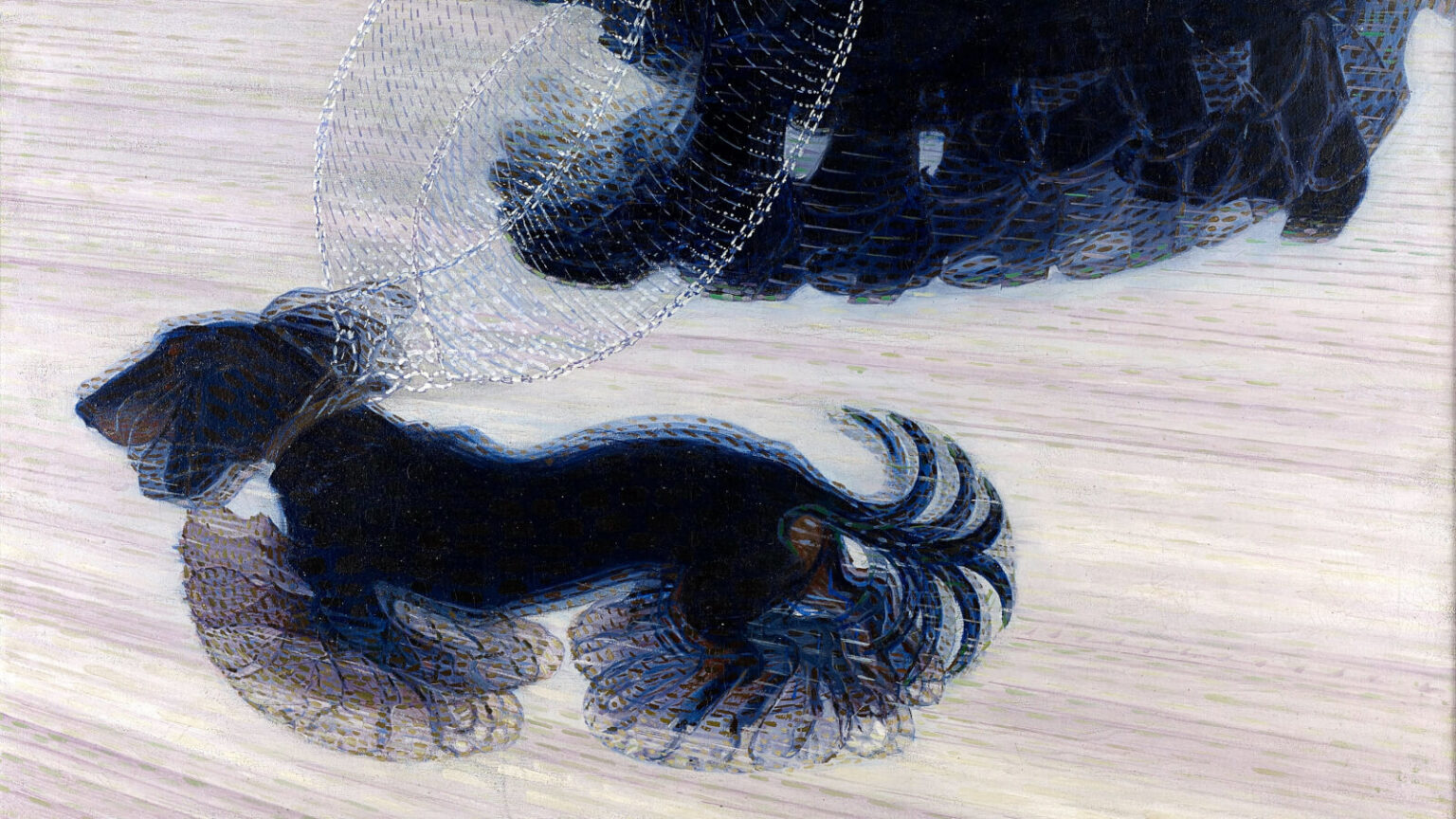
Dynamism of a Dog on a Leash
Balla
1912
Futurism

Hand of the Violinist
Balla
1912
Futurism

Portrait of II Duce
Dottori
1933
Futurism

Aeroritratto di Mussolini Aviatore
Ambrosi
1930
Futurism
Futurism
Founded in Italy, 1909, to celebrate speed, machines, modern cities, & rapid change
Futurists wanted to break away from traditional art, museums, and historical weight in Italy
They focused on cars, airplanes, trains, factories, and noisy urban life
Repeated shapes, blurred edges, and diagonal "force lines" to show movement and time passing
Futurists famously praised war, violence, and aggressive nationalism, and many aligned with Italian Fascism

The Knife Grinder
Malevich
1912
Cubo-Futurism

Morning in Village after Snowstorm
Malevich
1912
Cubo-Futurism

Airplane in Flight
Malevich
1915
Suprematism

Boy with Knapsack
Malevich
1915
Suprematism

Black Sqaure
Malevich
1915
Suprematism
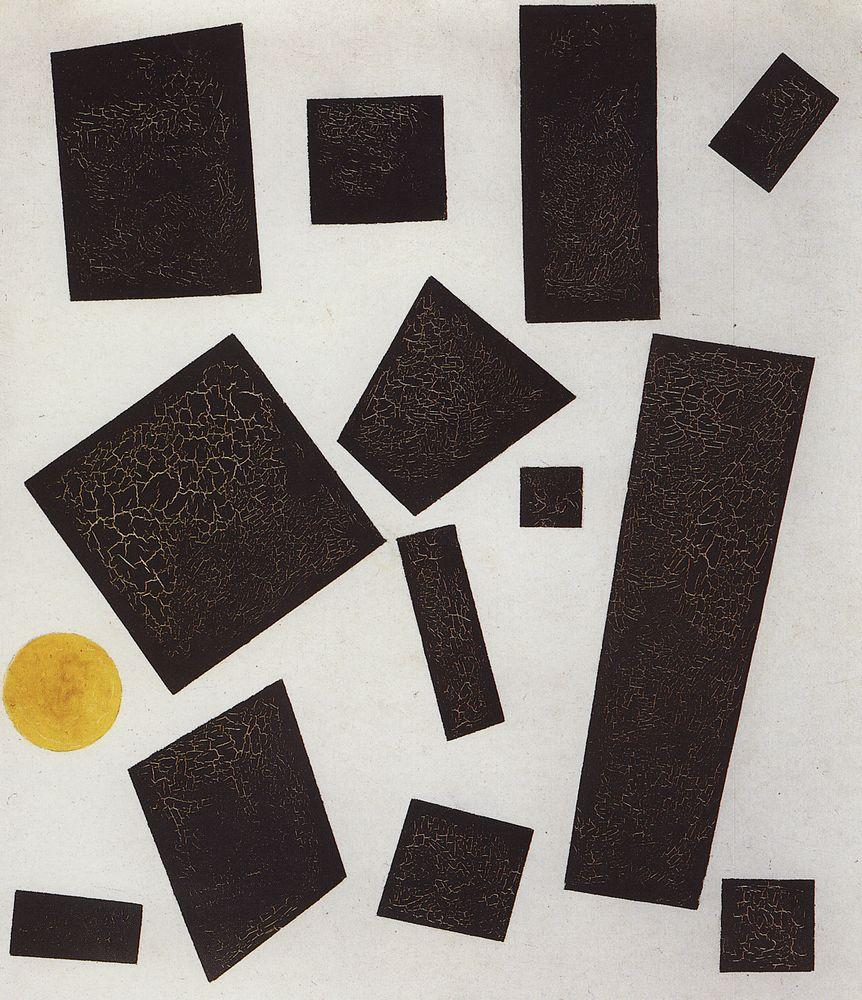
Composition of Suprematism
Malevich
1915
Suprematism
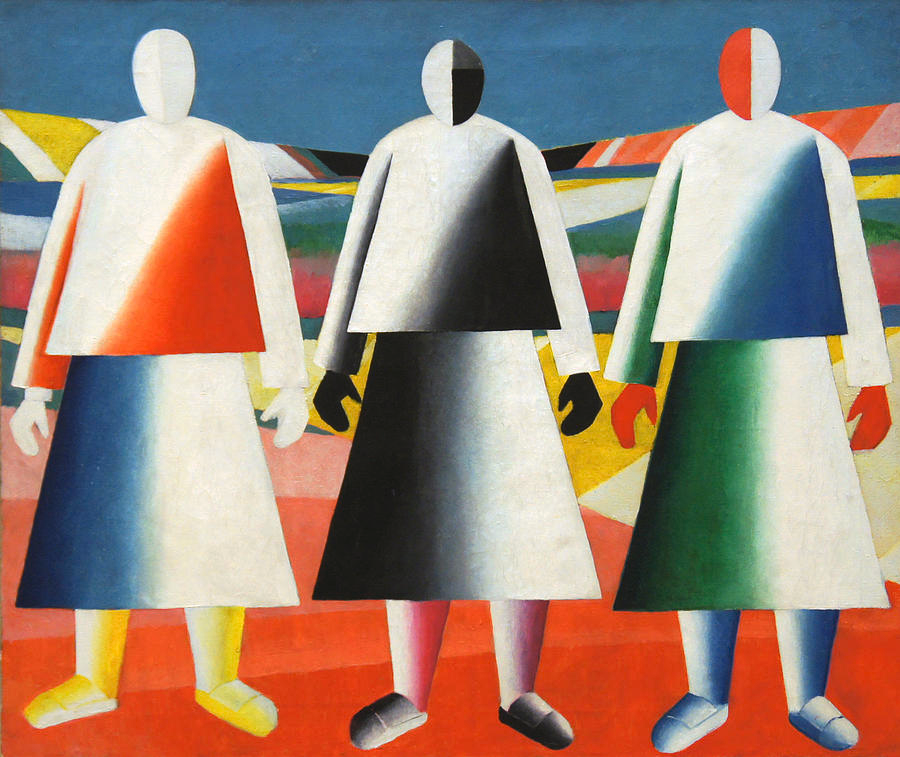
Girls in a Field
Malevich
1928-32
Socialist Realism (Neo-Suprematism)

The Reaper
Malevich
1930
Socialist Realism

Sensation of an Imprisoned Man
Malevich
1931
Socialist Realism
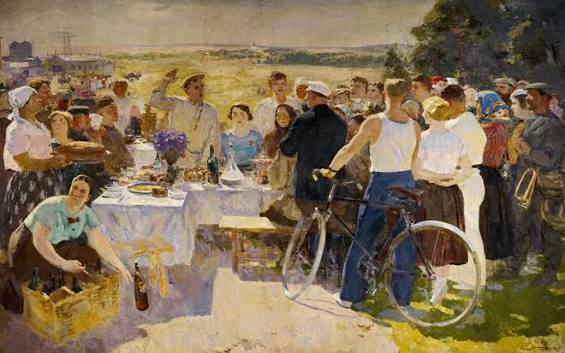
Kolkhoz Celebration
Gerasimov
1937
Socialist Realism

Women of the Kolkhoz
Unknown artist
Unknown date
Socialist Realism
Cubo-Futurism
Russian avant-garde art and literature movement of the 1910s (peaking around 1912–1915) that blended the fragmented geometric forms of French Cubism with the speed and energy of Italian Futurism
Combined structures and angles (cubism) with motion and modern life (futurism)
Influenced by Italian Futurism, compositions used repeated contours, sharp diagonals, and rhythmic lines to simulate speed, vibration, and continuous motion
Russian Cubo-Futurists used vibrant, high-contrast colors—such as bright reds, yellows, and blues—inspired by traditional Russian religious icons and folk prints (lubok)
Suprematism
Early 20th-century Russian abstract art movement that uses simple geometric shapes to express "pure feeling" rather than depicting real-world objects
Rejects traditional perspective, landscapes, objects, and storytelling to abandon all reference to the outside world
Uses fundamental geometric shapes like squares, circles, rectangles, and crosses
Limited color palettes, Places flat, bold shapes against neutral white backgrounds to suggest infinite space
Socialist Realism
State-mandated art style that beganin the early 1930s Soviet Union under Joseph Stalin and lasted into the late 1980s, designed to promote communist ideals and celebrate the working class
Works used lifelike, easy-to-understand imagery, replacing abstract or avant-garde art that leaders viewed as elitist
Factory workers, farmers, and scientists were shown as strong, noble role models driving progress
Idealized optimism, Party loyalty

Nude Descending a Staircase
Duchamp
1912
Cubo-Futurism

L.H.O.O.Q
Duchamp
1919
Dadaism

The Bride Stripped Bare by her Bachelors, Even (The Large Glass)
Duchamp
1915-23
Dadaism, Conceptual

The Chocolate Grinder
Duchamp
1914
Cubism and Dada

Fountain
Duchamp
1917
Dada

Gadji Beri Bimba
Ball
1916
Dada

The Art Critic
Hausmann
1919-20
Berlin Dada movement

Dada Dolls
Hoch
1916-20
Berlin Dada movement

Cut with the Kitchen Knife Dada through the Last Weimar Beer-Belly Cultural Epoch in Germany
Hoch
1919-20
Berlin Dada movement
Dadaism
“Anti-art" protest movement that began in 1916 as an angry, absurd reaction to the horrors of World War I.Artists and writers rejected traditional logic, reason, and beauty, arguing that the "rational" society of the time had only led to mass destruction
Embraced the irrational, the ridiculous, and the chaotic
Abandoning standard oil paintings and bronze sculptures, Dada artists created mixed-media works using discarded junk, tickets, scraps of cloth, and newspaper or magazine photographs
Artists let randomness dictate creative choices