BIOMI Prelim 1 Study Guide
 Call Kai
 Learn
Learn Practice Test
 Spaced Repetition
 Match
Match Flashcards
 Knowt Play
1/50

There's no tags or description
Looks like no tags are added yet.
Name | Mastery | Learn | Test | Matching | Spaced | Call with Kai | Chat |
|---|
No analytics yet
Send a link to your students to track their progress
51 Terms
Characteristics of Living Things, Viruses?
made of cells; grow and develop; reproduce; respond to stimuli; maintain homeostasis; metabolize energy; and adapt to surroundings.
Viruses are debated as living because they cannot independently metabolize or reproduce, and do not share a universally conserved cellular function.
Microorganisms
Microorganisms are living things at microscopic scale. They can include bacteria, archaea, fungi, and small singlecelled eukaryotes. Do not equate “microbe” with “bacterium.”
Three Domains

Four Macromolecules
A nucleotide has a pentose sugar, phosphate, and nitrogenous base.
Amino acids differ by their R group.
Amino-acid chains are polypeptides; folded polypeptides are proteins.
Turning monomers into polymers is a hallmark of life.
Fatty acids in water can form micelles and phospholipid membranes. Membranes create a diffusion barrier and permit concentration gradients

Central Dogma
DNA -> RNA -> protein
Replication: DNA copies itself.
Transcription: DNA is used to make RNA.
Translation: ribosomes use RNA information to build protein.
DNA base-pairing: A-T and G-C. RNA uses U instead of T: A-U and G-C.
DNA is more stable than RNA.
Ribosomes consist of RNA and protein, and occur in every form of life.
Formation of Acne
Acne forms around hair follicles. Sebaceous glands make sebum; blockage of the duct into a follicle favors growth of Propionibacterium acnes (also called Cutibacterium acnes).
P. Acne Characteristics
Gram-positive.
A bacterial chemoheterotroph: it gets energy and carbon from organic chemicals.
A consumer of hair oils/sebum in sebaceous glands.
Able to release products that trigger immune inflammation and contribute to acne vulgaris.
Benzoyl peroxide and sometimes clindamycin can reduce P. acnes.
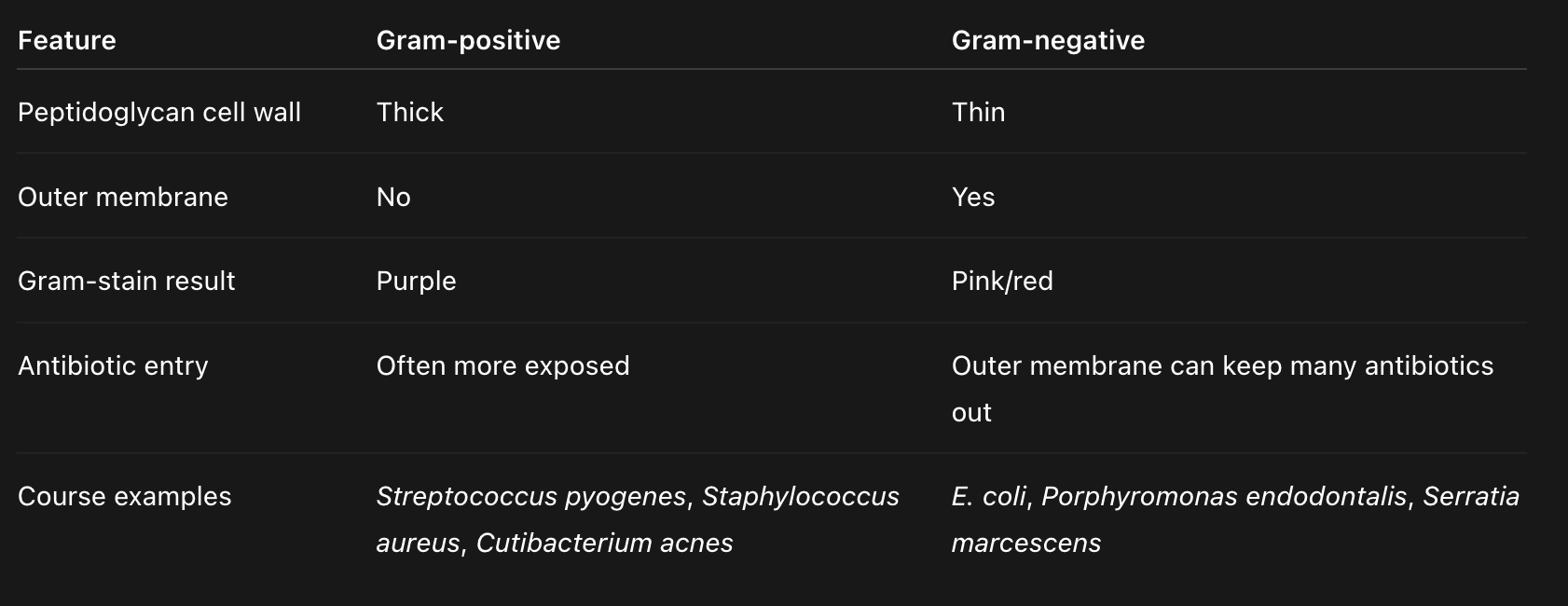
Gram Positive vs. Gram Negative
Dandruff
Dandruff is mainly dead skin that can increase with scalp irritation.
The fungus Malassezia lives on skin, consumes sebum, and releases lipases that break down sebum oils into irritating free fatty acids.
Those fatty acids can irritate some scalps; phospholipases and keratinases may contribute as well.
Bacterial Shapes
Cocci: spherical.
Bacilli: rod-shaped.
Spirilla: spiral-shaped.
Shape alone is not a reliable indicator of evolutionary relationship.
Cell Envelope
The bacterial cell membrane is a phospholipid bilayer. The cell wall contains peptidoglycan and provides protection and shape. Together they form the cell envelope. Gram-negative bacteria have a thin peptidoglycan layer plus an outer membrane; this outer membrane can exclude many antibiotics. Gram-positive bacteria have a thicker peptidoglycan wall.
Peptidoglycan: a tough, mesh-like polymer made of sugars and amino acids that forms the protective cell wall of almost all bacteria.
Types of Symbiosis
Symbiosis is a close association between two different species.
Host (larger)-Symbiont (smaller)

Endosymbiosis and eukaryotes
Eukaryotes evolved through symbiosis of archaea and bacteria. Mitochondria descended from bacteria; chloroplasts descended from cyanobacteria (photosynthetic)
Evidence for this origin includes:
Circular organelle DNA.
Double membranes around mitochondria and chloroplasts.
Retention of bacterial-like cellular features.
Progressive loss of genes required for independent living.
Levels of Endosymbiosis (chloroplasts)
Primary endosymbiosis: an early eukaryotic cell engulfed a cyanobacterium directly. Instead of digesting it, the cyanobacterium became a chloroplast.
Result: plant/algal chloroplasts with two membranes.
Secondary endosymbiosis: a different eukaryotic cell engulfed an alga/eukaryote that already had a chloroplast from primary endosymbiosis.
Result: the new host inherited that chloroplast, often with an extra surrounding membrane.
Tertiary endosymbiosis: a eukaryote engulfed another eukaryote whose chloroplast was already acquired through secondary endosymbiosis.
Result: an even more nested evolutionary history and potentially more membrane layers.
Head Lice
Head lice are multicellular arthropods (metazoan eukaryotes) and obligate parasites of humans. They consume scalp blood and lay eggs on hair. Their spread depends on close contact and sharing items such as hats, pillows, or hairbrushes; it is not a consequence of poor hygiene.
Head Lice Counters
Pyrethrins are insecticides that delay closure of nerve voltage channels, producing simultaneous nerve firing. Combing is a physical-removal treatment.
Lice Associated Bacteria
First is a mutualistic endosymbiont, second is a vector-borne human pathogen
Riesia is dependent on lice and has lost energy-metabolism genes.
Head/body lice can vector Rickettsia prowazekii (epidemic typhus), Borrelia recurrentis (relapsing fever), and Bartonella quintana (trench fever). '
A bacterium in a louse can be a human pathogen without being an endosymbiont or a louse pathogen.

Oral Community
he oral cavity is warm, moist, and supplied with dead mucosa, food, and other nutrients. It includes bacteria, archaea, eukaryotic microbes, and viruses, but bacteria dominate the healthy oral microbiome.
Aerobic habitats are directly exposed to oxygen.
Anaerobic habitats include protected biofilms and the back of the tongue.
Dental plaque is a multispecies biofilm in which microbes exchange waste products and interact with saliva and host tissue.
Redox, ATP, catabolism, and anabolism
Oxidation: loss of electrons.
Reduction: gain of electrons.
Electron transfer releases energy that cells capture in ATP.
Catabolism: breaks molecules down and yields/captures energy.
Anabolism: uses ATP to build molecules and cells.
Anabolism builds amino acids into proteins, nucleotides into nucleic acids, sugars into polysaccharides, and fatty acids into lipids. Enzymes are proteins that catalyze reactions, and genes encode proteins.
Respiration and Fermentation
Organic acids that cause cavities are primarily products of fermentation, which is catabolic.

Halitosis (bad breath) and gingivitis
Anaerobic catabolism can generate reduced, odorous compounds:
Hydrogen sulfide: rotten-egg smell.
Methyl mercaptan: rotten-cabbage smell.
Allyl mercaptan/allyl methyl sulfide: garlic smell.
Dimethylamine/trimethylamine: fish smell.
Porphyromonas endodontalis is a Gram-negative anaerobe associated with gingivitis. It can produce methyl mercaptan from methionine. Gingipain, an enzyme secreted to break down host proteins, supports catabolism, not anabolism.
Gingipain breaks down host proteins (catabolism) → bacteria access amino acids/nutrients → anaerobic metabolism produces odorous compounds such as methyl mercaptan (halitosis) and microbial activity can contribute to gum inflammation (gingivitis).
Cavities and pathogenicity
Tooth enamel is largely hydroxyapatite, a calcium-phosphate mineral. Fermentation products such as lactate, acetate, propionate, formate, butyrate, pyruvate, and valerate can accumulate at the tooth surface and dissolve enamel.
A pathogen is a microorganism that causes infection/disease, not simply a microorganism that is present. It can cause tissue damage through enzymes, toxins, metabolism, and activation of host immunity.
cavities are tissue damage caused by bacterial metabolism
Koch’s Postulates
Find the suspected microbe in people with the disease.
Isolate it and grow it in the lab.
Introduce it into a healthy host and see whether it causes the same disease.
Re-isolate the same microbe from that newly diseased host.
If all four happen, there is strong evidence that the microbe caused the disease.
Why this does not always work:
Some people carry a pathogen but do not become sick.
Some microbes cannot be grown in the lab.
A microbe may lose its disease-causing ability after lab growth.
Diseases such as cavities often involve a whole biofilm community and diet/environment—not one single organism.
Virulence Associated Structures
Pili/fimbriae are hair-like structures that help bacteria attach to teeth, gum tissue, or other surfaces. Attachment helps them avoid being washed away and helps biofilms form.
Capsules/slime layers are protective outer coatings. They can help bacteria stick to surfaces and make it harder for the immune system to remove them.
Streptococcus pyogenes and strep throat
Strep throat is caused by infectious Group A beta-hemolytic S. pyogenes. It is Gram-positive, coccoid, chain-forming, aerotolerant anaerobic, and a fermenter rather than a respirer. It may occur in the human microbiome, but particular strains and conditions cause disease.
Virulence factors support adhesion, immune evasion, invasion, and host damage. Streptolysin is an exotoxin that binds cholesterol in host membranes, forms pore-like structures, and causes cytotoxicity/hemolysis.
Innate immunity
Innate immunity is broad, rapid, and present in all metazoans.
It includes:
Anatomical barriers: physically keep microbes out
skin, mucus and tissue surfaces
Inflammation: rapid alarm response to infection or injury
Host cells use PRRs (pattern-recognition receptors) to detect broadly microbial molecules, called PAMPs.
The host releases chemical signals such as histamine and serotonin.
Nearby blood vessels dilate and become more permeable.
More fluid and immune cells reach the area.
This causes familiar signs such as redness, heat, swelling, and sometimes pain.
Complement: pathogen-associated molecules become labeled so immune cells can recognize and destroy them.
Opsonization means coating/tagging a pathogen so phagocytes can identify it more easily.
Phagocytes can then engulf and destroy or lyse the pathogen.
Phagocytic/cell-mediated processes:
Phagocytes are cells that engulf and digest microbes.
Other immune cells can release antimicrobial compounds or signals that coordinate the response.
This is called “cell-mediated” because cells, rather than only dissolved molecules in blood/serum, perform the action.
Antigen
An antigen is a molecule that the immune system recognizes as “non-self”—often a protein or surface feature from a bacterium or virus.
For example, a strep bacterium has particular surface molecules. Your adaptive immune system can learn to recognize those specific molecules.
Adaptive Immunity
Adaptive immunity is antigen-specific and develops after prior exposure or immunization.
The immune system recognizes an antigen
B cells and T cells respond: B cells make antibodies, T cells coordinate immune responses or directly kill infected cells.
B cells and T cells are lymphocytes—specialized white blood cells.
B cells make antibodies
Antibodies are proteins that bind a specific antigen, like a lock and key.
When antibodies bind a pathogen, they can:
Mark it so phagocytes can find and eat it more easily.
Block it from attaching to host cells.
Help activate other immune defenses.
This is called the humoral adaptive response because antibodies are dissolved in blood and other body fluids, rather than being the immune cells themselves.
The correct cells multiply: clonal expansion
At first, only a small number of B or T cells recognize a particular antigen.
Once one recognizes it, it divides repeatedly, making a large group of identical antigen-targeting cells. This is clonal expansion.
Cytotoxic T cells kill infected host cells
Some pathogens hide inside your own cells, where antibodies cannot easily reach them. Cytotoxic T cells recognize infected host cells and kill them so the pathogen cannot keep reproducing inside them.
T cell mechanisms
Perforin: makes holes in the infected cell membrane.
Granulysin: helps damage microbes/infected cells.
Granzyme: enters and triggers apoptosis, controlled cell death.
Why Vaccines Work
A vaccine exposes the adaptive immune system to a safe version or piece of a pathogen. Your body makes pathogen-specific B/T cells and memory cells without requiring the full disease first.
Later, if the real pathogen appears, the response is faster and stronger.
Humoral vs. Cell-mediated
Innate humoral: complement proteins in blood.
Innate cell-mediated: phagocytes.
Adaptive humoral: B-cell antibodies.
Adaptive cell-mediated: T cells.

Immune Evasion
S. pyogenes has a hyaluronic-acid capsule that masks its antigens. Its M protein can bind fibrinogen and hinder opsonization.
General evasion strategies include changing antigens, preventing phagocytosis, surviving within phagocytes, resisting antimicrobial peptides, and interfering with immune signaling.
Pinkeye
Conjunctivitis is inflammation of the conjunctiva. Most cases are viral, commonly adenovirus; bacterial, allergic/toxic, and other causes also occur. Bacterial causes can include S. aureus, S. pneumoniae, H. influenzae, P. aeruginosa, and others. Chlamydia trachomatis can cause chronic conjunctivitis; Neisseria gonorrhoeae and N. meningitidis can cause hyperacute disease.
Staph Aureus
S. aureus is Gram-positive and facultatively anaerobic. Many people carry it harmlessly on skin or in nasal passages. It can become opportunistically pathogenic after a barrier breach.
Important S. aureus factors:
Protein A interferes with antibody-based recognition.
Coagulase promotes a clot-like coating.
Hyaluronidase helps tissue spread.
DNase and lipases assist tissue/resource use.
Conjunctivitis Transmission
Transmission of conjunctivitis commonly involves contaminated fluid transferred by hands; contact-lens misuse can contribute. Handwashing, avoiding shared items and fluid contact, equipment cleaning, and physical barriers reduce transmission.
Mold
“Mold” describes a mode of fungal growth, not a branch of life. Black mold may refer to fungal growth such as Stachybotrys; dark coloration can arise from spores, and some fungi produce mycotoxins. The red film found in showers is commonly a bacterial biofilm, often Serratia marcescens, not a red mold.
Serratia marcescens and opportunism
S. marcescens is a rod-shaped environmental bacterium that often is harmless but can be opportunistically pathogenic. It forms robust biofilms in moist habitats and produces the red pigment prodigiosin, a density dependent secondary compound with antimicrobial, anticancer, and immunomodulatory activity. Prodigiosin can disrupt membranes and respiration.
It can colonize shower surfaces and sometimes biological sites, including eyes and urinary tracts. Opportunistic infection is more likely with weakened immunity, wounds, catheters, removal of healthy microbiome members by antibiotics, or access to a susceptible body site.
Biofilm
A biofilm is a microbial community attached to a solid-liquid or air-liquid surface and embedded in an extracellular matrix. The matrix contains polysaccharides, proteins, and extracellular DNA.
Biofilm sequence:
1. Find a surface.
2. Attach using cell-surface proteins, pili, fimbriae, or flagella.
3. Cooperatively build extracellular polymeric substance (EPS) matrix.
Biofilms are especially useful in low-nutrient, wet environments. Their structure can change with the environment and carbon source. They may be single-species or multispecies communities, like dental plaque.
Biofilms help survival and can make antibiotics less effective. They contribute to chronic infection, contamination, hospital-acquired infection, and damage/cost in pipes and equipment. They are also useful in environmental processes such as wastewater treatment.
Quorum sensing
Quorum sensing is bacterial cell-cell communication used to estimate population density.
1. Each cell releases a chemical signal, an autoinducer.
2. At low density, too little signal enters cells to activate a response.
3. At high density, signal accumulates above a threshold.
4. Cells turn on coordinated traits such as bioluminescence, biofilm formation, or virulence-factor production.
Quorum sensing depends on cell density, not simply absolute cell number. Aliivibrio fischeri light production in squid-associated high-density populations is the model example.
Gut Ecosystem
The large intestine is a dense, largely anaerobic fermentation ecosystem, with approximately 10^12 bacteria per gram in the course material. The upper GI tract is less densely colonized because of low pH and other conditions. Gut organisms include bacteria, fungi, archaea, and viruses.
The gut microbiome provides:
Nutrition, especially access to complex carbohydrates/fiber.
Colonization resistance against incoming pathogens and overgrowth.
Immunomodulation and immune education.
Metabolites that can influence host physiology, including mood/brain-associated signaling.
Microbes communicate with each other via quorum sensing and with the host through microbially associated molecular patterns (MAMPs) and metabolites. Host diet strongly influences microbiome composition and function.
Antibiotics and Superinfection
Antibiotics save lives but can remove beneficial community members. This collateral damage can lower colonization resistance and permit superinfection, including Clostridioides difficile infection. The correct takeaway is appropriate antibiotic use, not that antibiotics are never useful.
A superinfection is a new secondary infection that happens during or after the treatment of a primary infection, most commonly caused when broad-spectrum antibiotics wipe out beneficial protective microbiome bacteria and allow resistant or opportunistic microbes to overgrow.
Gastroenteritis and water treatment
Gastroenteritis can cause diarrhea, nausea, abdominal pain, and fever. It is often fecal-orally transmitted and can result from bacteria (e.g., cholera/typhoid), protozoa (e.g., Cryptosporidium, Giardia), or viruses (e.g., polio/hepatitis A).
The major public-health strategy is wastewater treatment and safe water purification. The central drinking-water treatments emphasized are filtration and chlorination.
Coliforms
Coliforms are Gram-negative, non-spore-forming, facultatively aerobic rods that ferment lactose and make gas under test conditions. Fecal coliforms come from the guts of warm-blooded animals. E. coli is a common fecal coliform.
We test water for fecal coliforms because E. coli is an indicator of fecal contamination and overall water quality. It does not mean all waterborne illness is caused by E. coli.
MacConkey agar
MacConkey agar is a selective and differential culture medium used to isolate Gram-negative bacteria and differentiate them based on lactose fermentation
Selective: bile salts inhibit many Gram-positive organisms, stopping growth
Differential: a pH indicator differentiates lactose fermenters.
E Coli Strains and Genomes
Closely related strains differ because the core genome does not include every gene a strain has. The accessory genome contains variable genes, including virulence factors that can promote gut colonization and disease. Thus, “species identity” is not enough to predict risk.
Pathogenic E. coli can respond to quorum-sensing signals in the gut and activate virulence genes.
K-12 has one circular chromosome of about 4.64 Mb and roughly 4,500 genes. It can divide about every 20 minutes under rich, aerated laboratory conditions at 37 C. Research on E. coli established many foundational concepts: DNA replication, gene regulation, the genetic code, viral replication, restriction enzymes, recombinant DNA, RNA catalysis, ATP generation, and protein targeting.

Body Site Microbiomes
Microbial communities differ by body site because local conditions differ: oxygen, pH, moisture, salinity, nutrients, and host defenses all select for particular organisms.
Dental plaque is an oral biofilm. Streptococcus and others make polysaccharide matrix; lactic-acid producers make acid from sugar.
The critical pH for enamel dissolution is approximately 5.3.
Skin is generally dry, salty, acidic, and unfavorable for microbes; moist sites support more growth. Common skin associated gram-positive groups include Staphylococcus, Streptococcus, and Propionibacterium/Cutibacterium.
Helicobacter pylori
Despite the stomach’s acidity, H. pylori can colonize the stomach epithelium. It is a motile spiral bacterium related to Campylobacter and is associated with many gastric ulcers. Barry Marshall’s self-inoculation experiment supported causation: he developed gastritis and then improved after antibiotic treatment.
Key nuance:
Many carriers do not develop ulcers.
Humans and H. pylori have coevolved for a long time.
It may modulate/educate immune responses.
Loss of the organism can have both benefits and possible tradeoffs.
Hygiene Hypothesis
The hygiene hypothesis proposes that reduced microbial exposures and frequent disruption of microbiota may contribute to immune dysregulation in some contexts. It is a hypothesis, not a reason to avoid hygiene or needed medical care.
Colon Ecology/Gut-brain ideas
The colon has roughly 10^10-10^11 cells/mL and up to around a thousand species in the course material. Microbial fermentation produces volatile fatty acids that can enter the bloodstream and provide host carbon/energy. Gut microbes also make vitamins/cofactors, influence inflammatory signaling, and can interact with diet and medicines.
The gut-brain axis refers to microbiome-associated metabolic, immune, and neural signaling. The course uses examples involving GABA and mouse studies, but distinguish association from proof of causation in humans.
Products in this space may have limited evidence; do not assume every probiotic claim is established.

Early Life Microbial Colonization
Initial microbial colonization begins around birth and is shaped by maternal contact, environmental exposure, diet, breastfeeding/formula, and antibiotics. The microbiota changes substantially in early childhood before becoming more adult-like.
Breast milk includes oligosaccharides that select for organisms such as Bifidobacterium and Lactobacillus.
Bifidobacterium is an Actinobacterium often described as a desirable probiotic organism.
The course notes that honey can carry Clostridium botulinum spores, which pose a risk to an immature GI tract.
Exam Traps
1. A bacterium that breaks down host protein using a secreted enzyme is doing catabolism.
2. Organic acids driving cavities are mainly products of fermentation.
3. A relationship required for survival is obligate, even if it harms a host.
4. A human pathogen temporarily carried in a louse is not necessarily a louse endosymbiont.
5. A microbe can be part of a normal microbiome and still become an opportunistic pathogen.
6. A bacterium in a biofilm is not necessarily pathogenic, but biofilms often improve persistence and treatment resistance.
7. Quorum sensing turns on group behaviors after autoinducer reaches a threshold reflecting high local density.
8. PRRs detect PAMPs in the innate immune response; antigen-specific memory is adaptive.
9. E. coli in water testing is a fecal-contamination indicator, not proof that E. coli caused illness.
10. The accessory genome explains why strains of the same bacterial species can have dramatically different pathogenicity.
11. Gram-negative bacteria have an outer membrane; Gram-positive bacteria have a thicker peptidoglycan wall.
12. Mitochondrial/chloroplast double membranes and circular DNA support endosymbiotic origin.