Attitudes and Behaviour
 Call Kai
 Learn
 Practice Test
 Spaced Repetition
 Match
 Flashcards
 Knowt Play
1/26

Earn XP
Description and Tags
Whether attitudes predict behaviour (and when and how this occurs - theories of reasoned action and planned behaviour), applications, limitations and extensions
27 Terms
Why are attitudes of interest?
Is thought that they predict behaviour → can change behaviour by changing attitudes
Describe LaPiere’s (1934) study. What is the significance of this?
Toured USA with Chinese couple → visited 66 hotels + other establishments + ate in 184 restaurants
Refused service 1/170 service encounters
6 months later → questionnaire sent to all places about attitudes
Asked “will you accept members of the Chinese race as guests in your establishment?”
128 replies → 92% no, 1% yes, 7% depending on circumstances
Not scientific study BUT undermined (presumed) predictive power of attitudes → critics argue that social psych should abandon the concept of attitude
What other studies support LaPiere’s findings?
Wicker (1969) → reviewed 42 studies that measured attitudes + behaviours
Mean correlation = 0.15
Kraus (1995) → meta-analysis of 100 studies
Average correlation = 0.38
BUT still indicates only 14% of variance in behaviour is accounted for by a related attitude
When do attitudes predict behaviour?
Other influences on attitude expressions are minimal (e.g. social desirability, situation influences)
Aggregate behaviour over time + take account of ability to act
Attitudes are specific to the behaviour, rather than general (Ajzen + Fishbein, 1977)
Describe Davidson and Jacard’s (1979) study
2-year longitudinal study
Used different measures of women’s attitudes to birth control
Different degrees of correlation with actual use of birth control pills when asked about:
Attitudes towards birth control = 0.08
Attitudes towards birth control pills = 0.32
Attitudes towards using birth control pills (over next 2 years) = 0.52 (0.57)
What is Fishbein and Ajzen’s (1975) theory of reasoned action?
Aimed to improve predictive power of attitudes on behaviour by taking other factors into account

How can theory of reasoned action be applied to Bledsoe (2006) and quitting smoking?
If you look at the attitude and subjective norms, they were related to the intention to quit
The stronger they were, the closer the relation with the stage of deciding to quit
E.g. really positive attitude towards quitting + the subjective norm was strong → more likely to be thinking about quitting in the next 30 days (vs 6 months vs sometime in the future)

What are the strengths and weaknesses of the theory of reasoned action?
Goes beyond simply considering attitudes + behaviours
Includes a social element (subjective norms)
Gives important role to behavioural intentions
Emphasises rationality of behaviour
Support
Fishbein, Ajzen + Hinkle (1980)
Webb + Sheeran (2006)
BUT assumes behaviour is under the person’s conscious control → limited application
What is Ajzen’s (1985) theory of planned behaviour?

What is the advantage of the theory of planned behaviour over the theory of reasoned action?
Includes behavioural control
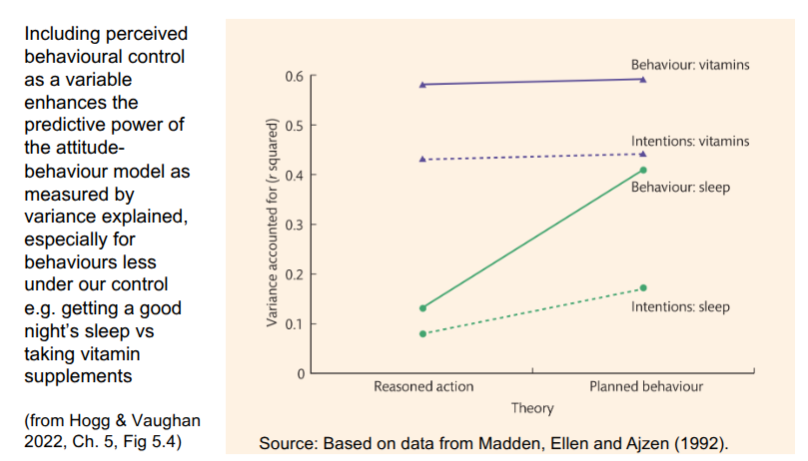
Madden, Ellen + Ajzen (1992) → compared how well TRA + TPB could predict different behaviours
Included behaviours we have varying degrees of control over (e.g. taking vitamins vs getting a good night’s sleep)
Students asked about attitudes to target behaviours, subjective norms, perceived behavioural control + intentions
2 weeks later → asked whether they had done any of the target behvaiours
Gives the model greater predictive power (esp for behaviours harder to control) → TPB is better
Especially the case for behaviours that are more challenging to control (e.g. getting a good night’s sleep vs taking vitamin supplements - Hogg + Vaughan, 2022)
What can the theory of planned behaviour be applied to?
Many kinds of health-related + other behaviours
Schifter + Ajzen (1985) → applied to issue of weight loss over 6-week period (83 psych UGs)
Attitude, subjective norms + perceived behavioural control all predicted weight loss intentions
Perceived control was a good predictor of actual weight loss (attitudes + subjective norms weren’t)
Intentions predicted behaviour BUT only for PPTs with high degree of perceived control
Blanchard (2009) → measured attitudes, subjective norms + perceived behaviour control
Week later → fruit/veg consumption was assessed of 511 student son health + fitness courses
Attitudes + perceived behavioural control were the best predictors → has implications for developing an intervention
Parker (1992) → used TPB to account for divers’ intentions to commit 3 driving violations (drinking + driving, speeding, risky overtaking)
Attitude towards the behaviour + subjective norm accounted for ~21% of variance in intention to drink + drive
Addding control beliefs explained a further 21%
Similar findings for speeding + risky overtaking

What are some benefits of the theory of planned behaviour?
Generated a huge number of studies
Armitage + Conner (2001) → meta-analysis of 185 studies
TPB predicted 27-38% of all variance in behaviour
Useful framework for thinking about appropriate intervention
Elliott + Armitage (2009) → small but significant effects of an intervention (info booklet) targeting relevant attitudes, subjective norms + perceived control in relation to speeding
What are some problems with the theory of planned behaviour?
Assumes that people of rational, make systematic use of info available + consider the implications of their behaviour before they decide to engage in the behaviour
Control, intention + behaviour can be conceptualised + measure din different ways with different results
Behavioural control may refer to feelings of self-efficacy or external constraints or control over behaviour (Terry + O’Leary, 1995)
Kraft (2005) → perceived confidence (efficacy) predicted self-reported exercise (but not recycling); perceived control predicted self-reported recycling (but not exercise)
Behaviour measured through self-report, observed behaviour or using a driving imulator to measure speeding (Elliot, 2007)
Some variables are better than others in particular contexts (e.g. perceived behavioural control can be strongest predictor)
Other work suggests further variables that may be important in predicting behaviour
Past behaviour or habits
De Bruijin (2008) predictors of how much saturated fat Dutch adults consume → perceived lack of control + past eating habits were key predictors of current + intended eating
Sheeran (2005) → past, habitual behaviour important predictor of current/intended behaviour
Attitude strength or accessibility
Attitudes that are more strongly held (Holland, 2002) or more accessible (coming easily to mind because acquired through direct experience) (Doll + Ajzen, 1992)
What is attitude accessibility? What are its characteristics?
The ease with which an attitude can be recalled from memory and expressed
Expressed quickly
Exert a strong influence on behaviour
Show greater attitude–behaviour consistency
Are more stable over time
Are more selective in judging info
Are more resistant to change (insensitivity)
If the attitude object changes, a person with a highly accessible (frozen) attitude may fail to detect the change
Fazio (2000) → morphed facial images
PPTs with highly accessible attitudes were slower + less accurate at detecting changes in the images compared to those with less accessible attitudes
How did Van Overwalle and Siebler (2005) describe attitude accessibility?
Connectionist perspective
Viewing accessible attitudes as well-connected cognitive nodes that adapt weights based on the history of co-occurrences between objects and their attributes
What is an implication of attitude accessibility?
Orient visual attention and categorisation → e.g. if a "health food" attitude is made accessible, yoghurt is more likely to be categorised as health food rather than just a dairy product
How did Fazio (1995) describe attitudes? What are the implications of this?
Associations in memory between an object + an evaluation
Strength of association determines likelihood of automatic activation
Strong associations are functional → aid rapid decision-making
How does attitude strength relate to behaviour?
Strong attitudes (e.g., towards Greenpeace) are far more likely to predict behaviour (e.g., donating) than weak attitudes
Are highly accessible and allow for automatic activation
How do attitudes formed through direct experience relate to attitude strength and accessibility?
Attitudes formed through direct experience or those involving a vested interest (something that strongly affects one's life) are stronger + more accessible
E.g. people living near a nuclear reactor have stronger attitudes about its safety
Direct experience → attitudes more consistent with behaviour
E.g. someone who has participated in psychology experiments (direct experience) is more predictable in their future participation than someone who has only read about them
What factors (aside from direct experience and accessibility) does attitude strength involve?
Salience
Ambivalence
Consistency between affect + cognition
Extremity
Certainty
Importance
Latitudes of rejection
What did Glassman and Albarracin (2006) find about when attributes best predict behaviour?
Correlations are stronger when:
Attitudes are accessible (easy to recall)
Attitudes are stable over time
Individuals have had direct experience with the attitude object
Individuals frequently report their attitudes
Persuasive arguments relevant to the behaviour are one-sided and supportive
What are moderator variables?
Specify when the relationship between attitudes + behaviour is stronger/weaker
Can sometimes be more powerful predictors than the attitude itself
How are situational variables an example of moderator variables?
Situational context can cause behaviour inconsistent with attitudes (esp for weak attitudes)
Social norms (contextually salient expectations) can overwhelm private attitudes
Social identity theory
Challenges the traditional view that separates internal attitudes from external norms
Attitudes are often normative properties of a group
When individuals identify strongly with a group, they internalise the group's norms
Terry + Hogg (1996) → students' intentions to exercise or protect themselves from the sun were stronger when they identified with a peer group that normative engaged in those behaviours
What does it mean for individuals to be consistent in their personality traits (e.g. high scores on extraversion)?
Tend to behave consistently across situations (those with variable traits don't)
Which individual differences count as moderator variables?
Habits = deeply ingrained behaviours performed automatically + are tied to contextual cues (can change if cues change)
Mood
E.g. angry jurors were found to detect fewer inconsistencies in testimony + judge defendants more harshly (sadness didn't have the same effect on judgement accuracy)
Cognitive biases
E.g. people often believe alcohol affects others more adversely than themselves; this bias correlates with greater support for alcohol restriction
Self-identity
How are habits moderator variables?
When habits are strong, the relationship between attitude/intention + behaviour is near 0
When habits are weak, the relationship is sizeable
Ajzen (2002) → for habitual behaviours, attitudes + intentions are activated automatically without conscious review, rather than being irrelevant (theory of planned behaviour)
How is self-identity a moderator variable?
Distinct from social identity (group membership)
Focuses on specific social roles
Influences intentions to act based on how well the behaviour aligns with one's sense of self in those roles (component of TPB)
Charng, Piliavin, + Callero (1988) → people were more likely to express an intention to donate blood if being a blood donor was an important part of their self-identity