ch 6 electronic structure and periodic properties of elements
 Call Kai
 Learn
 Practice Test
 Spaced Repetition
 Match
 Flashcards
 Knowt Play
1/49

There's no tags or description
Looks like no tags are added yet.
50 Terms
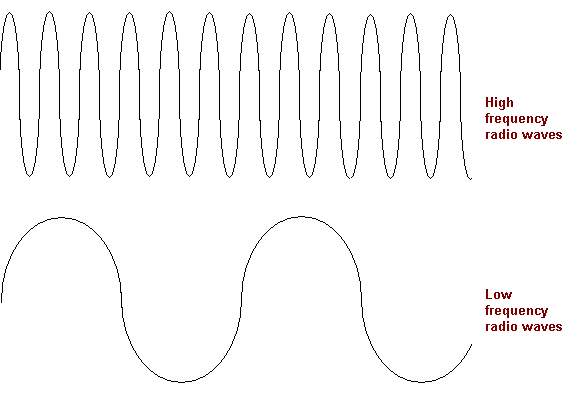
wavelength (λ)
distance between successive peaks. λ= distance/cycle

frequency (v)
number of waves passing a given point in 1s. v=cycle/s or 1/s. Units are Hz
speed of light
c = 2.998 × 10⁸ m/s
c = λ x v
The product of wavelength and frequency is equal to the speed of light in a vacuum
quanta
matter absorbs/emits energy in bundles
E = hv = hc/λ where h = 6.626 × 10⁻³⁴J*s
Energy is proportional to the frequency (v) and wavelength

Emission Spectra
continuous or line spectra of radiation emitted by substances
continuous spectrum
spectrum of all wavelengths of light. A heated solid (e.g. the filament in an incandescent light bulb) emits light that spreads out to give a continuous spectrum
atomic fingerprint
An element’s line spectrum. Each element has a unique line spectrum
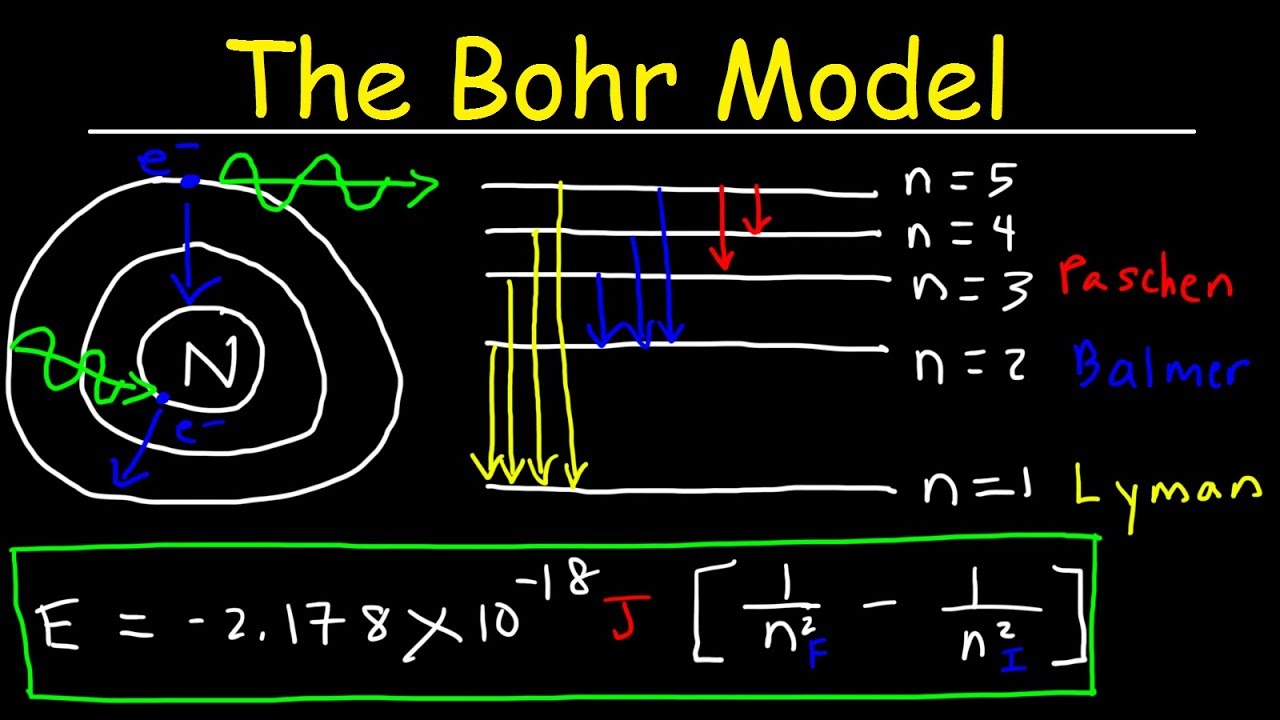
Energy-level Postulate for hydrogen atoms
Electrons may only exist in discrete, quantized, circular orbits around the nucleus.
Tennis ball and stairs analogy (Bohr Postulates: Bohr Model of the Atom)
A ball can bounce between stairs, but can never sit halfway between two levels, representing quantized energy levels.
Energy orbit indicator (n)
A number indicating a specific orbit and its associated energy, expressed as n = 1,2,3… (starts at 1 for the innermost orbit)
Ground state (n = 1)
The lowest energy state for a one-electron atom when the electron is in the lowest energy orbit
Excited state
A state where the electron is in a higher energy orbit where n = 2, 3, 4,….

Electron Transitions & Energy Spacing
Absorption: Electron absorbs energy and jumps from a lower to a higher energy orbit.
Emission: Electron drops from a higher to a lower energy orbit, releasing energy (sometimes as visible light).
Spacing: As n increases, the energy difference between levels decreases (higher levels are closer together).
Energy change (ΔE) formula for electron transitions
Sign conventions for ΔE in atoms
ΔE > 0: Atom gains energy (absorption)
ΔE < 0: Atom loses energy (emission)
Core premise of Quantum Mechanics
It makes no attempt to specify exact positions or paths of submicroscopic particles; it only gives the probability of finding them. Focus on probability over certainty.
Heisenberg Uncertainty Principle
For very small particles (like electrons), it is impossible to know precisely both the position (Δx) and the momentum (mΔv) at the same time.
Heisenberg Uncertainty Principle (Mathematical Form)
h is Planck’s constant

Louis de Broglie’s Dual Nature of the Electron
If light can behave like both a wave and a particle, then matter (such as electrons) can also behave like waves.
Standing Waves and Quantized Energy
Electrons as circular waves must have specific wavelengths to form a continuous standing wave (other wavelengths cancel out).
Because they are restricted to specific wavelengths, they can only have specific corresponding frequencies and energies.
The de Broglie Relation Formula & Purpose
h is planck’s constant, m is mass and v is velocity. Used to determine the wavelength of any matter given its velocity and mass.

When are wave properties significant for matter?
Only for submicroscopic particles, because their wavelength is about the same size or larger than the particle itself, directly affecting its behavior.
Why did the Bohr Model fail for atoms other than hydrogen?
It failed because atoms with more than one electron are much more complicated due to multiple electron-nuclear attractions, electron-electron repulsions, and nuclear-nuclear repulsions.
Polyelectronic vs. Hydrogen Orbital Energies
Hydrogen (1 electron): Sublevels within the same principal energy level (n) have the same energy.
Polyelectronic atoms (every atom except hydrogen): Electron repulsions cause sublevels (s, p, d, f) to split into different energy levels

What causes sublevel energies to change and split in polyelectronic atoms?
Electron-electron repulsions caused by having more than one electron in the atom.
Schrödinger’s Equation & Probability Density ψ²
ψ² represents the probability of finding an electron in a given region in space.The probability density region is called an electron cloud or atomic orbital. Think "probability map" rather than a fixed circular path.
Characteristics of s Orbitals
Shape: Spherical.
Size trend: The size of the orbital increases as the principal quantum number (n) increases (e.g., 3s > 2s > 1s). Think of concentric spheres getting larger.

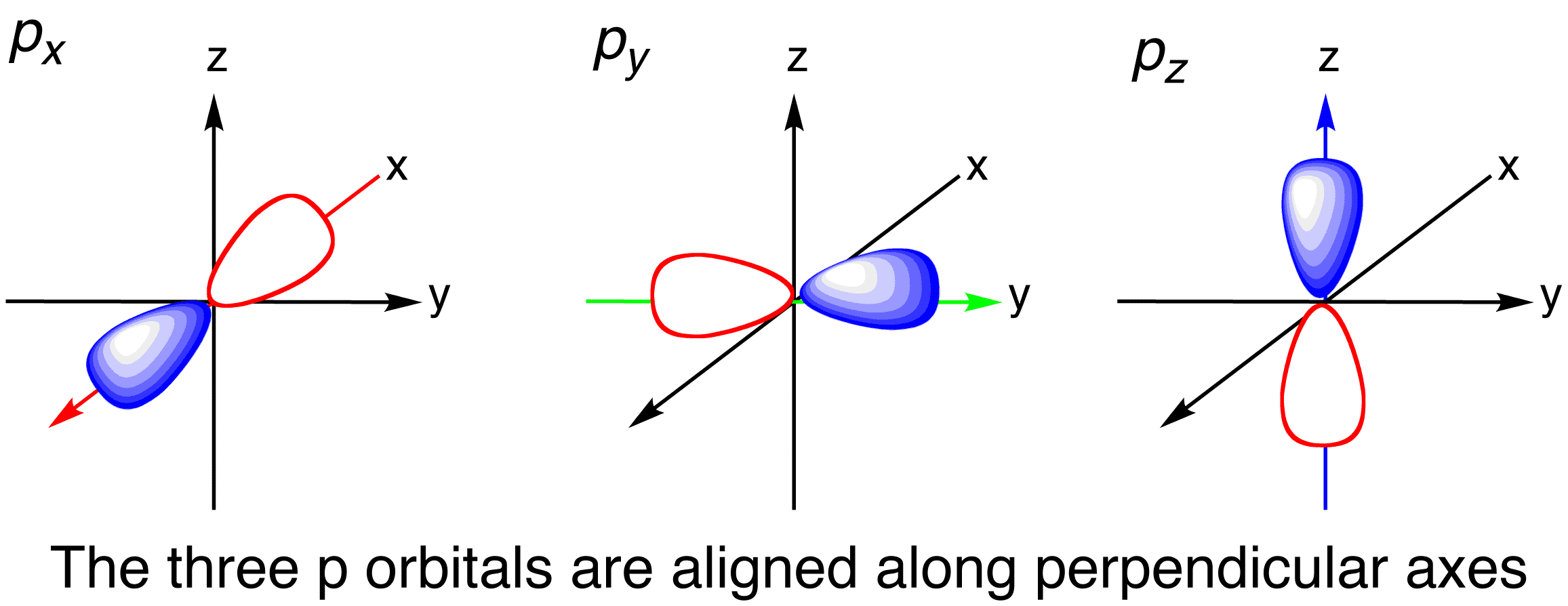
Characteristics of p Orbitals
Shape: Dumbbell-shaped.
Types: 3 orientations along the axes (px, py, pz).
Shaped like a dumbbell aligned along an x, y, or z axis.
d Orbitals
There are 5 types of d orbitals (dxy, dxz, dyz, dx2-y2, dz2).
Generally characterized by four-lobed cloverleaf shapes (except for dz2, which has a doughnut-ring/dumbbell shape).

Orbital Filling Order
Electrons fill the lowest energy orbitals first (1s < 2s < 2p < 3s < 3p < 4s < 3d).
Capacities: s holds 2, p holds 6, d holds 10, f holds 14 (each individual orbital holds max 2).
Hund's Rule: When filling degenerate orbitals (like p or d), electrons occupy separate orbitals singly with positive (+ / spin-up) spins first before pairing up.
Noble-Gas Core Notation
Inner electrons in completely filled orbitals, abbreviated using a Noble gas (e.g., [Ne]).
Valence Electrons
Electrons in the outermost, unfilled shell responsible for reactivity.
d-Subshell Stability Exceptions (Cr, Cu, etc.)
Electrons are promoted from an s orbital to a d orbital to achieve extra stability from half-filled (d5) or completely filled (d10) subshells.

Principal Quantum Number (n)
Represents the main energy level (shell) and the average distance of the electron from the nucleus (size and energy). The larger n is, the farther and higher in energy the orbital is,

Angular Momentum Quantum Number (l)
Defines the sublevel shape (l = 0 is s, l = 1 is p, l = 2 is d, l = 3 is f). Set by the value of n.
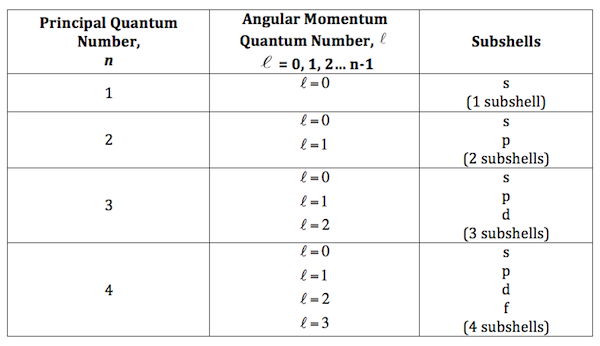
Magnetic Quantum Number (ml)
Indicates the specific orientation and number of individual orbitals within a sublevel. Set by the value of l.
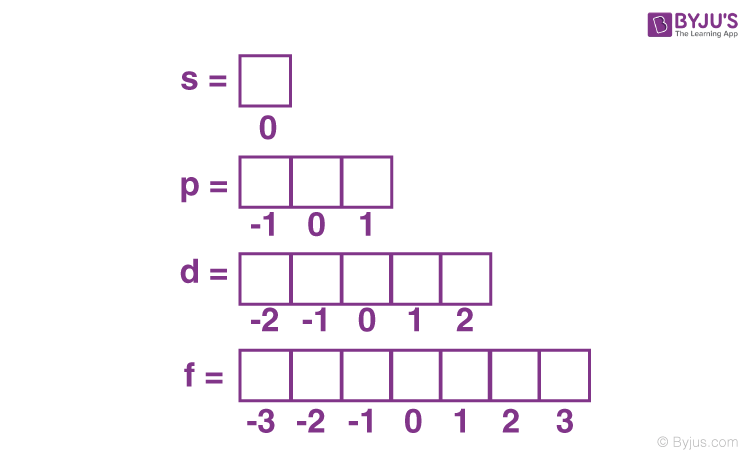
Electron Spin Quantum Number (ms)
Indicates the direction of the electron's spin (spin-up or spin-down) within an orbital. ms = +1/2 or -1/2

Pauli Exclusion Principle
No two electrons in an atom can have the exact same set of four quantum numbers (n, l, ml, ms). Therefore, two electrons in the same orbital must have opposite spins
Hund's Rule for Orbital Diagrams
When filling degenerate orbitals (like p or d), electrons must occupy separate orbitals singly with parallel spins first before pairing up.
The most stable arrangement has the greatest number of parallel spins.
Spread them out into empty boxes with the same spin before doubling up.
Ion Electron Configurations and Transition Metal Rules
Representative elements gain or lose electrons to become isoelectronic with a noble gas. Transition metals lose their s electrons before their d electrons when forming cations.
Atomic Radius and Ionic Radius Trends
Atomic radius increases down a group and decreases left-to-right across a period due to effective nuclear charge (Zeff). For ion sizes: cation < neutral atom < anion.
Zeff = # of protons – # of core electrons
Ionization Energy Trends and Successive Jumps
1st ionization energy decreases down a group and increases across a period. A massive jump in successive ionization energies occurs right after all valence electrons are removed and you start breaking into a stable noble-gas core.
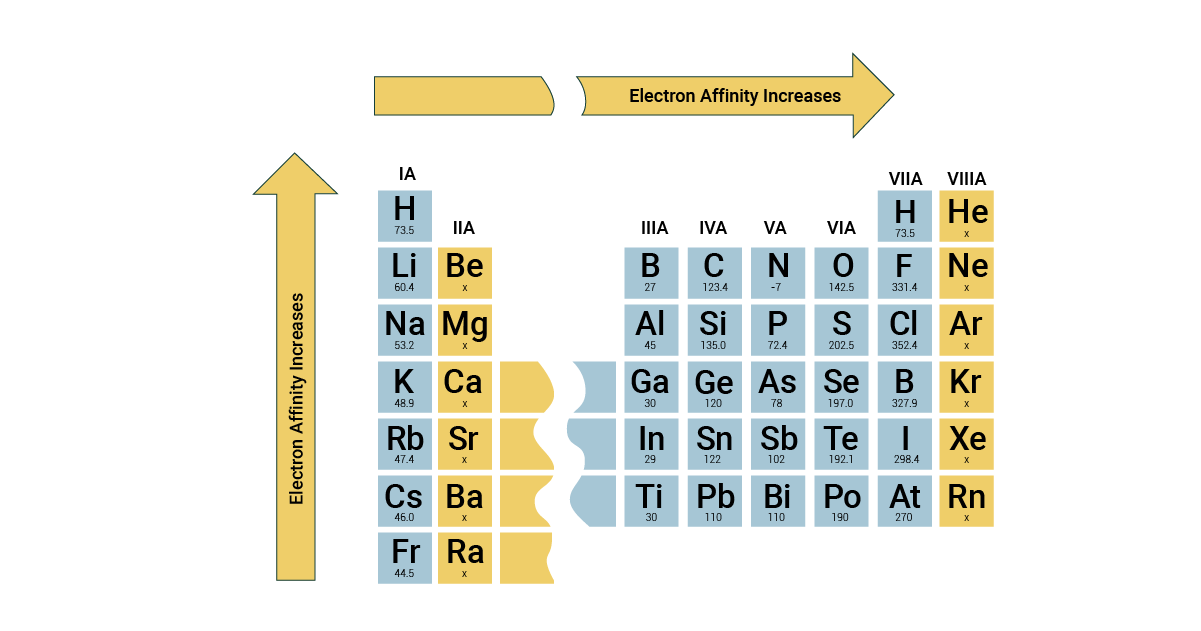
Electron Affinity
Electron affinity is the energy change when a gaseous atom gains an electron. Halogens have the most negative values, but unlike atomic radius, there is no single clear periodic trend.
quantum number
number having only specific allowed values and used to characterize the arrangement of electrons in an atom
shell
atomic orbitals with the same principle quantum number
subshell
atomic orbitals with the same value of n and l
electron density
a measure of the probability of locating an electron in a particular region of space
interference pattern
the pattern typically consisting of alternating bright and dark fringes, it results from constructive and destrutive interference waves