NEUR30080 L6 SQ patch clamping
 Call Kai
 Learn
 Practice Test
 Spaced Repetition
 Match
 Flashcards
 Knowt Play
1/34

There's no tags or description
Looks like no tags are added yet.
35 Terms
the resolution trade-off
macroscopic (EEG/MEG): non-invasive, captures the summed activity of millions of neurons, BUT loses biophysical detail
microscopic (patch clamp): highly invasive, but the only technique capable of resolving the real-time biophysics of a single cell or single ion channel
which is more invasive?
microscopic
which has more biophysical detail?
microscopic
the gentics
genetics can identify a channelopathy (e.g. SCN1A mut in Dravet syndrome)
however, DNA cannot tell us if the mutation causes a loss or gain of function
patch clamping required to measure exactly how the channel’s physically broken, making it the gold standard for targeted drug screenings
no. of pathogenic ion channel variants confirmed per gene image

membrane current changes Vm AND Vm changes membrane current
therefore neither can be measured as a function of the other
current clamp: inject a known current, let the voltage respond. used to watch natural events (e.g. synaptic integration & APs)
voltage clamp (controlling): force the voltage to a fixed command potential. Used to measure the exact underlying ionic currents
current vs voltage clamp image

a glass pipette sealed to the memb. with resistance above 1GΩ reduces current noise enough to resolve picoampere single-channel currents
pipette about 1 um, seal 10-100 GΩ after gentle suction
current noise falls as seal resistance rises
first single-channel currents: ACh receptors in denervated frog muscle (Neher & Sakmann 1976)
the gigaseal isolates the patch both electrically and mechanically
image: a glass pipette sealed to the memb. with resistance above 1GΩ reduces current noise enough to resolve picoampere single-channel currents
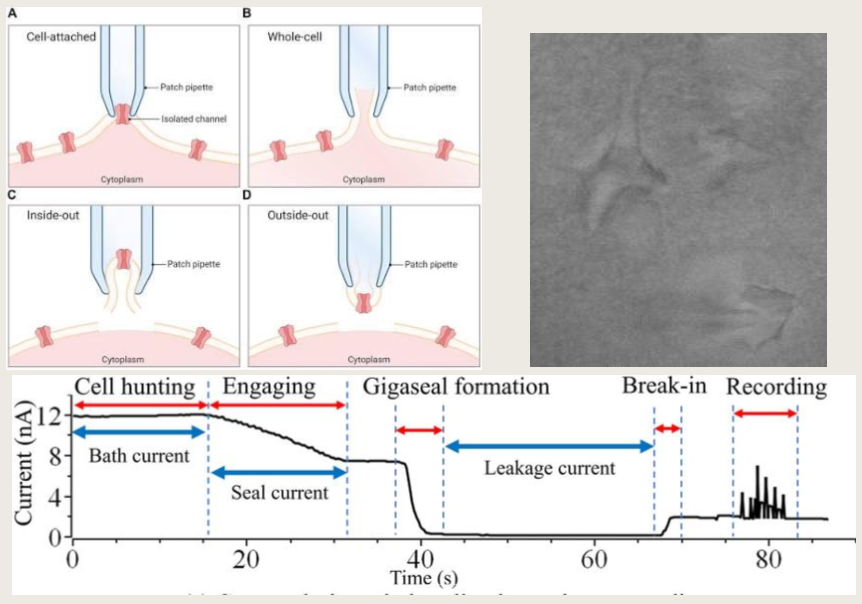
current clamp - current steps give the resting potential, input resistance and tau (image)

current clamp - current steps above threshold evoke APs of fixed amplitude (image)
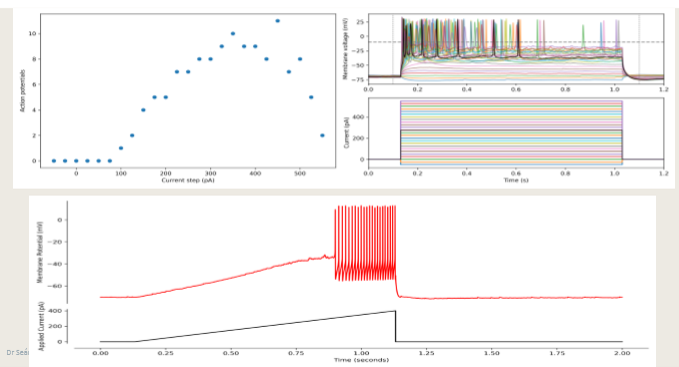
voltage clamp - in unclamped axon, membrane current changes Vm and Vm changes membrane current
neither can be measured as a function of the other
gNa and gK depend on voltage and time
during an AP, both variables change together
a conductance measurement requires one of them to be held constant

permeability (P)
structural property
how readily an ion crosses the memb, set by the number and open state of selective channels
conductance (g)
electrical property
measures the flow of net electrical charge (current) per unit of driving force (voltage) under Ohm’s law
Ohm’s law
in a well-behaved conductor, the electric current between two points is directly proportional to the voltage across the two points
a voltage clamp holds Vm at a command potential by injecting current equal and opposite to memb current
Amplifier output ∝ (Vcommand − Vm)
injected current = -Imembrane at every instant
the record is the injected current
the clamp measures current; conductance is obtained afterwards from g = I / (V - E)

current steps give the resting potential, input resistance and membrane time constant (image)

formula: ionic current
at Vm, the capacitive current is zero, so recorded current is ionic

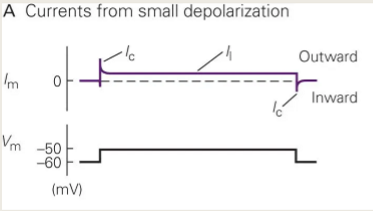
a step voltage change evokes a capacitive transient, an early inward current and a delayed outward current
early current: inwards, peaks in under 1 ms, then declines
late current: outward, develops after a delay, maintained for the step
hyperpolarising steps of the same size produce only leak and capacitive current
two voltage-dependent currents of opposite sign and different kinetics underlie the AP
a step voltage change evokes a capacitive transient, an early inward current and a delayed outward current (image)
TTX mechanism
abolishes the early inward current
TEA mechanism
abolishes the delayed outward current
conclusion from TTX and TEA mechanisms
selective block shows INa and IK flow through separate channels
TTX and TEA graph

which animals have TTX toxin?
blue ringed octopus & pufferfish
gNa activates within a ms, and inactivates during a maintained step. gK activates after a delay and does not inactivate
g = I / (Vm - Eion)
both conductances increase, and activate faster, with larger depolarisation
gK returns to baseline only on repolarisation
the time courses of gK and gNa account for the upstroke, repolarisation and after-hyperpolarisation (lecture 3)

which activates after a delay and does NOT inactivate?
gK
which activates within a ms and inactivates during a maintained step?
gNa
in mouse neocortical pyramidal neurons, blocking half the Na+ current raises rheobase but does not abolish firing
electrophysiology provides a real-time readout of pharmacological block#reveals exactly how a drug works (e.g. reducing spike amplitude vs. raising the firing threshold)

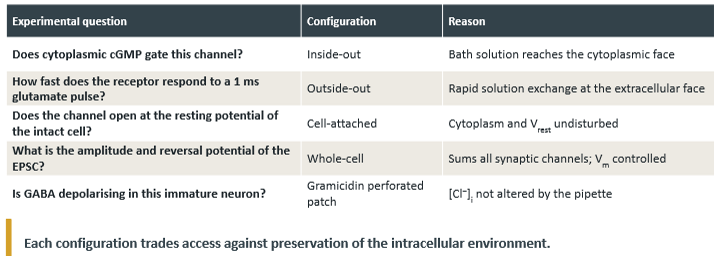
four configurations give access to whole-cell current or to either face of an isolated patch (table)

the choice of configuration follows from which membrane face the test agent must reach (table)
single Na+ channels in cultured rat muscle open stochastically to a fixed unitary current
Unitary conductance γ ≈ 18 pS
i = γ · (Vm − ENa): about 1.4 pA at −30 mV with ENa = +50 mV
Openings cluster early in the step; late openings are rare
amplitude is fixed by the pore. timing is probabilistic

under voltage clamp at -65 mV, the EPSC is inward and the IPSC is outward
EPSC: I = g(Vm - 0)
negative, plotted downward
IPSC: I = g(-65 -(-70))
positive, plotted upward
for ECl = -70 mV

what is current direction defined by?
the movement of positive charge
the synaptic reversal potential is the holding potential at which the post-syn current changes sign
Glutamatergic EPSC: Erev = O mV approx.
GABAa IPSC: Erev = ECl approx.
slope of the I-V relation = synaptic conductance
Erev identifies the permeant ions
the slope gives gsyn
