4.1 - Plate Techtonics
 Call Kai
 Learn
Learn Practice Test
 Spaced Repetition
 Match
Match Flashcards
 Knowt Play
1/6

There's no tags or description
Looks like no tags are added yet.
Name | Mastery | Learn | Test | Matching | Spaced | Call with Kai | Chat |
|---|
No analytics yet
Send a link to your students to track their progress
7 Terms
What are plate boundaries?
The Earth is composed of 3 Layers
Lithosphere (Crust)
Plates sit on the crust (Denser layers)
Hard Plate
Asthenosphere (Upper Mantle)
Softer
Mesosphere (Lower Mantle)
Hard
-Plates are the less dense upper part of the crust floating on the denser lower part
This process is called convection

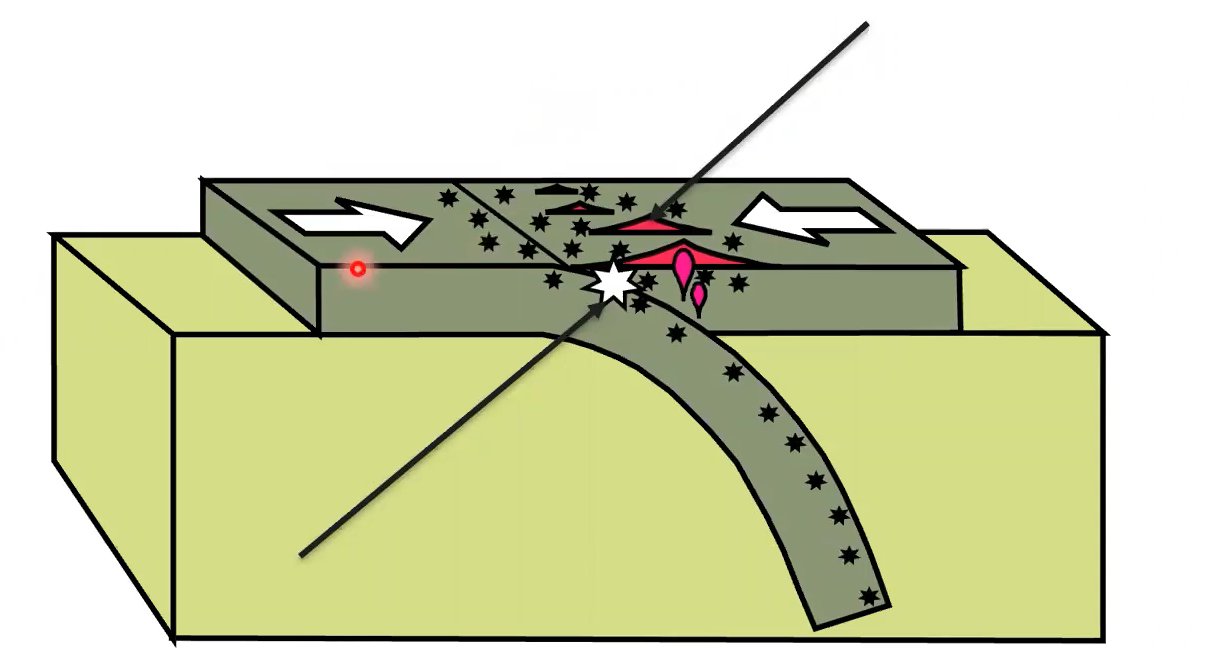
Convergent Plate Boundaries
Plates are pushing towards each other
Subduction: When one plate falls below the other
Typically causes volcanoes
Releases magma
May cause earthquakes
Divergent Plate Boundaries
Plates drive away from each other
Softer mantle gets pushed up
May lead to ridges and volcanoes
Typically causes sea floor spreading
May cause earthquakes (less frequent than converging)

Transform or Strike/Slip Plate Boundaries
Plates here slide past each other
No ridges or volcanoes
More frequent but shallow earthquakes

Where are Plate Boundaries?
ex. Pacific Plate
-The ring of fire
Plate boundaries vary globally
Move in various directions
Each plate may have all three different plate boundaries (convergent etc.)
Type of plate (continental or oceanic) also play a role in the feature

Tectonic Plates Consequences
Plates can have breaks in their surface, leading to volcanic island chains
ex. Japan, Indonesia, Hawaii
Tsunamies
Earthquakes—> Tsunamis
Tsunami — Long sea wave, can also be caused by underwater landslides
Ecological consequences of tsunamis
Destroys habitats
Drowns species
Uproots trees
Contaminates water with saltwater and debris