L02 - Nature and Variability of Speech
 Call Kai
 Learn
 Practice Test
 Spaced Repetition
 Match
 Flashcards
 Knowt Play
1/24

There's no tags or description
Looks like no tags are added yet.
25 Terms
In speech recognition, what is the difference between variability and ambiguity?
Variability: the same message sounds different. Ambiguity: different messages sound similar.
Words that sound the same but differ in meaning, such as "to", "two" and "too", are called ____.
Homophones.
Why can a recogniser not find word boundaries simply by looking for silences?
Speech is continuous, so words run together and silences often fall inside words, not between them.
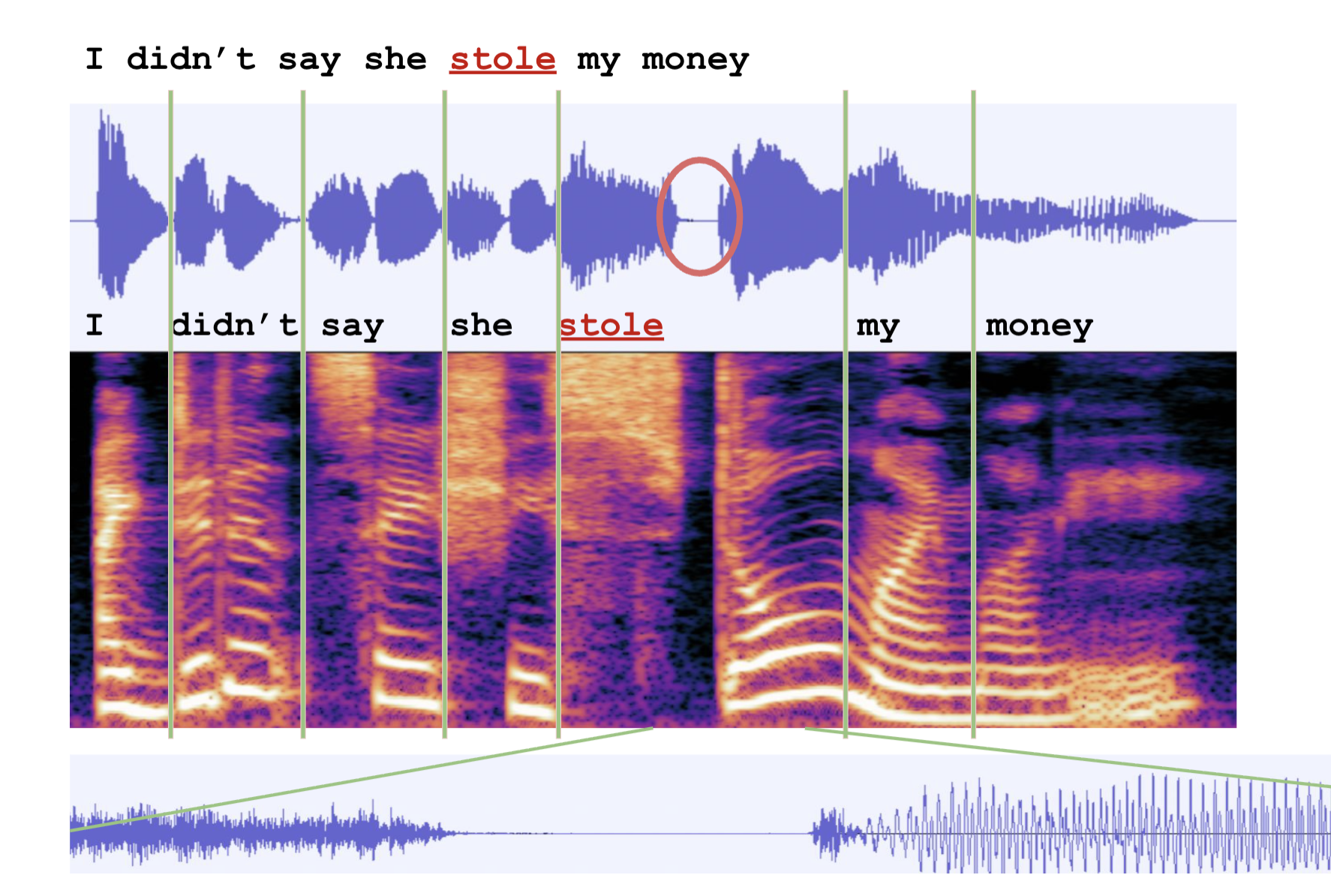
Where is the most obvious silence in this utterance, and why does it mislead segmentation?
Inside "stole", at the "t", so the silence is within a word rather than at a boundary.
What is coarticulation?
Overlapping articulatory movements, so each sound is shaped by its neighbours, because articulators move towards the next sound.
Why is "handbag" often pronounced "hambag" in normal speech?
The lips prepare early for "b", so the "nd" becomes "m" (coarticulation).
Why are casual reductions such as "tem'pry" for "temporary" not considered sloppy speech?
They balance the speaker's effort against what the listener needs to understand.
What is the difference between inter-speaker and intra-speaker variation?
Inter: differences between people (anatomy, age, accent). Intra: one person varying over time (fatigue, mood, rate).
A person's voice sounding different when they are tired or ill is an example of ____-speaker variation.
Intra.
What is the difference between a dialect and an accent?
Dialect: different words are used. Accent: the same words are pronounced with different sounds.
How do speakers change their voice in a noisy environment, and what is this called?
They speak with more effort and articulate more clearly (hyper-articulation): the Lombard effect.
Why is speech recorded in a noisy place more than clean speech plus added noise?
The speaker changes their production in noise, so the speech itself differs acoustically.
The exaggerated, simplified way adults often speak to babies is called ____.
Parentese.
"Four candles" and "fork handles" sound almost identical. What does a recogniser rely on to choose between them?
Context: it picks the most likely meaning given the surrounding words and situation.
Why is speech recognition described as inference rather than direct reading of words?
The acoustic evidence is uncertain, so the system chooses the most probable interpretation.

Complete the stages that turn sound into meaning.
Acoustic signal, candidate words, context, most likely meaning.
The sentence "I didn't say she stole my money" can carry seven different meanings with identical words. What changes between them?
Which word is stressed, because prosody shifts emphasis and the implied meaning.
What is the difference between linguistic and paralinguistic information in speech?
Linguistic: words, phones, language. Paralinguistic: how it is said, such as emotion, attitude and style.
Why might a model trained to detect a health condition from speech learn the wrong thing?
It may learn a confound, such as microphone or accent, that happens to correlate with the labels.
Why are filled pauses and false starts not simply errors in spontaneous speech?
They are normal and help humans produce and understand speech more easily.
What does the McGurk effect show about speech perception?
What we see of lip movements can change or override what we hear.
In real-world recording, the observed signal = speech + ____ + channel.
Environment (other voices, noise, reverberation).
What is the difference between a waveform and a spectrogram?
Waveform: amplitude over time (time domain). Spectrogram: energy at each frequency over time.

What are the evenly spaced horizontal stripes in the voiced parts of this spectrogram?
Harmonics: multiples of the fundamental frequency, produced by vocal fold vibration.
Why does this region show spread-out high-frequency energy with no horizontal stripes? [IMAGE: Slide 4, hide the "Unvoiced Consonant" label]
It is an unvoiced consonant: turbulent noise with no vocal fold vibration, so no harmonics.