Biochem lecture 7
 Call Kai
 Learn
 Practice Test
 Spaced Repetition
 Match
 Flashcards
 Knowt Play
1/70

There's no tags or description
Looks like no tags are added yet.
71 Terms
competitive
type of inhibition in which inhibitor competes with substate for active site

EI
in competitive inhibition, the inhibitor forms a ____ complex
V0 = Vmax[S]/alphaKm + [S]
equation for Vo in competitve inhibition
un-competitive
type of inhibition which the inhibitor binds to spot other than the active site, rendering enzyme inactive

ESI
in un-competitive inhibition, the inhibitor forms the ____ complex
V0 = Vmax[S]/Km + alpha’[S]
equation for V0 in un-competitive inhibition
mixed
type of inhibition in which substrate can bind to spot OTHER than active site in E or ES complex
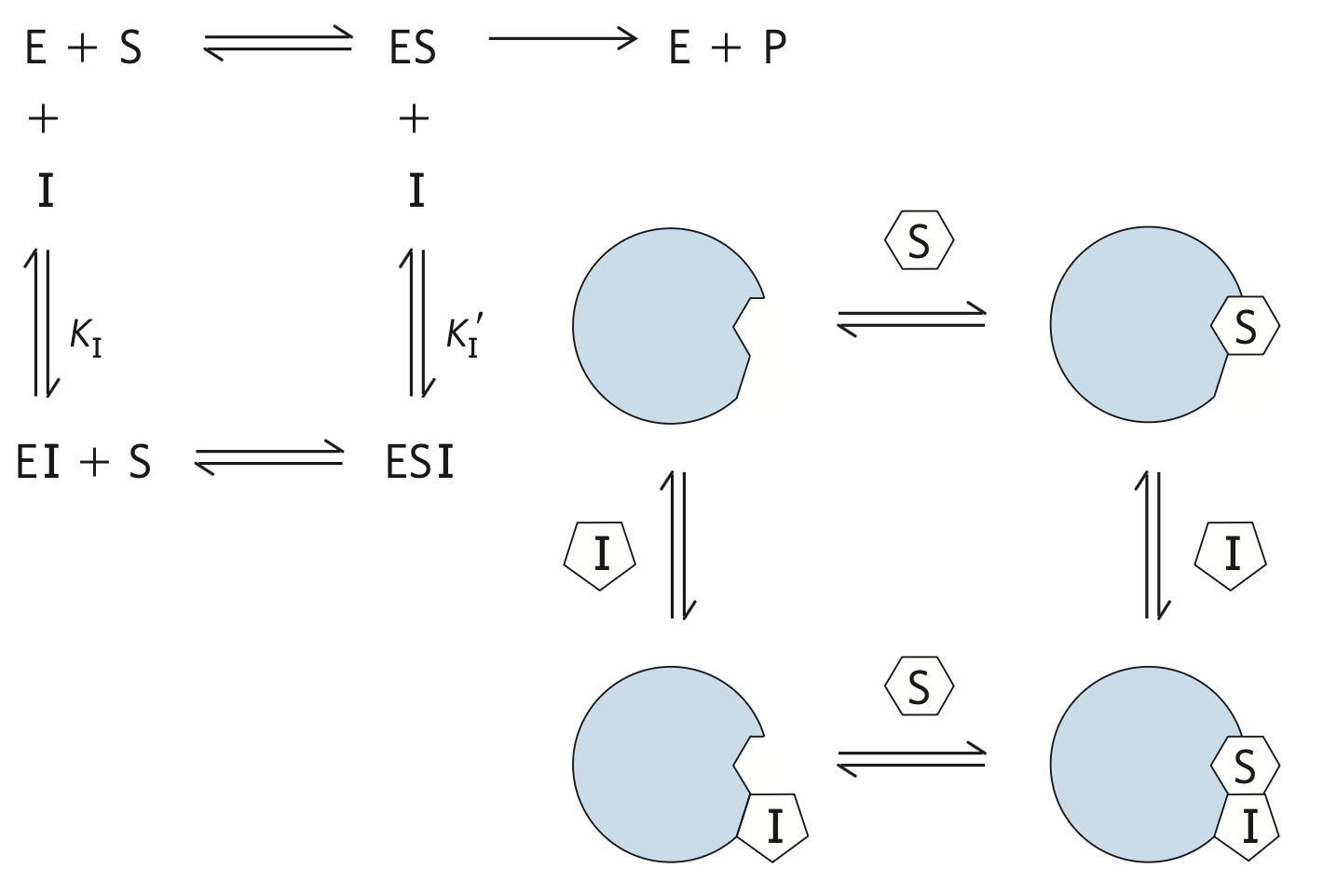
V0 = Vmax[S]/alphaKm + alpha’[S]
equation for V0 in mixed inhibition
increases; stays the same
in competitive inhibition, Km ______ and Vmax ____

decreases; decreases
in un-competitive inhibition, Km ______ and Vmax____

increases; decreases
in mixed inhibition, Km ______ and Vmax____

non-competitve inhibition
special case of mixed inhibition in which alpha = alpha’ and inhibitor can bind E or ES complex
stays the same; decreases
in non-competitive inhibition, Km ______ and Vmax____

irreversible inhibition
type of inhibition that involves suicide inhibitors that form covalent bonds with their target
permanently
suicide inhibitors ______ bind to the active site
penicillin
example of irreversible inhibition we talked about in class
regulatory enzyme
type of enzyme that is regulated so they can regulate something
feedback inhibition
when end product of a pathway is a molecule that shuts down the pathway
materials; energy
feedback inhibition prevents the waste of _____ and _____
allosteric modulation
binding of a molecule on one part of protein affects the shape, thus and behavior of the protein
active; regulatory
in allosteric modulation, there is an _____ site and a _______ site
speciic
both sites in allosteric modulation are _______
heterotropic enzymes
modulator is different from the substrate (binds outside active site)
homotropic enzymes
modulator IS the substrate (active site IS the regulatory site)
sigmoidal
change in rate caused by modulatorr in allosteric enzymes creates a _______ cuve
positive; negative
heterotrophic enzymes can either have ______ regulators or ____regulators
increase; not affect
you cannot predict the curve for heterotropic enzymes because positive regulators can either _____ K0.5 and _____ _____ Km and vice versa + same with negative regulators.
methylation
type of reversible covalent modification that adds a methyl group

ADP-ribosylation
type of reversible covalent modification that transfers an ADP-ribose group from NAD+ onto target molecules

acetylation
type of reversible covalaent modification that adds an acetyl group
adenylation
type of reversible covalent modification that adds an adenosine monophosphate (AMP)
Myristoylation
type of reversible covalent modification that adds carbon chains
ubiquitination
type of reversible covalent modification in which ubiquitin is added
ubiquitin
tags proteins for destruction (degraded by proteosome)
phosphorylation
type of reversible covalent modification that adds a phosphate group
protein kinase
enzyme that catalyzes the attachment of phosphoryl groups to specific amino acid residues
tyrosine, serine, threonine, sometimes histidine
kinase targets these amino acids:
structure; function
phosphorylation changes the _______ of protein, changing its _______
activate; inactivate
kinases either ___ or _____ proteins
Trypsin
protease that is activated by proteolytic cleaves and produced by pancreas and sent to your duodenum
gut
trypsin breaks down proteins in your ____
arginine; lysine
trypsin recognizes ____ and _____
trypsinogen
precursor (pre-cleavage) for trypsin
enteropeptidase
enzyme that clips off part of trypsinogen once it enter tthe duodenum, activating it to trypsin
trypsin inactivating protein
protein that binds to trypsin and keeps it inactive
tyrosine kinase
large family of plasma membrane receptors with intrinsic protein kinase activity, transduce extracellular signals by a mechanism fundamentally different from that of GPCRs
glycogen phosphorylase
enzyme that takes one glucose monomer off at a time through phosphorylation by putting phosphate group onto glucose and cleaving if off
insulin
hormone that we release when we want to decrease glucose in blood by stimulating the inactivation of GPK
glucagon
hormone that stimulates GPK pathway
serine
amino acid on GPK that can be reversible phosphorylated
a
more active form of glycogen phosphorylase ___
b
less active form of glycogen phosphorylase ___
disordered, ternary complex
name of complex:
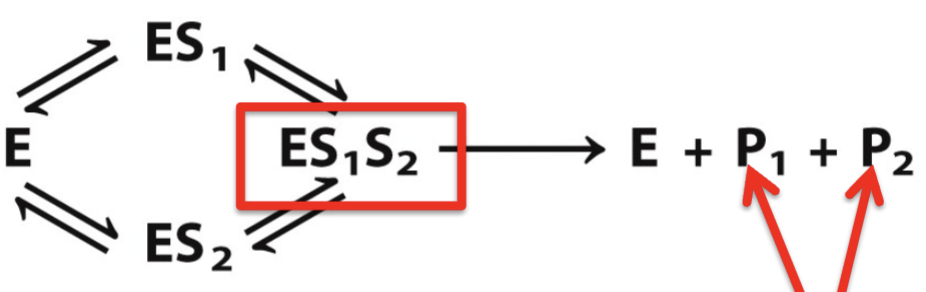
ordered, ternary complex
name of complex:

glucose; ATP
hexokinase binds ___ and _____
no ternary complex
image shows an enzyme with _____

increases; lower
in competitive inhibition Km ______ by factor alpha, making it appear that the enzyme has a _____ affinity for substrate.
stays the same; “wash out” the effects of the inhibitor
in competitive inhibition, the Vmax ______ because as your keep increase [S], you ____________.
decreases; higher
in un-competitive inhibition Km ______ , making it appear that the enzyme has a _____ affinity for substrate.
protein kinase
enzyme that catalyzes the attachment of phosphoryl groups to specific amino acid residues
ATP
𝛾-phosphoryl group derived from ____ is transferred to Ser, The, Tyr (occasionally His) by PROTEIN KINASE
protein phosphatase
enzyme that catalyzes the removal of phosphoryl groups
kinase
Glycogen Phosphorylase is not a ____ because it does not utilize ATP
Phosphorylase Phosphatase
removes phosphoryl groups from glycogen phosphorylase
A; B
phosphorylase phosphatase converts ___ form to ___ form of glycogen phosphorylase
B; A
phosphorylase kinase converts ___ form to ___ form of glycogen phosphorylase
e) All of the above regulate ATCase.
The allosteric enzyme ATCase is not regulated by a:
a) positive regulator.
b) negative regulator.
c) heterotropic regulator.
d) homotropic regulator.
e) All of the above regulate ATCase.
d) contains a catalytic triad.
Chymotrypsin:
a) is a zymogen.
b) is activated through phosphorylation.
c) cuts at the carboxy-end of positively charged amino acid residues within polypeptides.
d) contains a catalytic triad.
e) is an enzyme with no disulfide bonds.
d) Siliconation
Which of the following is not a common form of regulation through covalent modification?
a) Adenylation
b) Ubiquitination
c) Myristoylation
d) Siliconation
e) Acetylation
d) Two of these are true.
Blood coagulation involves:
a) a kinase cascade.
b) zymogen activation.
c) serine proteases.
d) Two of these are true.
e) All of these are true.
b) Phosphorylase activates phosphorylase kinase.
Which of the following is false about glucose metabolism in muscle cells:
a) Glucose release requires active phosphorylase kinase.
b) Phosphorylase activates phosphorylase kinase.
c) Insulin stimulates the inactivation of phosphorylase kinase.
d) Phosphorylase kinase must put a phosphate group on a serine, threonine, or tyrosine of its target protein.
e) Insulin has the opposite effect of glucagon.