Unit 4, Chapter 7D-7E: The Adaptive Immune System and Lymphatic System
 Call Kai
 Learn
 Practice Test
 Spaced Repetition
 Match
 Flashcards
 Knowt Play
1/34

35 Terms
Define the Third Line of Defence
The third line of defence is a component of the immune system within vertebrates and is composed of the humoral and cell-mediated responses which are specific immune responses that form immunological memory.
List the 5 Cellular Components of the Second Line of Defence
HINT: T lymphocytes and B lymphocytes
T helper cells
Cytotoxic T cells
T memory cells
Plasma cells
B memory cells
Define T Lymphocytes
T lymphocytes are a type of leukocyte that plays an important role in cell-mediated immunity. They differentiate into cytotoxic T cells, T memory cells and T helper cells.
Define Cytotoxic T Cells
Cytotoxic T cells are differentiated T lymphocytes that are responsible for the destruction of infected or abnormal cells that are displaying specific foreign antigens on their MHC Class I markers.
Define T Helper Cells
T helper cells are differentiated T lymphocytes that interact with antigen-presenting cells and are required for the activation of B and T cells through the release of cytokines which initiate their cloning and differentiation.
Define T Memory Cells
T memory cells are differentiated T lymphocytes that are responsible for providing long-lasting immunological memory. They can proliferate rapidly into T helper cells and cytotoxic T cells when they recognise a previously encountered disease.
Define B Lymphocytes
B lymphocytes are a type of leukocyte that plays an important role in humoral immunity. They differentiate into plasma cells and B memory cells.
Define Plasma Cells
A differentiated B lymphocyte that is responsible for the generation and secretion of antibodies during the humoral response.
Define B Memory Cells
B memory cells are differentiated B lymphocytes that are responsible for providing long-lasting immunological memory. They can proliferate rapidly into plasma cells when they recognise a previously encountered disease.
Explain the Process of Antigen Presentation
Antigen-presenting cells display pathogenic antigens on their MHC Class II markers
They then travel via the lymphatic system to lymph nodes where they can present foreign antigens to T helper cells
Eventually a T helper cell with a complementary receptor to the foreign antigen is selected (activated) and can help initiate a pathogen-specific response via cell-mediated or humoral pathways
Define Humoral Immunity
Humoral immunity is an adaptive response in which extracellular pathogens are neutralised and destroyed via the production and secretion of antibodies by plasma cells.
Define Antibodies
Antibodies are proteins produced by plasma cells during the humoral immune response. They are each specific to an antigen and are able to target and combat pathogens in a variety of ways.
Describe the Structure of an Antibody
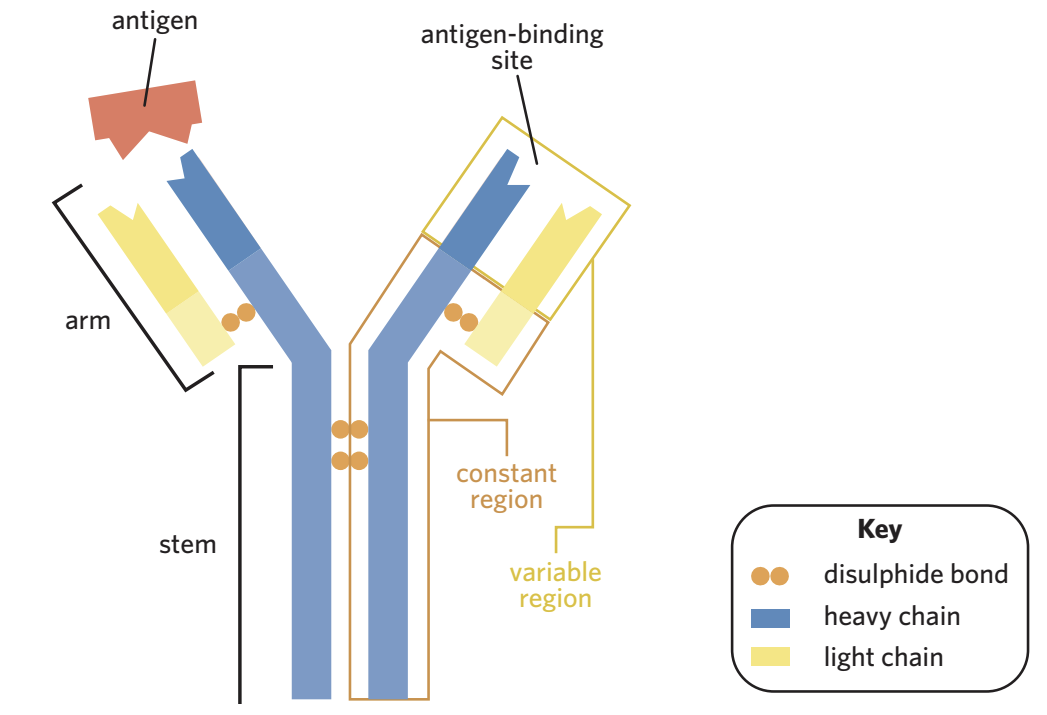
Antibodies have a quaternary structure, composed of 4 polypeptide chains (2 heavy chains and 2 light chains) arranged in a Y shape. The stem is the constant region and the arm is the variable region that contains the antigen-binding sites (2 identical sites per antigen).
List 5 Key Functions of Antibodies
Neutralisation
Agglutination
Immobilisation
Opsonisation
Activation of Complement Proteins
Describe Neutralisation with Antibodies
Antibodies can block the sites used to attack host cells on pathogens and can block the active sites of toxins.

Describe Agglutination with Antibodies
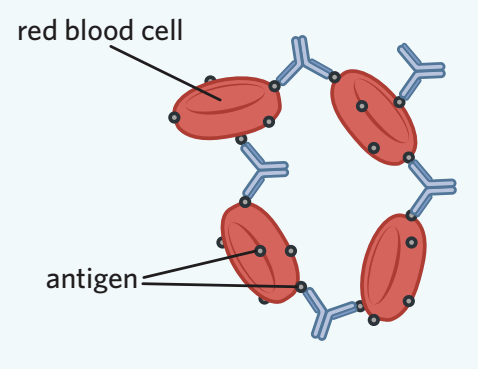
Antibodies can bind together with antigens on separate pathogens, due to their two antigen-binding sites, forming large antigen-antibody complexes. This makes it easier for phagocytes to recognise and destroy pathogens.
Describe Immobilisation with Antibodies
Antibodies can bind together with antigens on separate pathogens, due to their two antigen-binding sites, forming large antigen-antibody complexes. This can restrict the movement of pathogens.
Describe Opsonisation with Antibodies
Antibodies can bind directly to the surface of pathogens to make them easier to phagocytose.

Describe Activation of Complement Proteins with Antibodies
Antibodies attached to the surface of pathogens can facilitate the actions of complement proteins, including the formation of membrane attack complexes.

Define Clonal Selection
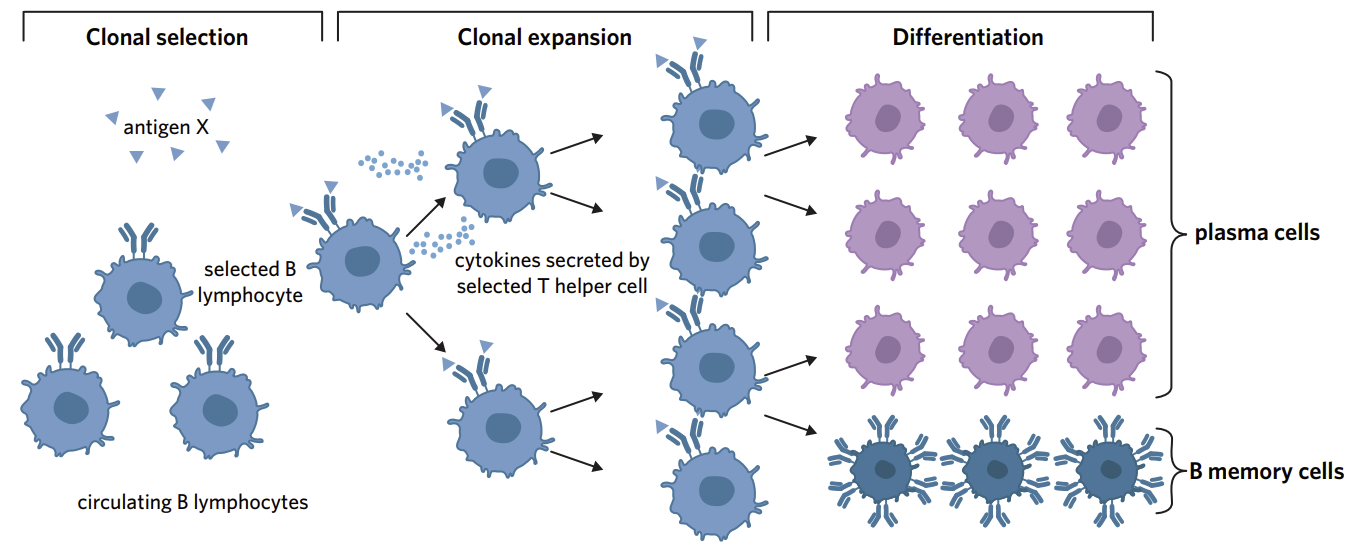
Clonal selection is the process in which B and T cells encounter an antigen that matches their antigen binding site and become activated (or ‘selected’).

Define Clonal Expansion
Clonal expansion is the process in which many copies of a lymphocyte are generated.
Explain the Stages of the Humoral Immune Response
A pathogen interacts with and selects a B-cell with a complementary antigen to the antigen-binding site of a B cell’s receptors
A T helper cell selected through antigen presentation, also with a complementary receptor, will recognise the selected B cell and secrete a number of different cytokines.
The cytokines initiate the clonal expansion and differentiation of the B cell into B memory cells and plasma cells.
The plasma cells secrete antibodies to defend against the specific pathogen and the B memory cells create long-lasting immunological memory.
Define Cell-Mediated Immunity
Cell mediated immunity is an adaptive response that involves the destruction of infected or abnormal cells (intracellular threats) via cytotoxic T cells.
Explain the Stages of the Cell-Mediated Immune Response
A T helper cell and naive T cell, both with complementary cell receptors for a specific antigen, are selected via antigen presentation
The naive T cell is now selected. The T helper cell releases cytokines to initiate the clonal expansion and differentiation of the naive T cell.
The clones differentiate into T memory cells and cytotoxic T cells, the latter of which leave the lymph node and travel throughout the body until they reach the site of infection.
The cytotoxic T cells eventually reach the abnormal cells presenting complementary foreign antigens on their MHC Class I merkers, which they bind to. They then secrete chemicals to induce apoptosis in the abnormal cell.
Define and Summarise the Purpose of the Lymphatic System
The lymphatic system is a large network of vessels throughout the body through which lymph flows.
It acts as a transport system for antigen-presenting cells and serves as the location of clonal selection, making it the initiation site of the adaptive immune system.
Define Lymph
Lymph is a pale fluid that flows through the lymphatic system and has a high concentration of leukocytes.
Define Primary Lymphoid Tissue with 2 Examples
Primary lymphoid tissue refers to components of the lymphatic system that serve as the sites for the production and maturation of lymphocytes. These include the bone marrow and thymus.
Define Secondary Lymphoid Tissue with 2 Examples
Secondary lymphoid tissue refers to components of the lymphatic system that are responsible for the maintenance of mature lymphocytes and the activation of the adaptive immune response. These include the lymph nodes and spleen.
Outline the Role of the Bone Marrow
The bone marrow is where the production of B and T lymphocytes occurs. B lymphocytes remain in the bone marrow to mature further.
Outline the Role of the Thymus
The thymus is an organ where T lymphocytes go to mature, after migrating from the bone marrow.
Outline the Role of the Lymph Nodes
Lymph nodes are small secondary lymphoid tissues found throughout the body where antigen-presenting cells activate the adaptive immune system (eg. tonsils).
Explain the Swelling of Lymph Nodes during Infection
Lymph nodes contain clusters of mature lymphocytes that ‘scan’ passing lymph for pathogens or antigen-presenting cells, ready to undergo clonal selection, expansion and differentiation. Large numbers of differentiated B and T cells are generated in these tissues, resulting in the swelling during the response to some infections.
Describe the First Part of the Lymphatic System’s Action
HINT: Lymphatic drainage
Fluid from blood vessels constantly leaks into tissues of the body
Lymphatic capillaries are the smallest for of lymphatic vessel and are located in the spaces between cells where they collect fluid in tissues as well as any pathogens and immune cells that may be present
The drained fluid is now lymph
Describe the Second Part of the Lymphatic System’s Action
HINT: Lymphatic flow
The small lymphatic capillaries gradually join together to form larger vessels that contain an increasing amount of lymph
The vessels have thin walls and rely on surrounding muscle movements to squeeze lymph through the system
Lymph vessels feature a number of one-way valves to ensure that lymph only moves away from the tissues and towards lymph nodes
Describe the Third Stage of the Lymphatic System’s Action
HINT: Lymphatic surveillance
Afferent lymphatic vessels deliver the lymph to the lymph nodes where it travels through clusters of B and T cells
This is where antigen-presenting cells and pathogens are most likely to interact with a lymphocyte with a matching antigen-binding site, stimulating clonal selection
Efferent lymphatic vessels transport lymph and activated cytotoxic T cells and antibodies away from the lymph nodes to circulation near the heart.
Lymph continues to be pumped around the body