Ion and Water balance
 Call Kai
 Learn
 Practice Test
 Spaced Repetition
 Match
 Flashcards
 Knowt Play
1/22

There's no tags or description
Looks like no tags are added yet.
23 Terms
what can be a meaning of environment?

what r 3 homeostatic processes?

what r some ionic and osmotic challenges (4)

what r 2 strategies used to meet osmotic challenges

what r 2 strategies used to meet ionic challenges


explain
This diagram shows how different marine animals manage their internal water and salt balance compared to surrounding seawater.
Osmoconformer vs. Osmoregulator: Osmoconformers match their total internal solute concentration (osmolarity, shown by total bar height at ~1100 mOsm) to seawater. Osmoregulators maintain a different internal concentration regardless of the environment.
Ionoconformer vs. Ionoregulator: Ionoconformers allow their internal ion ratios (primarily \(\text{Na}^{+}\) and \(\text{Cl}^{-}\)) to mirror seawater. Ionoregulators actively pump specific ions in or out to keep internal ion levels controlled.
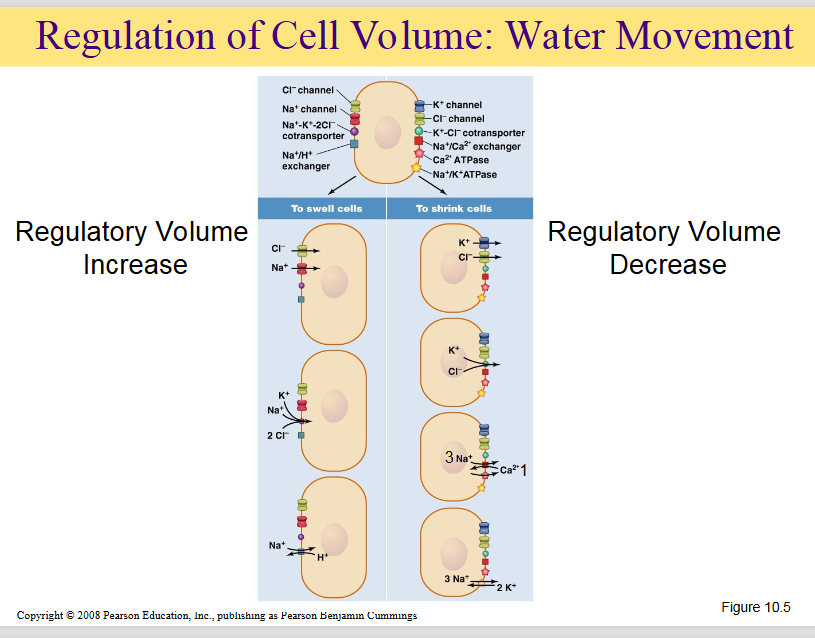
how do cells control their volume?
Cells controls their volume by regulating solutes across the plasma membrane
Regulatory volume increase: importing ions, influx of water
Regulatory volume decrease: exporting ions, efflux of water
wo won the nobel prize of chemistry in 2003

what do epithelial tissues form? (2)
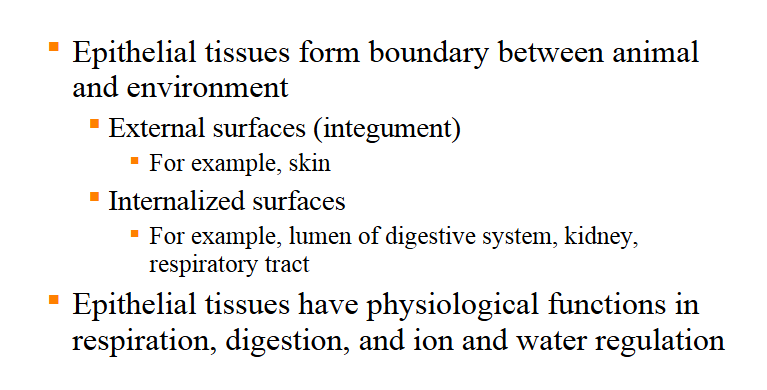
talk about the integument: osmotic barrier
how do animalsreduce flux of water across body surface?
What kind of channel increases permeability and by how much?
what are external covers animals use as a layer of hydrophobic molecules (2)


explain
This diagram shows how transporting epithelial cells (such as those in fish gills, kidneys, or intestines) are physically structured to move ions in a controlled, one-way direction between the outside environment and the bloodstream.
Cell Polarity (Apical vs. Basolateral Membranes): The cell has two distinct sides with different sets of transport proteins.
Apical membrane: Faces the external environment and is heavily folded to increase surface area for absorbing or secreting ions.
Basolateral membrane: Faces the internal side (resting on the basement membrane next to a blood vessel), using different pumps and channels to move ions into or out of the blood.
Why it matters: Having different transporters on opposite sides guarantees unidirectional transport rather than ions simply bouncing back and forth.
Tight Junctions (Cell-Cell Junctions): Seal the spaces between neighboring epithelial cells so ions cannot leak freely between them, forcing ions to pass through the regulated transporters inside the cells.
Abundant Mitochondria: Generate the large amounts of ATP required to power active transport pumps that move ions against their concentration gradients.
what are the epithelial tissue properties for ion movement
what r 4 features of transport epithelia

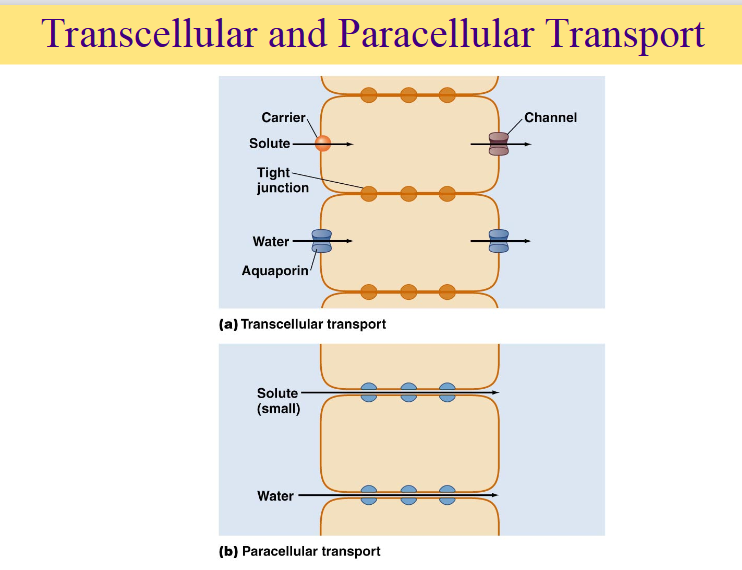
explain this
This diagram illustrates the two pathways substances use to cross an epithelial cell layer: either through the cells themselves or between adjacent cells.
Transcellular transport gives the animal strict, active control over exactly which ions and how much water enter or leave the body.
Paracellular transport provides a low-energy, passive route when small solutes or water only need to move down an existing gradient.

what r the 2 main routs of transport in epthelial tissue
what r 5 types of transporters

what r fish gills composed of (3)

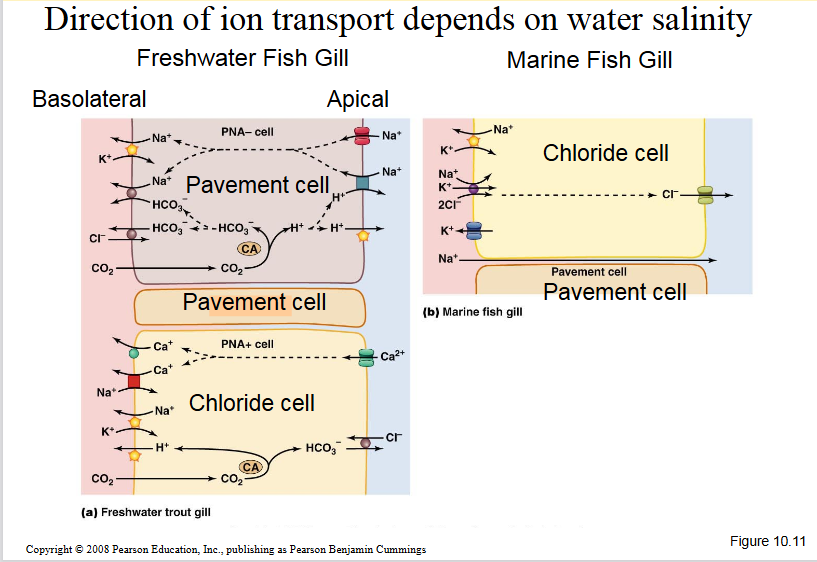
in ion transport by fish gills, what does direction of ion transport depend on?
1. Freshwater Fish Gill (Left): Pumping Ions IN
Freshwater has very few ions, so ions passively leak out of the fish's body. To survive, the gill must actively absorb \(\text{Na}^{+}\) and \(\text{Cl}^{-}\) from the water into the blood:
Pavement cells (PNA⁻ cells) absorb \(\text{Na}^{+}\):
Apical side: An active \(\text{H}^{+}\)-ATPase pump pushes \(\text{H}^{+}\) out into the water, creating a negative electrical charge inside the cell that pulls \(\text{Na}^{+}\) in through a channel.
Basolateral side: The \(\text{Na}^{+}/\text{K}^{+}\)-ATPase pump moves that \(\text{Na}^{+}\) into the blood.
Chloride cells (PNA⁺ cells) absorb \(\text{Cl}^{-}\):
Inside both cells, carbonic anhydrase (CA) converts \(\text{CO}_{2}\) and water into \(\text{H}^{+}\) and \(\text{HCO}_{3}^{-}\).
Apical side: A \(\text{Cl}^{-}/\text{HCO}_{3}^{-}\) exchanger trades intracellular \(\text{HCO}_{3}^{-}\) out into the water in exchange for bringing \(\text{Cl}^{-}\) in.
2. Marine Fish Gill (Right): Pumping Ions OUT
Seawater is much saltier than the fish's blood, so excess ions constantly flood into the fish. The gill must actively excrete \(\text{Na}^{+}\) and \(\text{Cl}^{-}\) out into the ocean using transcellular and paracellular transport together:
\(\text{Cl}^{-}\) takes the transcellular route:
Basolateral side: The \(\text{Na}^{+}/\text{K}^{+}\)-ATPase keeps intracellular \(\text{Na}^{+}\) low, powering the \(\text{Na}^+/\text{K}^+/2\text{Cl}^-\) cotransporter (NKCC) to load \(\text{Cl}^{-}\) from the blood into the chloride cell.
Apical side: \(\text{Cl}^{-}\) exits into the seawater through an apical \(\text{Cl}^{-}\) channel.
\(\text{Na}^{+}\) takes the paracellular route:
Pumping negatively charged \(\text{Cl}^{-}\) out into the water creates a negative electrical charge on the outside of the gill, which passively attracts positively charged \(\text{Na}^{+}\) from the blood between the chloride and pavement cells (leaky tight junction) into the seawater.
talk about saltwater-freshwater transitions (3)
This slide explains how anadromous fish like salmon physically remodel their gills to switch between freshwater and saltwater osmoregulation during their life cycle.


explain
This slide summarizes how the digestive tract (small and large intestines) serves as the primary entry point for water and salts into the body.
Solute-Driven Water Absorption: Intestinal epithelial cells use transcellular transport (such as \(\text{Na}^{+}/\text{K}^{+}\)-ATPase pumps on the basolateral membrane) to actively pull salts (\(\text{Na}^{+}\), \(\text{Cl}^{-}\)) and nutrients out of the gut lumen and into the blood.
Osmotic Water Movement: Moving those solutes into the blood creates an osmotic gradient that pulls water across the epithelium right behind them—both transcellularly (through aquaporins) and paracellularly (between cells).
Why It Matters for Osmoregulation:
In marine bony fish, which constantly lose water to the ocean, drinking seawater and absorbing that water across the intestinal epithelium is essential to stay hydrated (leaving the gills to pump out the excess salt).
In terrestrial animals, the small and large intestines reclaim ingested water and digestive secretions so they aren't lost in feces.
