Art history survey 1 test 2 study guide
 Call Kai
 Learn
 Practice Test
 Spaced Repetition
 Match
 Flashcards
 Knowt Play
1/35

There's no tags or description
Looks like no tags are added yet.
36 Terms

15-1,8,9,&10 Indian, Great Stupa at Sanchi (with detail of gate and
yakshi), third century BCE to first century CE
The East Torana at the Great Stupa at Sanchi in India features a finely carved Yakshi, a female nature spirit associated with fertility and abundance. Her idealized body, curved posture, and flowing movements reflect Indian artistic traditions and emphasize the connection between women, nature, and fertility. She is shown interacting with a tree, reinforcing her association with the natural world's life-giving power.
The gateway also depicts Buddhist stories and teachings. An important contrast is that the Yakshi is represented through an expressive human body, while the Buddha is often represented symbolically rather than in human form in early Buddhist art. Symbols such as the Bodhi tree and an empty throne could represent his presence. The torana served as an entrance to the sacred stupa, and its imagery helped prepare visitors spiritually for meditation and devotional practices. The combination of Yakshi imagery and Buddhist symbolism demonstrates how early Indian religious art incorporated cultural beliefs about nature and fertility alongside Buddhist teachings.
Key Points
Style: The Yakshi's idealized body and flowing curves reflect Indian artistic traditions and the connection between humans and nature.
Context: The carved gateway stands at the Great Stupa at Sanchi, a major Buddhist religious monument.
Meaning: The Yakshi symbolizes fertility and abundance, while the gateway's imagery communicates Buddhist stories and teachings.
Significance: The contrast between the Yakshi's physical form and the Buddha's symbolic representation shows how early Indian artists expressed spiritual ideas in different ways.
Function: The gateway welcomes visitors into a sacred space and helps prepare their minds for meditation and devotional practice.
Indian, Frieze from Gandhara with Life of Buddha (birth, enlightenment, first
sermon, and death), second century CE

Indian, Gupta Period, Boar Avatar of Vishnu Rescues the Earth from a cave at Udayagiri, early fifth century
The relief of Vishnu as Varaha, his boar avatar, was created during the Gupta Dynasty in India. In Hindu mythology, Vishnu takes the form of a powerful boar to rescue the Earth from the demon Hiranyaksha, who has dragged it beneath the cosmic waters. The female figure carried by Varaha represents the Earth and humanity being saved from destruction. The surrounding figures emphasize the divine struggle between good and evil.
The sculpture also has political significance because Gupta rulers associated their authority with the protection and power of Hindu gods. Just as Vishnu rescues the Earth, the Gupta king presents himself as a protector of his people. Stylistically, the relief demonstrates characteristics of Indian art, including the figures’ full, fleshy bodies and flowing, sinuous movements. The female figure can be compared to the Yakshi at the Great Stupa of Sanchi, whose body similarly emphasizes fertility and the connection between humanity and nature. Located in a cave sanctuary at Udayagiri, the relief combines Hindu religious storytelling with royal imagery, reinforcing both the power of Vishnu and the legitimacy of Gupta rule.
Key Points
Style: Full, fleshy bodies and flowing, sinuous movements reflect traditional Indian artistic characteristics.
Context: Created at the Udayagiri Caves during the Gupta Dynasty, when Hindu religious imagery was closely connected to royal authority.
Meaning: Vishnu's boar avatar rescues the Earth, represented by the female figure, from the demon Hiranyaksha.
Political Significance: The Gupta king's authority is reinforced by comparing his role as protector of his people to Vishnu's protection of the Earth.
Comparison: Like the Yakshi at Sanchi, the female figure emphasizes the human body's connection to fertility, nature, and life.

Figure 15-19 — Indian, Shiva from Elephanta, ca. 550–575 CE
The sculpture of Shiva from Elephanta was created around 550–575 CE on Elephanta Island, near modern-day Mumbai, India. It is located inside the Elephanta Caves, which were made as a religious space. What stood out to me about this sculpture is how large and powerful Shiva looks compared to the space around him. Shiva has multiple faces, which represent different sides or qualities of the god. The central face has a very calm expression, while the other faces have different expressions. This helps show that Shiva has many different roles and qualities within Hinduism. The sculpture was carved directly into the rock, which makes it feel like it is a permanent part of the temple itself. I also think its placement inside the cave would have made the sculpture feel even more impressive to people who came there to worship. Overall, this work shows how Indian artists used sculpture and architecture together to communicate religious ideas. the different genders of the faces are used to express an ongoing cycle of creation and destruction.
Key Points
The sculpture is very large and was carved directly into the rock, with multiple faces and detailed features.
It is located inside the Elephanta Caves, a Hindu religious complex near Mumbai, India.
The sculpture was part of a sacred space and was connected to Hindu religious practices

16-1, Chinese, Qin Dynasty, Army of the Tomb of the Emperor, ca. 210 BCE
The Terracotta Army was made during the Qin Dynasty around 210 BCE in China. These statues were made for Qin Shi Huang, the first emperor of China, and were placed near his tomb to protect him in the afterlife. In the picture, there are hundreds of life-sized soldiers standing in rows underground. One thing that stands out to me is how each soldier looks a little different. They have different faces, hairstyles, clothing, and positions, which makes them seem more realistic. The soldiers are also wearing armor and are organized like an actual army. This shows how important the military was to the Qin Dynasty and how much power the emperor had. The statues were meant to serve a religious purpose because people believed the emperor would need protection and servants after death. I think the huge size of the army also shows how wealthy and powerful the Qin Dynasty was. Today, the Terracotta Army is important because it gives us a look into Qin military life, art, and beliefs about the afterlife.
Important Points
Style: The statues are life-sized and have detailed faces, clothing, hairstyles, and armor.
Context: They were placed underground near the emperor’s tomb in China.
Meaning: The army was created to protect the emperor and serve him in the afterlife.
Historical Significance: The statues show the power of the Qin Dynasty and give historians information about ancient Chinese culture and military life.

Chinese, Han Dynasty, Incense
Burner, ca. 113 BCE
This bronze incense burner was discovered in the tomb of Prince Liu Sheng, a member of China's Han royal family. During the Han Dynasty, tomb objects were placed with the deceased to provide comfort and necessities in the afterlife. The burner's elaborate design reflects Liu Sheng's wealth, status, and political power. Its lid is shaped like a miniature mountain landscape, decorated with small animals and supernatural figures. Mountains were important in Chinese art and beliefs because they were associated with spiritual realms and the relationship between humans and nature.
The burner was designed to hold incense, and the rising smoke would have surrounded the mountain-shaped lid, creating the appearance of mist drifting through the landscape. This effect may be connected to Daoist ideas about nature and the search for the Dao, or the “Way.” The object therefore served both a practical and symbolic purpose, combining ritual use with spiritual imagery. Its elaborate bronze craftsmanship demonstrates the technical skill of Han artisans and the period's interest in representing landscapes and supernatural worlds. The incense burner illustrates how Chinese burial practices connected wealth, spirituality, nature, and beliefs about life after death.
Key Points
Style: Elaborate bronze craftsmanship, a mountain-shaped lid, and miniature animals and supernatural figures reflect Western Han artistic traditions.
Context: Found in Prince Liu Sheng's tomb, the burner was intended to accompany him into the afterlife and reflect his high status.
Meaning: The mountain landscape represents the connection between nature and the spiritual world.
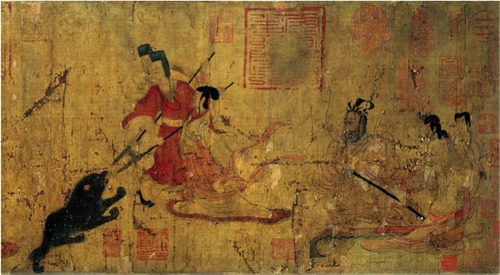
16-13 Chinese, Period of Disunity, Lady Feng and the Bear, late fourth
century
Brief Slide Summary:
Reflecting Confucian values due to the depiction of Lady Feng placing herself between the emperor and the bear.
This work is a handscroll, showing how "secular" art flourished in the dynasties because rulers sought calligraphers and painters to lend prestige to their courts.
Was not created by Gu Kaizhi, but exemplifies key elements of his art.
A piece of a larger work, which illustrates seven historical accounts of wifely virtue.
This work includes the figures' poses/fluttering drapery ribbons conveying clear animation in addition to the individualized facial expressions.
The style and the paintings ideals, which were expressed in texts at the time, work well together when "representing inner vitality and spirit took precedence over reproducing surface appearances."
Like many other Chinese paintings, the artists put the figures against a black background with minimal setting for a scene.
Handscroll, ink and colors on silk, entire work: 9 3/4' x 11' 4 1/2"
Bullet Points:
The "wifely virtue" depicted in this section is heroism.
Perfect model for Confucianism because Lady Feng showed courage and selflessness when risking her life to save the emperor.
Movement is understood to the viewer through the style of the work: the figures' poses, fluttering drapery, and individual facial expressions.
The handscroll is on silk and has ink->silk roads trading.

Chinese, Northern Song Dynasty, Fan
Kuan, Travelers among Mountains and
Streams, early 11th century
Fan Kuan’s Travelers Among Mountains and Streams reflects both Daoist and Confucian beliefs in Northern Song Chinese culture. Fan Kuan was a Daoist who spent long periods studying nature, believing it was a better teacher than other artists. The enormous central mountain makes the trees, people, and animals appear small, emphasizing nature’s greatness. The mountain may also symbolize the emperor, reflecting Confucian ideas about authority and hierarchy. Fan Kuan used texture strokes known as “raindrop strokes” to create detailed surfaces on the mountain and rocks. The contrast between dark and light areas and the relationship between solid forms and empty space reflect Daoist ideas about balance and nature. The vertical composition and hierarchy of scale also express Confucian values of order and authority.
Bullet Points:
Style: Monumental vertical composition, shifting perspectives, “raindrop strokes,” and contrasts between dark/light and solid/empty space.
Context: Created during the Northern Song dynasty; reflects Daoist beliefs in nature and Confucian values of hierarchy and authority.
Meaning: The enormous mountain emphasizes nature’s power and humanity’s smallness. The mountain may also symbolize the emperor and his authority.

17-6 Japanese, Ise Jingu
This Japanese shrine is dedicated to Amaterasu, the Shinto sun goddess and mythical ancestor of the Imperial family. The structure resembles traditional Japanese granaries and demonstrates Japanese craftsmanship through its wooden construction and distinctive roof. The shrine is built using wood from nearby forests, and its components are traditionally replaced approximately every 20 years. This rebuilding practice helps maintain the shrine’s purity, which is a central belief in Shintoism. The shrine also connects the Imperial family to divine ancestry through Amaterasu.
Bullet Points:
Style: Traditional Japanese architecture resembling ancient granaries, with wooden construction and distinctive roof design.
Context: Dedicated to Amaterasu, the Shinto sun goddess and mythical ancestor of Japan’s Imperial family.
Meaning: The periodic rebuilding of the shrine represents renewal and the preservation of purity, a central feature of Shintoism. The shrine also honors the goddess and reinforces the Imperial family’s divine connection.
Japanese, Heian Period, Tale of Genji, first half of 12th century
Tale of Genji is a Japanese literary classic written by a lady-in-waiting at the Heian Imperial Court, Murasaki Shikubu. Lady Murasaki told the story of the fictional Prince Genji’s life and his many loves, as well as those of his descendants. “Genji Visits Murasaki” is one panel on a set of handscrolls made sometime in the first part of the twelfth century. The handscrolls are the earliest examples that we still have of an illustrated copy of Tale of Genji. The scene shows Prince Genji visiting Murasaki, his longest and greatest love, before she passes away. Genji’s lowered head and shoulders show his sorrow. The building shown in this panel uses diagonal lines to create a three-dimensional space. The lack of ceiling or roof provides an intimate look into the character’s personal spaces and lives. The bushes that can be seen outside the window are thin and wispy and look like they are blowing in the wind. This helps to place the scene in Autumn, which is seen as a time of somberness, fading love, and death. The intertwining of nature and human emotions is common in Japanese works of art. Later Japanese artists consider the Genji illustrations to be reflective of the traditional Japanese painting style.
“native subjects, bright mineral pigments, lack of emphasis on strong brushwork, and general flatness” point to native-style Japanese painting
Like many other pieces of Japanese literature, both Tale of Genji and this specific panel portray the natural human sensitivity to the inherent sadness in the fleeting and ever-changing ideas of life and love.
Wilted, billowing bush represents autumn, a season of death and loss. The relation of nature’s cycles and the cyclical emotions of life and love are common in Japanese art works
“Genji visits Murasaki” is one panel from what is assumed to be around 10 handscrolls which contain the oldest existing illustrated version of the Japanese literary classic, Tale of Genji
The work, Tale of Genji, as a whole, provides a detailed look into the environment of the Heian imperial courts, which functioned as the center for culture and art, especially poetry. This emphasis on art and creativity by the imperial courts implies a time of peace and prosperity
The panel, “Genji visits Murasaki”, represents the deep sorrow of fading love

Japanese, Asuka
Period, Shaka Triad, 623
The Shaka Triad was created in 623 by the sculptor Tori Busshi during Japan’s Asuka period. The sculpture depicts Shakyamuni Buddha (Shaka) in the center, accompanied by two bodhisattvas. It was commissioned by Empress Suiko and is associated with Hōryūji, a Buddhist temple in Japan. The sculpture reflects the growing influence of Buddhism in Japan, which arrived from the Asian mainland through Korea. Its symmetrical composition, frontal pose, and stylized drapery reflect Chinese and Korean artistic influences. The central Buddha’s larger size and position emphasize his spiritual importance, while the halos and formal poses communicate the sacred nature of the figures.
Bullet Points:
Style: Symmetrical composition, frontal poses, stylized drapery, and halos influenced by Chinese and Korean Buddhist art.
Context: Created in 623 during the Asuka period, when Buddhism was gaining support in Japan.
Meaning: Shakyamuni Buddha is the central figure, symbolizing spiritual enlightenment. The two bodhisattvas flank him, emphasizing his sacred status and the importance of Buddhism in Japanese culture.

Etruscan, Archaic, Sarcophagus with Reclining Couple, ca. 520 BCE
The Etruscan civilization was located in central Italy, where fertile land and resources such as copper, iron, and terracotta supported its prosperity. During the Archaic period (600–480 BCE), trade and cultural exchange brought strong Greek influences into Etruscan art. The Sarcophagus of the Spouses depicts a married couple reclining together as if participating in a banquet. Their archaic smiles and stylized features reflect Greek artistic influences. However, the couple’s shared dining position reflects Etruscan social customs, in which women could participate in banquets alongside men. The sarcophagus would have been placed in a family tomb. The deceased are shown enjoying a banquet, reflecting the importance of food, family, and communal dining in Etruscan funerary traditions. Living family members would return to tombs to dine together at certain times of the year, maintaining connections with the deceased.
Bullet Points:
Style: Archaic smiles, stylized figures, and reclining banquet poses influenced by Greek art.
Context: Created during the prosperous Etruscan Archaic period; placed in a family tomb and reflects Etruscan customs of men and women dining together.
Meaning: Depicts the deceased enjoying a banquet, connecting the afterlife with the living. Family members could dine at the tomb during annual rituals, maintaining bonds with deceased relatives.

Etruscan, Classical, Capitoline Wolf, ca. 500-480 BCE
The Capitoline Wolf is a bronze sculpture associated with the legend of Rome’s founding. It depicts a she-wolf with Romulus and Remus, the twin brothers who were believed to have founded Rome, nursing beneath her. However, the bronze wolf’s date and origin are debated, and some scholars argue that it may have been created during the Renaissance rather than the Etruscan period. The twin infants were added during the Renaissance. The wolf’s tense body, visible ribs, powerful legs, alert eyes, and lion-like mane communicate strength, vigilance, and fierceness, resembling a protective mother. The sculpture symbolizes Rome’s legendary origins and growing power. It can also represent the waning influence of the Etruscans as Rome rose to prominence.
Bullet Points:
Style: Bronze sculpture featuring a tense body, visible ribs, powerful legs, alert eyes, and a lion-like mane to emphasize the wolf’s fierce, protective nature.
Context: Traditionally attributed to the Etruscans and dated ca. 500–480 BCE, but the wolf’s date and origin remain debated. Romulus and Remus were added during the Renaissance.
Meaning: Symbolizes Rome’s founding through the legend of Romulus and Remus. The powerful she-wolf represents Rome’s strength, while the story reflects Rome’s rise and the decline of Etruscan influence.
High roman art period card
Roman Art, High Empire Period, 96–192 CE
The High Empire period lasted from 96 to 192 CE and included the reigns of several emperors during a time when the Roman Empire reached its greatest territorial extent. The period was generally marked by prosperity and relatively stable transitions of power, although conflicts and political challenges occurred. Roman art continued to draw inspiration from High Classical Greek art, emphasizing idealized figures, naturalistic proportions, and balanced compositions. However, Romans developed new ways to communicate imperial power through monumental architecture and public sculpture, including Trajan’s Column, the Pantheon, and the Column Base of Antoninus Pius. Over time, some works moved away from Classical idealism toward more direct, easily understood visual messages that emphasized the emperor’s authority and achievements.
Bullet Points:
Style: Classical Greek influences, idealized figures, naturalistic proportions, and monumental architecture; later works sometimes used less Classical, more direct imagery.
Context: 96–192 CE; the Roman Empire expanded to its greatest territorial extent and experienced periods of prosperity and relatively stable imperial succession.
Meaning: Art and architecture communicated imperial authority, military achievements, religious devotion, and the power of Rome. Works such as Trajan’s Column and the Column Base of Antoninus Pius used public imagery to make imperial messages visible and understandable.

Etruscan, Hellenistic, Aule Metele,
early 1st century BCE
The Aule Metele, also known as the Arringatore (Orator), is a life-size bronze statue of an Etruscan man created during the early 1st century BCE. The figure wears a Roman toga and high boots and raises his right arm in a gesture used by public speakers addressing a crowd. His short hair and realistic, aging face reflect the Roman preference for veristic portraiture, which emphasized an individual's actual age and facial characteristics. An inscription in Etruscan on the garment identifies Aule Metele and his family. Created during the period when Etruscan communities were increasingly integrated into Roman society, the sculpture demonstrates the blending of Etruscan identity with Roman political and artistic traditions. Following the Social War, Roman citizenship was extended to communities throughout Italy. Although Etruscan bronze-casting traditions continued, Etruscan art increasingly adopted Roman styles.
Bullet Points:
Style: Realistic Roman portraiture, including an aging face, short hair, a Roman toga, high boots, and a raised speaker's gesture.
Context: Created in the early 1st century BCE as Etruscan communities became integrated into Roman society. The Etruscan inscription preserves the figure's name and family identity.
Meaning: Represents the blending of Etruscan and Roman cultures. His Etruscan identity remains in the inscription, while his clothing, appearance, and gesture reflect participation in Roman public life.
*******88STOP NOW AND STUDYYYYYYYYYYYYYYYYYYYYYYYYYYYYYYYYYYYY**********
Special Question on Roman Wall Painting*
• Study pages 189-193 in the textbook and the relevant slides
in the posted powerpoint about the four styles of
Pompeian wall painting so that you are able to distinguish
between them.
• On the exam, one of the two “Unknown Slide Questions”
will display a Roman wall painting that is not illustrated in
our textbook. Students will have to identify to which of the
four styles the unknown painting belongs.

Roman,
Republican, Temple
of Portunus, ca. 75
BCE
The Temple of Portunus is a Roman Republican temple located in Rome near the ancient river port. It was dedicated to Portunus, the god associated with ports, harbors, and waterways. The temple shows how Roman architecture was influenced by the Greeks and Etruscans while still developing its own style. One of the most noticeable features is the deep porch with free-standing columns in front and engaged columns along the sides. The temple is also raised on a high podium, which makes the entrance stairs and front of the building especially important. The use of columns, a triangular pediment, and a symmetrical design connects the building to Greek architectural traditions. However, the strong front-facing design and high podium are especially characteristic of Roman temple architecture. The temple’s location near the river also relates to its function and dedication to Portunus. Overall, the building demonstrates how Romans adapted earlier architectural ideas to fit their own religious and cultural needs.
Style: Roman Republican architecture with Greek and Etruscan influences.
Context: Located near Rome’s ancient river port and connected to Portunus.
Meaning: The temple served a religious purpose and honored a god associated with waterways.
Importance: Its combination of Greek-inspired columns and distinctly Roman planning shows the development of Roman architecture.

Roman, Republican, General from Tivoli,
ca. 75–50 BCE
Slide Summary: This artwork is a temple dedication to the Sanctuary of Heracles. This is a "bilingual" piece as it used the head reminiscent of that of Roman sculptures, but the body of Grecian sculptures. Beside the figure there is an armor stand, communicating that he is in fact a general. The reason for the body and head being two different styles is to appeal to the audience in two different visual languages. With the Grecian aspect, the heroic nudity. Common amongst the Greeks, but since the Romans weren't as keen on the nudity as the Greeks, so the figure is covered over the crotch area. The statue itself is made of Marble and stands at around 6 feet high
Bullet points:
The visual language used by the Romans involved the over-aging of faces, common in the Republican period of Roman art.
The fact that this was a dedication to Heracles, known for his superhuman strength, adds to the power expressed by the General
The "bilingual" aspect of the artwork reinforced the strength and capability of said general to those who saw it at the time.

Roman, Early Empire, Augustus
Primaporta, ca. 20 BCE
The Augustus of Primaporta depicts Emperor Augustus as a powerful military leader and ideal ruler. His right arm is extended in a commanding gesture, as if addressing his troops, while his military regalia emphasizes his authority. The breastplate depicts the diplomatic recovery of Roman military standards from Parthia in 20 BCE, which Augustus presented as a major achievement. Rather than portraying Augustus as an aging man, the sculpture idealizes him with a youthful, athletic body. His pose borrows from Polykleitos’ Spear-Bearer, connecting Augustus to the artistic ideals of High Classical Greece. Cupid riding a dolphin beside his leg references Augustus’ claimed divine ancestry through Venus, the mother of Aeneas, whose descendants included the Julian family. The dolphin also alludes to his victory over Mark Antony and Cleopatra at the Battle of Actium in 31 BCE, which helped establish him as Rome’s sole ruler.
Bullet Points:
Style: Idealized, eternally youthful body; commanding military pose; and a contrapposto stance inspired by Polykleitos’ Spear-Bearer.
Context: Created during Augustus’ rule; the breastplate commemorates the recovery of Roman standards from Parthia in 20 BCE, achieved through diplomacy rather than battle.
Meaning: Augustus’ pose and armor communicate military and political authority. Cupid and the dolphin reference his divine ancestry and the victory at Actium. The sculpture connects Greek artistic ideals with Augustus’ vision of a new Roman golden age.

Roman, High Empire,
Apotheosis of Antoninus Pius and
Faustina, ca. 161 CE
The Apotheosis of Antoninus Pius and Faustina is a sculpted relief created around 161 CE to commemorate Emperor Antoninus Pius and his wife, Faustina the Elder. Apotheosis refers to the elevation of a deceased person to divine status. The relief depicts the imperial couple being carried toward the heavens by a winged figure, representing their transition into the divine realm. Below them, the personification of Campus Martius and the goddess Roma symbolize Rome and its military power. The sculpture reflects Roman beliefs about imperial divinity and the emperor’s role in maintaining the stability and greatness of the empire. Its composition uses symbolic figures and hierarchical scale to communicate the couple’s elevated status and their connection to Rome.
Bullet Points:
Style: Symbolic relief sculpture featuring idealized figures, hierarchical scale, and a winged figure carrying the imperial couple toward the heavens.
Context: Created around 161 CE during the High Empire to commemorate Antoninus Pius and Faustina the Elder after their deaths.
Meaning: Represents apotheosis, the transformation of the deceased emperor and empress into divine figures. The imagery connects imperial authority with divine status, Rome’s military power, and the legacy of the ruling family. [Be aware that both of these reliefs come from
the same monument: the Column Base of
Antoninus Pius]

7-57 Roman, High Empire, Decursio,
ca. 161 CE
The Decursio is a composition on Antoninus's column pedestal. And a relief carving that breaks more strongly with Classical art conventions. The ground is the whole surface of the relief. Figures like marching soldiers and galloping horses stand on floating patches of earth. In the middle, it shows a group of soldiers with spears and shields. Around are men riding horses who do not seem like soldiers. It is made of marble depicting a traditional Roman military ritual performed around the funeral for the emperor Antoninus Pius and his wife. A ceremonial parade and a calvary carousel. The carving is unique because it combines a birds eye view of the circular racetrack of the horsemen and soldiers. This relief used a compressed, non-naturalistic, and folk inspired Roman art style.
Style: It marks a major stylistic shift in Roman imperial art, moving away form Classical Greek idealism.
Context: It has two parallel sides. The front depicting the emperor and his wife being carried to heaven. The back featuring the dedicatory inscription of the co-emperors and adoptive sons.
Meaning: The Decursio signifies the ritual performed for the emperor and his wife to guide their spirit and separate the sacred funeral space.
[Be aware that both of these reliefs come from
the same monument: the Column Base of
Antoninus Pius]

7-76&77 Roman, Late Empire, Arch of
Constantine with Distribution of
Largess, 312–315 CE
Figure 7-76: Roman, Late Empire, Arch of Constantine in Rome, 312–315 CE
The Arch of Constantine is a Roman monument located in Rome, Italy. It was built between 312 and 315 CE to celebrate Emperor Constantine’s victory over Maxentius at the Battle of the Milvian Bridge in 312 CE. The arch has three openings, with one large arch in the middle and two smaller ones on the sides. It is decorated with columns, sculptures, and carved scenes showing people and events connected to Roman power. Some of the decorations were taken from older Roman monuments, showing how Constantine connected his rule to successful emperors from the past. During the Late Empire, Roman art was used to celebrate emperors and show their authority. The arch served as a public monument that reminded people of Constantine’s military victory and leadership. I think the most interesting part is how the arch combines different styles and older artwork into one structure. Its size and detailed decorations make it stand out, while its location in Rome helped make it an important symbol of imperial power. The monument is still important today because it gives historians a better understanding of Roman architecture, political messages, and artistic traditions during Constantine’s reign.
Style: The arch has three passageways, columns, relief sculptures, and decorative carvings typical of Roman monumental architecture.
Context: It was built in Rome between 312 and 315 CE to celebrate Constantine’s victory over Maxentius.
Meaning: The monument communicated Constantine’s military success and authority to the people of Rome.
Significance: Reusing sculptures from earlier monuments connected Constantine with respected emperors of the past and shows how Roman art could serve political purposes.

Late Antique, Christian Sarcophagus, ca. 270
The Early Christian Sarcophagus is a marble coffin used for burial during the early development of Christianity. Christians increasingly favored burial over cremation because they believed in the resurrection of the body. The sarcophagus combines traditional Roman imagery with Christian themes, demonstrating how early Christians adapted familiar artistic traditions to express their faith. Its carved scenes include the story of Jonah, Christ as the Good Shepherd, and the baptism of Christ. Jonah's rescue from the sea monster symbolizes deliverance and rebirth, while Christ as the Good Shepherd represents protection and salvation. Other figures include the deceased's wife praying and the deceased portrayed as a philosopher. Their unfinished faces could be sculpted later to resemble the individuals who purchased the sarcophagus. On the far right, the baptism scene emphasizes Christ's divine identity through the presence of the Holy Spirit, represented by a dove. Overall, the sarcophagus demonstrates that wealthy Romans commissioned elaborate Christian burial objects even before Constantine's reign. It illustrates the blending of Roman artistic traditions with Christian beliefs about salvation and eternal life. Style
Combines traditional Roman pagan imagery with emerging Christian subjects.
Depicts Christ as a simple Roman shepherd, reflecting the typical pre-Constantinian style.
Context
Wealthy Romans commissioned marble sarcophagi for Christian burials instead of cremation, reflecting the belief in the resurrection of the body.
Shows that valuable objects were being made specifically for Christians even before Constantine's reign.
Meaning
Expresses Christian beliefs in salvation, resurrection, wisdom, and eternal life.
Transforms familiar Roman imagery, such as the shepherd and philosopher, into symbols of Christian faith and hope.

Late Antique, Sarcophagus of Junius Bassus, c. 359
This coffin (or Sarcophagus) was patroned by Junius Bassus, who was the chief administrative and judicial officer of the city during the mid-fourth century. While being the Romes perfect, he had converted to Christianity, and according to the inscription on the Sarcophagus, was baptized before his death in 359.
Junius Bassus is believed to be a good example of someone who was immersed in Roman culture and was dedicated to recognizing the old Roman Gods. He does so by choosing to be buried in an elaborately decorated Sarcophagus and uses depictions within the Bible.
The art itself does not include Junius but includes different relieves of Jesus' story within both the New and Old Testament, and also includes saints such as Peter and Paul. The only scene of Jesus' life that is not depicted would be the crucifixion, due to themes of death and suffering caused by immoral Romans.
In the upper zone, Christ, like an Roman emperor, sits above the sky god, who holds a billowing mantle over his head, indicating that Christ is the ultimate ruler. The scene below derives in part from representations of Roman emperors entering conquered cities on horseback, but the sculptor here emphasized humility, not majesty.
Junius Bassus (Roman Perfect) commissioned this to pay homage to Old Roman Gods, specifically Jesus, by using a Sarcophagus.
Includes imagery from Old and New Testaments of Jesus' Life (minus the crucifixion)
Recognizes that Christ is over-rules all, and the art does not depict Roman emperors to the same standard. Gives them humility instead of authority.

Late Antique, Old
Saint Peter’s, begun ca. 31
Old Saint Peter’s was one of the most important Christian buildings of Late Antiquity. Construction began around 319 CE under Emperor Constantine, following the legalization and growing acceptance of Christianity in the Roman Empire. The church was built over the traditional burial place of Saint Peter, a follower of Jesus and a significant leader of the early Christian community in Rome. Architecturally, Old Saint Peter’s adapted the Roman basilica, an all-purpose public meeting hall, for Christian worship. Unlike Roman temples, which typically housed the image of a deity and were associated with religious rituals, the church provided a large interior space where the Christian community could gather for worship. Its long, spacious design accommodated large congregations and supported the growing needs of the Christian faith. The building's impressive scale and location demonstrated Christianity's increasing influence under Constantine and helped establish Rome as an important religious center. Although the original building was eventually demolished and replaced by the present Saint Peter’s Basilica during the Renaissance and Baroque periods, Old Saint Peter’s remains a significant example of how early Christians adapted Roman architectural traditions to serve new religious purposes.
Style
Adapted the Roman basilica, an all-purpose public meeting hall, for Christian worship.
Featured a long, spacious interior designed to accommodate large congregations.
Context
Construction began around 319 CE under Emperor Constantine.
Built over the traditional burial site of Saint Peter, a follower of Jesus and an important leader of the early Christian community in Rome.
Meaning
Demonstrated Christianity’s growing importance and acceptance within the Roman Empire.
Its large size and location honored Saint Peter and established Rome as an important center of Christianity.

Late Antique, Suicide of Judas and Crucifixion, early 5th century
This early Christian panel depicts the crucifixion of Jesus alongside the suicide of Judas, the disciple who betrayed him. The figures include Judas, Mary, John, Christ, and a Roman soldier traditionally associated with piercing Christ's side. The inclusion of Judas's hanging makes this scene particularly distinctive because it connects Christ's sacrifice with the betrayal that preceded it. This artwork is significant as one of the earliest surviving depictions of Christ on the cross. Unlike many later representations, Christ does not appear dead or visibly suffering. Instead, his upright posture reflects an early Christian emphasis on his divine power and triumph over death. The image is also historically important because crucifixion was a degrading Roman punishment reserved for criminals, making its use as a Christian symbol especially striking. Although the figures surrounding the cross may appear predominantly male, this does not necessarily contradict the biblical accounts of women caring for Jesus after his death. Artists often selected figures according to the particular story or symbolism they wanted to emphasize. Overall, the panel demonstrates how early Christians transformed the shame associated with crucifixion into a symbol of sacrifice, redemption, and faith. Early Christian art that combines biblical storytelling with Roman artistic traditions.
One of the earliest surviving depictions of Christ on the cross.
Christ is shown upright and seemingly alive rather than dead or suffering.
Context
Crucifixion was a Roman punishment used for criminals, making its depiction significant in early Christian art.
The scene includes Judas, Mary, John, Christ, and a Roman soldier traditionally identified as the one who pierced Christ's side.
Meaning
Represents Christ's sacrifice and the central Christian belief in salvation through his death.
Judas's suicide emphasizes betrayal and the consequences of his actions.
Demonstrates how early Christians gradually transformed a humiliating Roman execution into a powerful symbol of faith.

Byzantine, Early Byzantine, Justinian, Bishop Maximianus and
Attendants, ca. 547
The mosaic titled 'Bishop Maximianus and Attendants' dates back to the early Byzantine era of 547 CE and was created in the Basilica of San Vitale in Ravenna, Italy. Byzantine Art revolved around the religion of Christianity and used religious imagery in order to express their spiritual beliefs along with the power of the Church. The figures are frontal and lack the element of depth, have huge eyes, elongated body parts and are not naturalistic in nature. The background of gold gives a feeling of heaven instead of that of realism (Which is very common for Byzantine art). Bishop Maximianus is recognized with an inscription and is portrayed as important he significance of his position in the Christian Church, but not more important than the king even though he's doing all of the work. The figures are presented in a very formal manner and show no action nor any communication amongst them, thus the focus is drawn towards their religious significance. This is a typical example of the Byzantine art style where the main emphasis was the spiritual aspect rather than the anatomical one of the human body.
Style: Early Byzantine style; frontally depicted, flat, symmetrical figures with elongated forms and large eyes that lack naturalism. Gold background denotes spiritual, other-worldly nature of the composition.
Context: Made in 547 CE at the Basilica of San Vitale in Ravenna, Italy, under the rule of Justinian I. It shows Bishop Maximianus along with priests and others, showing the closeness between Christian Church and Byzantine rule.
Meaning: The work celebrates Christian piety and authority of the church officials. An identifying inscription for the bishop makes it clear who he is.

Byzantine, Early Byzantine,
Icon of Virgin and Child between
Saints, 6th or early 7th century
Virgin and Child with Saints Theodore and George is an Early Byzantine icon located at the Monastery of Saint Catherine at Mount Sinai in Egypt. The artwork depicts the Virgin Mary holding the infant Jesus, with Saints Theodore and George standing on either side. Its style features flat figures, large eyes, solemn expressions, stiff poses, and a gold background. Rather than emphasizing realistic anatomy or natural movement, the artist focuses on the spiritual authority and holiness of the figures. This formal, unemotional style recalls Late Roman imperial art and Late Antiquity, when artists often used rigid poses and idealized features to communicate power and importance. These visual traditions were well suited to Christianity's growing influence in the Byzantine Empire, particularly in Constantinople, the capital established by Constantine. The icon was also created within a broader history of Christian disagreements about religious images. Some Christians believed icons encouraged devotion and helped worshippers connect with holy figures, while others feared they promoted idolatry. These disputes eventually contributed to periods of iconoclasm, during which religious images were destroyed. Overall, this icon demonstrates the importance of visual imagery in Byzantine Christian worship and belief.
Style
Features flat, stiff figures, large eyes, solemn expressions, and a gold background characteristic of Byzantine art.
Emphasizes spirituality and holiness rather than realistic anatomy, movement, or emotion.
Recalls the formal, unemotional style of Late Roman imperial art and Late Antiquity.
Context
Created during the Early Byzantine period and located at the Monastery of Saint Catherine at Mount Sinai, Egypt.
Reflects Christian debates over the use of religious images in worship, which eventually led to periods of iconoclasm.
Byzantine art continued the formal traditions of the Late Roman Empire, which were appropriate for expressing the authority of Christianity in the empire's new Christian capital, Constantinople.
Meaning
Mary holds the Christ Child, with Saints Theodore and George standing on either side.
The gold background and rigid poses emphasize the figures' sacred status rather than their earthly appearance.
Demonstrates how icons served as visual expressions of Christian faith and devotion.

Byzantine, Middle
Byzantine, Crucifixion with
Mary and Saint John, ca.
1090–1100
the byzantine empire was strongly influenced by christianity, specifically, eastern orthodox. at this time and continually, religious art plays a very important role in how people worship, churches are decorated with mosaics of biblical evens to teach religious beliefs and they also can open people to spiritual reflection as well. this mosaic shows Jesus on the cross, accompanied by Mary and Saint John. The figures are shown to be very quiet and composed, to show the importance of his sacrifice instead of using the typical dramatic physical movement seen in a lot of art. the gold background also helps make an almost heavenly aura and shows the separation between the sacred from the ordinary. the figures’ forms are also very stylized with outlines, not showing a lot of depth. this is because Byzantine art prioritizes religious significance over realism. its located in the church of the dormition, the mosaic helped create a more sacred environment for people to worship. the image is supposed to remind people of Christ’s suffering and the promise of salvation.
style: the mosaic features a gold background, stylized figures, clear outlines, and limited depth. characteristics of Middle Byzantine art.
context: created around 1090–1100 in Daphni, Greece, the work shows the role of christianity in byzantine culture.
meaning: Jesus crucifixion shows his sacrifice for while Mary and saint John are grieving over his death.

Byzantine, Late Byzantine,
Icon of Christ as Savior of Souls,
early 14th century
the byzantine empire was strongly influenced by christianity, specifically, eastern orthodox. at this time and continually, religious art plays a very important role in how people worship, churches are decorated with mosaics of biblical evens to teach religious beliefs and they also can open people to spiritual reflection as well. this mosaic shows Jesus on the cross, accompanied by Mary and Saint John. The figures are shown to be very quiet and composed, to show the importance of his sacrifice instead of using the typical dramatic physical movement seen in a lot of art. the gold background also helps make an almost heavenly aura and shows the separation between the sacred from the ordinary. the figures’ forms are also very stylized with outlines, not showing a lot of depth. this is because Byzantine art prioritizes religious significance over realism. its located in the church of the dormition, the mosaic helped create a more sacred environment for people to worship. the image is supposed to remind people of Christ’s suffering and the promise of salvation.
style: the mosaic features a gold background, stylized figures, clear outlines, and limited depth. characteristics of Middle Byzantine art.
context: created around 1090–1100 in Daphni, Greece, the work shows the role of christianity in byzantine culture.
meaning: Jesus crucifixion shows his sacrifice for while Mary and saint John are grieving over his death.

Byzantine, Middle
Byzantine, Crucifixion with
Mary and Saint John, ca 1090–1100
the byzantine empire was strongly influenced by christianity, specifically, eastern orthodox. at this time and continually, religious art plays a very important role in how people worship, churches are decorated with mosaics of biblical evens to teach religious beliefs and they also can open people to spiritual reflection as well. this mosaic shows Jesus on the cross, accompanied by Mary and Saint John. The figures are shown to be very quiet and composed, to show the importance of his sacrifice instead of using the typical dramatic physical movement seen in a lot of art. the gold background also helps make an almost heavenly aura and shows the separation between the sacred from the ordinary. the figures’ forms are also very stylized with outlines, not showing a lot of depth. this is because Byzantine art prioritizes religious significance over realism. its located in the church of the dormition, the mosaic helped create a more sacred environment for people to worship. the image is supposed to remind people of Christ’s suffering and the promise of salvation.
style: the mosaic features a gold background, stylized figures, clear outlines, and limited depth. characteristics of Middle Byzantine art.
context: created around 1090–1100 in Daphni, Greece, the work shows the role of christianity in byzantine culture.
meaning: Jesus crucifixion shows his sacrifice for while Mary and saint John are grieving over his death.

Byzantine, Late Byzantine,
Icon of Christ as Savior of Souls,
early 14th century
This icon of Jesus Christ was created in Macedonia during the early 1300s, in the Late Byzantine period. Made using tempera, linen, and silver on wood, the artwork demonstrates the continued popularity of religious icons after the period of Byzantine Iconoclasm, when religious images were forbidden. Following the end of iconoclasm, Middle Byzantine art often emphasized emotional expression and the physical form of the body. However, Late Byzantine art moved away from these characteristics toward a more restrained and formal appearance. This shift occurred during a troubled time for the Byzantine Empire, which faced political and economic difficulties. Despite these challenges, religious icons remained important in Christian worship, helping believers express their faith and focus on sacred figures. The image of Christ reflects the lasting importance of Christianity in Byzantine culture, even as artistic styles evolved. Rather than prioritizing realistic anatomy or emotional expression, the artwork emphasizes Christ's religious significance. Overall, this icon illustrates both the continued role of religious imagery in Byzantine life after iconoclasm and the artistic changes that distinguished the Late Byzantine period from the Middle Byzantine era.
tyle
Uses a flatter, more formal appearance with religious symbolism rather than realistic depth and anatomy.
Moves away from the emotional expression and greater emphasis on the body's physical form found in Middle Byzantine art.
Reflects the changing artistic traditions of the Late Byzantine period.
Context
Created in the early 1300s in Macedonia using tempera, linen, and silver on wood.
Demonstrates the continued popularity of religious icons after the period of Byzantine Iconoclasm, when religious images were forbidden.
Created during a troubled period in Byzantine history, when the empire faced political and economic difficulties.
Meaning
Depicts Jesus Christ as the central figure of Christian devotion.
Shows how icons continued to help worshippers express their faith and connect with sacred figures after iconoclasm ended.
Demonstrates that Christianity remained an important influence on Byzantine art and everyday life, even as artistic styles changed.

Roman, Republican, First Style wall
painting from Herculaneum (Samnite
House), late 2nd century BCE
The “First Style” was the simulation of colored
marble using painted plaster and the technique
came from Greece.
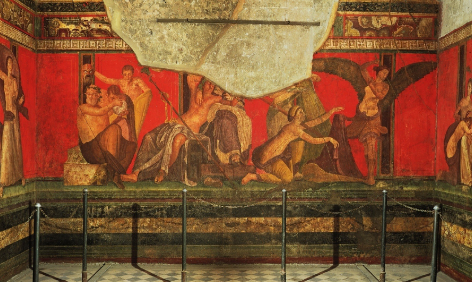
Roman, Republican, Dionysiac mystery frieze from
Pompeii (Villa of the Mysteries), ca. 60–50 BCE
The “Second
Style”
emerged in the
early 1st
century BCE
and imitated
architectural
forms but used
flat plaster
(instead of
stucco
architectural
details) on
which depth
was suggested
using shading
and
perspective.
In second style wall painting, the wall seems to be transformed
into a window that provides a view into another place (dramatic
scene, architecture, garden, etc.).

Roman, Early Empire, Third Style wall
painting from Boscotrecase (Villa of Agrippa
Postumus), ca. 10 BC
The “Third Style” began with Augustus’ reign (ca.
20 BCE) and rejected illusionism in favor of surface
ornamentation.
Mostly monochrome backgrounds are painted
with decorative architectural elements, often with
a small figural and/or landscape scenes in the
center.

Roman, Early Empire,
Fourth Style wall paintings
from Pompeii (House of
the Vettii), ca. 70–79 CE
The “Fourth Style” (mid 1st
century CE) is sometimes seen as
a baroque reaction to the third
style, reviving large-scale
narrative painting and
panoramic vistas; while it retains
many of the architectural details
of the third style, it is much less
structured.
I always tell students to identify
something as fourth style once
they have clearly determined it
is not first, second, or third
style!
7-22 Roman, Early Empire,
Fourth Style wall paintings
from Pompeii (House of
the Vettii), ca. 70–79 CE