Peripheral Nervous system - Kin 2204 Lecture content
 Call Kai
 Learn
Learn Practice Test
 Spaced Repetition
 Match
Match Flashcards
 Knowt Play
1/38

There's no tags or description
Looks like no tags are added yet.
Name | Mastery | Learn | Test | Matching | Spaced | Call with Kai | Chat |
|---|
No analytics yet
Send a link to your students to track their progress
39 Terms
What is a Visceral Afferent?
a sensory nerve fiber that carries signals from the internal organs, glands, and blood vessels to the central nervous system (mostly subcscious info but can still become aware of these stimuli)
What is the difference between a somaesthetic and a proprioceptive somatosensory receptor?
somaesthetic: (body feeling) - a specialized nerve ending or cell that detects physical stimuli from the body and converts them into electrical signals for the central nervous system
sensations like heat, cold, wetness, or other stimuli detected through the skin
Proprioception: knowledge of where the body is and how it moves in space (doesn’t rely on on other stimuli to do this)
what are special senses receptors?
a receptor involved in our special senses: vision, hearing, taste, smell, and equilibrium.
they use transduction to turn our special sensory (mechanical or chemical) data into an electrical signal
Define Adequate Stimulus as it relates to the PNS receptors
Each type of receptor is specialized to respond best to one type of energy, known as an adequate stimulus.
is modality of stimulus detected by a specific receptor (photo-, mechano-, chemo,
thermo-)
What is meant by Threshold with regards to the PNS receptors?
he minimum stimulus required to activate the receptor is known as the threshold.
what are the following receptors general function?
Photoreceptors
Thermoreceptors
Chemoreceptors
Mechanoreceptors
Photoreceptors - responsive to visible wavelengths of light.
Thermoreceptors - responsive to temperature
Chemoreceptors - responsive to specific chemicals, ex: Chemo receptors include the receptors for smell and taste
Mechanoreceptors - sensitive to mechanical energy. Ex skeletal muscle receptors sensitive to stretch
what are the 4 mechanoreceptors? and their roles?
Pacinian corpuscles – pressure and vibration
Meissner’s corpuscles – light touch (slow adapting) - fire continuously during a steady stimulus to signal shape and texture
Merkel’s disks – light touch (fast adapting) - fire only when a stimulus starts or stops to signal movement and vibration
Ruffini corpuscles – skin stretch, proprioception
define Labelled lines as it relateds to somatosensory pathways. how does this help the brain distingush the type, location and intensity of the stimulus? (type, location strength)
The sequence of synapses that transmit 1 specific signal (that is therefore labelled or dedicated) to the somatosensory cortex (there wont be a thermo receptor and a mechanoreceptor attached on the same nerve, only the same types of receptors)
consult picture
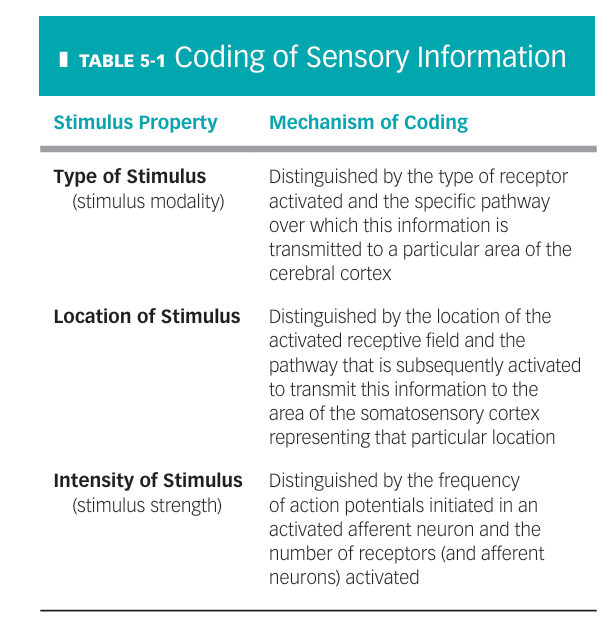
With regards to labelled lines and the sequence of synapses to the somatosensory cortex, what is the difference between the 1st order, 2nd order and 3rd order neuron?
Labelled lines – sequence of synapses
- 1st order sensory neuron – afferent neuron and its receptor synapsing to the 2nd order in the spinal cord or brainstem
- 2nd order sensory neuron - along spinal cord or brain stem to the Thalamus
- 3rd order sensory neuron - from the Thalamus to higher
brain areas

what are the 2 structural types of receptors?
A receptor may be either:
(1) a specialized ending of the afferent neuron or
(2) a separate receptor cell closely associated with the peripheral ending of the neuron.
What is a Generator Potential? what are the 3 steps which occur to propogate an action potential?
a graded potential in response to the detection of a stimulus when the receptor is a specialized afferent ending of a sensory nerve (in afferent endings are depolarizations that trigger APs in the same afferent neuron)
Sodium channels open due to specific stimulus and depolarizes the membrane (Generator potential is local depolarization)
Local current flow causes the opening of voltage gated sodium channels
at threshold, an action potential is propogated up the afferent neuron to the CNS

what is a receptor potential? what are the 4 steps which occur to propogate an action potential?
a graded potential in response to the detection of a stimulus when a receptor is a seperate receptor cell from the neuron (in separate receptor cells use exocytosis of a NT from the receptor cell which binds to chem-gated channels in the afferent neuron to trigger APs)
Stimulus-sensitive channels open – Na+ influx leads to
receptor potential (local depolarization)Depolarization → voltage gated Ca2+ channels
Ca2+ in and NT exocytosis triggers
NT binds with receptor and opens chemically gated
channel on the afferent neuron to send an action potential to the CNS

do stimuli of the same intensity always bring about receptor and generator potentials of the same magnitude from the same receptor?
too many sames bro
Stimuli of the same intensity do not always bring about receptor potentials of the same magnitude from the same receptor.
Some receptors can diminish the extent of their depolarization despite sustained stimulus strength (adaptation)
What is meant by adaptation with regards to receptors?
what are the differences in adaptation between phasic and tonic receptors?
What is an “off response?”
Adaptation = A decrease in a receptor's response to a sustained stimulus of the same intensity, causing the receptor potential to decrease and the frequency of action potentials in the afferent neuron to decrease.
Phasic receptors:
are rapidly adapting receptors. The receptor rapidly adapts by no longer responding to a main tained stimulus,
but when the stimulus is removed, the receptor typically responds with a slight depolarization called the off response
Tonic receptors:
do not adapt at all, or they adapt slowly. These receptors are important in situations where it is valuable to maintain infor mation about a stimulus.

What is a receptive field? what are the sizes of receptive fields dtermined by?
Receptive field
Area around a receptor where stimuli are detected
Size differs inversely with the density of receptors in the region
High receptor density → smaller receptive field
Low receptor density → larger receptive field
what is “acuity” and what what can be said about receptive field size and aquity?
what is lateral inhibition?
Acuity = discriminative ability
a smaller receptive field = greater acuity (think finger vs. elbow)
influenced by receptor density (more densely packed receptors the greater the ability to differentiate between 2 points)
Lateral inhibition (the most strongly activated signal pathway originating from the centre of the stimulus area inhibits the less excited pathways from the fringe areas) – helps localize where stimulus is

What is the name for a pain receptor? what types of these receptors exist (3)?
nociceptors = pain receptors
there are:
Mechanical - respond to mechanical damage, such as cutting, crushing, or pinching.
Thermal - respond to temperature extremes, especially heat.
and Chemical variants - respond equally to many kinds of irritating chemicals released from damaged tissue.
what are prostaglandins?
Prostaglandins are a special group of fatty acid derivatives that are cleaved from the lipid bilayer of the plasma membrane and act to ↓ activation threshold of nociceptors (make it easier to fire)
what are the 2 different types of pain fibres and how do they differ in myelation, speed, diameter, and stimuli detection?
A-delta fibres - fastest fibre (fast pain pathway)- resulting in sharp pain
C fibres - slowest fibre (slow pain pathway, chemically mediated) - resulting in dull pain

what chemical mediates the slow pain pathway? what type of nociceptors are stimulated by this chemical?
bradykinin: a normally inactive substance which is activated by enzymes from damaged cells to provoke pain and inflammatory response to tissue injury
Polymodal nociceptors: small-diameter receptors that respond to more than one type of noxious (painful) stimulus
respond to bradykinin to induce pain
where do 1st order afferent pain fibres synapse?
1º afferent pain fibres → 2nd order interneurons (in dorsal horn of the spinal cord)
what is substance P with regards to pain signaling? what is its role?
Substance P is a neurotransmitter which binds to receptors on an excitatory interneuron in the dorsal horn of the spinal cord to activates higher brain areas to begin processing pain signal

when pain is detected and sent up a 1st order pain fibre to release substance P to bind with the 2nd order interneuron, how is that signal processed at the somatosensory cortex, the thalamus, the reticular formation and the hypothalamus + limbic system?
Higher areas process different aspects of painful experiences:
Somatosensory cortex - (senses localization of pain)
Thalamus - (perceives the pain)
Reticular formation (increases alertness)
Hypothalamus and limbic system (elicits behavioural and emotional responses to pain)
what is glutamate? what are the 2 plasma membrane receptors of dorsal horn neurons does it bind to and what responses occur in one versus the other?
Glutamate, the other neurotransmitter released from primary afferent pain terminals, is a major excitatory neurotransmitter
Glutamate acts on two different types of plasma mem brane receptors on the dorsal horn neurons, with two different outcomes:
when glutamate binds to AMPA receptors:
transmit pain signals to the brainwhen glutamate binds to NMDA receptors:
Ca2+ 2nd messenger system - makes 2nd order interneuron more excitable
↑ sensitivity of the affected area
what endogenous analgesics are there (3) ? and what do they do / how do they work?
endogenous analgesics which are released and bind to opiate receptors blocking the release of substance P signaled by an inhibitory interneuron in the dorsal horn of the spinal cord
3 of em:
Endorphins
Enkephalins
Dynorphins

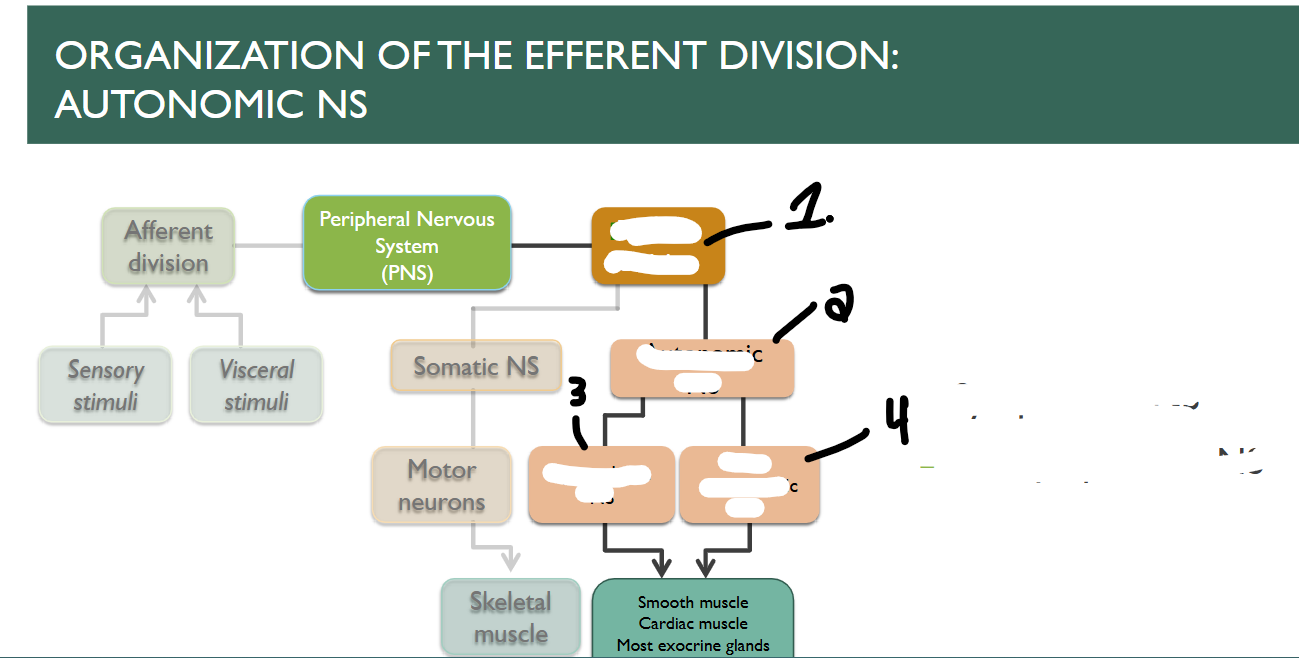
what is the branch of the PNS labeled 1? what about 2? 3 & 4?
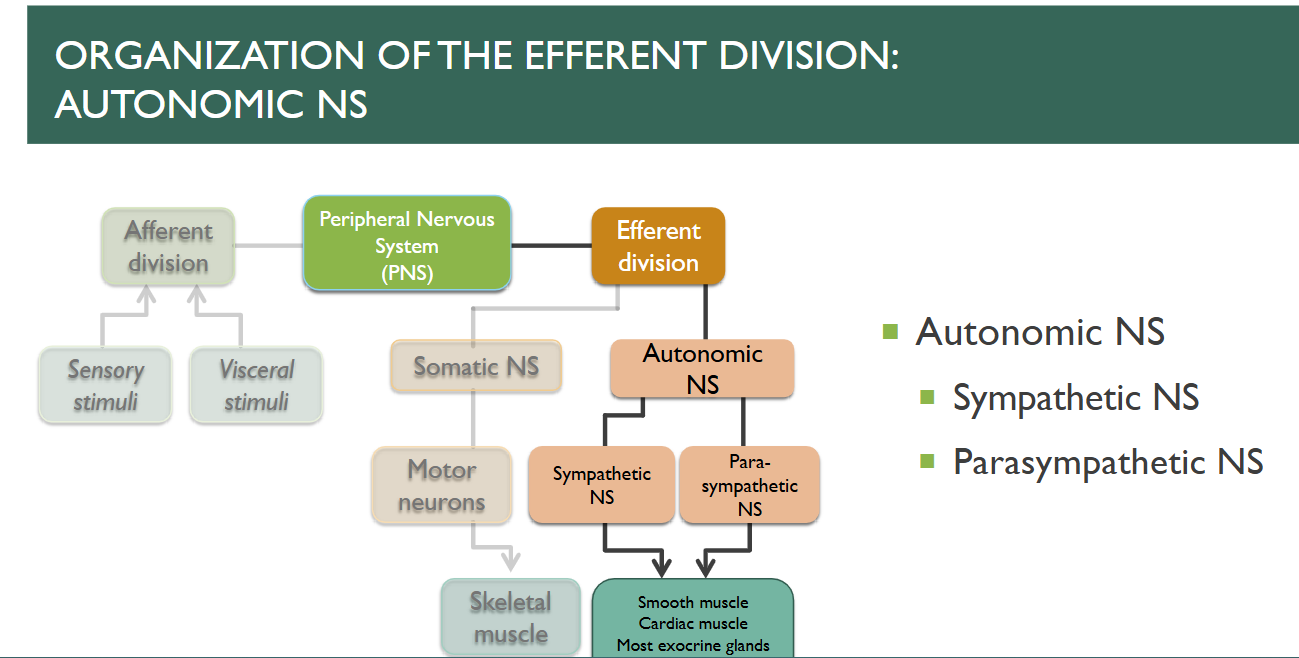
what are the key differences in function between the parasympathetic and the sympathetic nervous system?
Parasympathetic = rest and digest
Sympathetic = fight or flight
What is the Adrenal Medulla?
The adrenal medulla is a modified sympathetic ganglion which has no postganglionic fibres that acts as an endocrine organ secreting hormones (20% Noriepinephine - 80% Epinephrine) into the blood stream
creates a more widespread sympathetic response

where do the parasympathetic and the sympathetic nervous systems preganglionic fibres originate?
where do the parasympathetic and the sympathetic nervous systems postganglionic fibres originate?
how to the pre and postganglionic fibre of the para and symp systems differ in fibre type (NT) and length?
Which organs do they each innervate?
What types of receptors for other neurotransmitters are there for pre and postganglionic fibres in each system respectively?
SNS & PNS innervate the same organs but produce opposing effects depending on which one is more dominant. (SNS dominance vs PNS dominance)

what is meant by sympathetic and parasympathetic tone (tonic level).
tone or tonic levels in either system reflects the baseline continuous signal of that system at rest (in SNS is baseline SNS signaling and vice versa)
what are Nicotinic receptors and Muscarinic receptors examples of? how do they differ in which systems stimulate them, where they are located and their purpose?
both are cholinergic receptors (respond to acetylcholine binding)

what are adrenergic receptors? what subcategorizations exist? which receptors use other 2ndary messenger systems (4)? which ones elicit an excitatory vs inhibitory response?

what cell bodies are located in the dorsal, lateral and ventral horns of the spinal cord grey matter respectively?
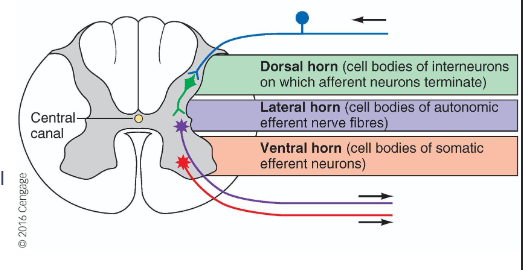
What cells in th primary motor cortex are the start of the efferent nervous system? Where do signals travel through? where do these signals leave the spinal cord?

What is the neuromuscular junction? what are the 2 interacting structures from the motor neuron and the muscle fibre respectively in an NMJ?
The structures surrounding the synapse between a motor neuron (alpha motor neuron) and a muscle fibre. the 2 interacting components are the terminal button / axon terminal where exocytosis of NT occur and the motor endplate which has receptors
what is the full sequence of events which occur at the NMJ to send a signal from the axon terminal to the motor endplate (muscle fibre)? (9 total)

what ways are NMJs vulnerable to disfunction as a result of Black widow spider venom; botulinum toxin; Curare; Organophosphate; and Myesthenia gravis?
Black widow spider venom;
triggering explosive release of ACh from the storage vesicles, not only at neuromuscular junctions but at all cholinergic sites. All cholinergic sites undergo prolonged depolarization, the most harmful result of which is respiratory failure.
Respiratory paralysis occurs as a result of prolonged depolarization of the diaphragm. During this so-called depolarization block, the voltage-gated Na1 channels are trapped in their inactivated state (p. 68), thereby prohibiting the initiation of new action potentials and resultant contraction of the diaphragm. Thus, the victim cannot breathe.
botulinum toxin;
lethal blow by blocking the release of ACh from the terminal button in response to a motor neuron action potential.
Clostridium botulinum toxin causes botulism, a form of food poisoning.
When this toxin is consumed, it prevents muscles from responding to nerve impulses. Death is due to respiratory failure caused by inability to contract the diaphragm.
Curare;
binds to ACh receptors on motor end plate preventing gated-channels from opening and preventing muscle contraction
Organophosphate;
group of chemicals which irreversible inhibit function of Acetylcholinesterase to break down released acetylcholine meaning muscles cannot repolarize
Myesthenia gravis:
an autoimmune disease of the NMJ which makes antiobodies that attack the motor endplate ACh receptors
means that AChE breaks down ACh before it may even reach a receptor
What are the differences between the autonomic and Somatic NS for the following features:
Site of origin?
Number of Neurons from origin in CNS to Effector Organ?
Organs Innervated?
Type of innervation?
NT released at effector organs?
Effects seen on effector organs?
Voluntary vs Involuntary control?
Higher brain centres involved in control of these systems?

how do the neurons differ between an Afferent, Efferent (both Auto and Somatic) and interneurons in the following features:
Origin, structure + location:
Where they Terminate?
Function of Neuron?
whether there is a convergence of input on the cell body?
What effect does the input has on a neuron?
What are their respective sites of Action Potential Initiation?
Is there a divergence of output?
What effects does each neuron have on the stucture it terminates in?
