Psychological Explanation and treatment
 Call Kai
 Learn
 Practice Test
 Spaced Repetition
 Match
 Flashcards
 Knowt Play
1/16

There's no tags or description
Looks like no tags are added yet.
17 Terms
What is an explanation for schizo according to the psychological explanation?
Family dysfunction
What are the 3 explanations for schizophrenia according to the family dysfunction explanation? Name the researchers
The Schizophrogenic Mother : Reichmann, 1940s
The Double-Bind(Communication Theory):Bateson et al, 1956
Expressed Emotion: George Brown
Schizophrogenic mother
By Reichmann (1940’s)
Suggests that a toxic, dysfunctional mother is a major factor in her child’s development of schizophrenia
A psychodynamic explanation suggesting that schizo roots from patients current internal conflict from bad childhood experiences
The SM is Rejecting, Emotionally distant, Cold and Controlling, which could be combined with a passive father
The SM’s behaviours create a tense and secretive behaviour believed to have manifested as paranoid delusions through distrust
Features of a schizophrogenic mother
Rejective
Emotionally distant
Cold
Controlling
RECC
Why does the SM cause schizophrenia?
The SM’s behaviours create a tense and secretive behaviour believed to have manifested as paranoid delusions through distrust
Double bind theory
Proposed by Bateson et al (1956)
Explanation focuses on an ongoing pattern of receiving mixed verbal and non verbal messages and inconsistent standards are imposed on them (eg parent saying “i love you” but pulling away physically) during their formative years
Child cannot seek clarification or escape the situation
A child caught in a double bind perceives the world as confusing and deceptive, leading to disorganised thoughts and paranoia
Double bind is a risk factor in schizo development
Why (risk factor) people develop schizo according to the Double Bind Theory?
A child caught in a double bind perceives the world as confusing and deceptive, leading to disorganised thoughts and paranoia
Expressed Emotion
Proposed by George Brown
Measures the emotional climate in the household/family towards the patient
Core elements include:
Hostility: Rejection and/or anger
Emotional Over involvement: Overprotective or self sacrificing behaviour where parents play “matyr” in their presence
Verbal criticism: Disapproval of behaviour
HEV
What does modern research suggest about EE?
High EE : associated with an increased risk of relapse in the person recovering from schizophrenia
Low EE: More liekly to produce an atmosphere of warmth, support and care which will help to faciliate recovery and prevent relapse
Trigger for relapse because people with schizo often have a lower tolerance for intense emotional stress
Why is EE a trigger for relapse?
It is because people with schizo often have a lower tolerance for intense emotional stress
Strength of Psychological explanation
Good supporting research' that by:
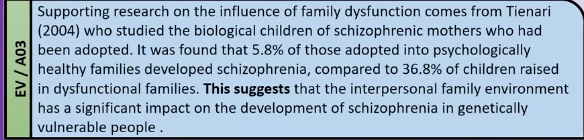
Kavanagh (1992), show that there is a high relapse rate (48% in the case of Kavanagh’s meta-analytical study) for schizophrenic patients who live with high EE families (compared to 21% for those who live with low EE families)
Increased generalisability and statistical power by combining results from a large number of individual studies. And validity
Weaknesses of Psychological explanation
Reductionist: Does not consider the biological explanation
Not empirically backed: SM has no empirical evidence. In double bind theory, it is difficult to differentiate from ordinary, everyday forms of family communication. Development of SM did not use controlled experiments, standardized questionnaires, or objective behavioural observations. Any evidence gathered for this theory relied on retrospective recall.
SM was based on Reichman’s on subjective psychoanalytic explanations
What is the psychological treatment for schizophrenia?
Family Therapy
What is the general aim of family therapy?
Aims to improve communication (expressed emotion) across the family and provides space for all members to share and process their thoughts and feelings through open and honest communication
Makes risk of relapse lower
List 3 strategies used in family therapy to improve family functioning
By improving the family’s ability to anticipate and solve problems
Helping family members balance caring for the individual with maintaining their own lives
Reducing anger and guilt in family members
HAR
Strength of psychological therapies
Family therapy should result in a person with schizo feeling less alone and isolated (Link- Ultimately benefits the economy, reducing reliance on mental health providers and patient may be able to work, meaning fewer days of absence)
Weakness of psychological therapies
CBTp or Family therapy may worsen someones symmptoms if they feel like they are forced to interact with or depend on emotionally destructive people, not everybody is suited to CBT because it may only be suited for those with mild or easily managed symptoms
Reductionist; does not consider biological