Econ 410 final UNC
 Call Kai
 Learn
Learn Practice Test
 Spaced Repetition
 Match
Match Flashcards
 Knowt Play
1/50

Earn XP
Description and Tags
Name | Mastery | Learn | Test | Matching | Spaced | Call with Kai | Chat |
|---|
No analytics yet
Send a link to your students to track their progress
51 Terms
A monopolist produces covid masks at a constant marginal cost of 3 dollars per mask. The demand for vaccinated customers is p1(Q1) = 20−Q1 and the demand for unvaccinated customers is p2(Q2) = 20 − 2Q2.
a) Determine the market demand for masks.
p=20-(2/3)QT
A monopolist produces covid masks at a constant marginal cost of 3 dollars per mask. The demand for vaccinated customers is p1(Q1) = 20−Q1 and the demand for unvaccinated customers is p2(Q2) = 20 − 2Q2.
b) What price should the producer charge to maximize profits?
p=11.5 dollars
A monopolist produces covid masks at a constant marginal cost of 3 dollars per mask. The demand for vaccinated customers is p1(Q1) = 20−Q1 and the demand for unvaccinated customers is p2(Q2) = 20 − 2Q2.
c) Now suppose that the producer uses vaccine cards to third degree price discriminate. What prices should they charge to the two groups to maximize profits?
p1=11.5 dollars p2=11.5 dollars
Consider tennis club with two types of players. Serious players have a demand curve Q1 = 6 − p, where Q1 is court hours per week and p is the court fee in dollars per hour. Occasional players have a demand curve Q2 = 3 − p 2 . You can assume that the marginal cost of court time is zero. In addition to the court fee, the club owner selects the club membership fee T in dollars per week.
a) First suppose that the owner charges a membership fee of 18 dollars per week and a court fee of zero. Which players will join the club? How much weekly profit will the owner get? (Hint: think about consumer surplus).
π=18 per serious player
Consider tennis club with two types of players. Serious players have a demand curve Q1 = 6 − p, where Q1 is court hours per week and p is the court fee in dollars per hour. Occasional players have a demand curve Q2 = 3 − p 2. You can assume that the marginal cost of court time is zero. In addition to the court fee, the club owner selects the club membership fee T in dollars per week.
b) Now suppose that the owner charges a membership fee of 9 dollars per week and a court fee of zero. Which players will join the club? How much weekly profit will the owner get?
Both serious and occasional players join, π=9 per serious player and π=9 per occasional player
Consider tennis club with two types of players. Serious players have a demand curve Q1 = 6 − p, where Q1 is court hours per week and p is the court fee in dollars per hour. Occasional players have a demand curve Q2 = 3 − p 2 . You can assume that the marginal cost of court time is zero. In addition to the court fee, the club owner selects the club membership fee T in dollars per week.
c) Now suppose that the owner raises the court fee to 1.50 dollars per hour. At that price, what is the biggest membership fee the club owner can charge to entice both types of players to join the club. How much weekly profit will the owner get?
π=20.25
Consider three firms that produce homogeneous goods and compete in the same market. The market demand curve is given by P = A − q1 − q2 − q3, where qi is the production of firm i. Each firm has a constant marginal cost of production given by m. Firm 1 is a Stackelberg leader, and firms 2 and 3 are the Cournot followers. In other words, firm one first picks a production level. Given this level, firm 2 and 3 decide on their production level in the traditional Cournot fashion (taking the choice of the other as given). As is the case with Stackelberg, firm 1 takes the subsequent behavior of the other two firms into account when it makes its initial selection.
a) Assume that firm 1 has selected some level of output q1. Determine the Cournot equilbrium for firms 2 and 3. This equilibrium should describe the output choices of firms 2 and 3 in terms of A, m, and q1.
q=(A-q1-m)/3
Consider three firms that produce homogeneous goods and compete in the same market. The market demand curve is given by P = A − q1 − q2 − q3, where qi is the production of firm i. Each firm has a constant marginal cost of production given by m. Firm 1 is a Stackelberg leader, and firms 2 and 3 are the Cournot followers. In other words, firm one first picks a production level. Given this level, firm 2 and 3 decide on their production level in the traditional Cournot fashion (taking the choice of the other as given). As is the case with Stackelberg, firm 1 takes the subsequent behavior of the other two firms into account when it makes its initial selection.
b) Now formulate and solve firm 1’s profit maximization problem.
q1=(A-m)/2
Consider three firms that produce homogeneous goods and compete in the same market. The market demand curve is given by P = A − q1 − q2 − q3, where qi is the production of firm i. Each firm has a constant marginal cost of production given by m. Firm 1 is a Stackelberg leader, and firms 2 and 3 are the Cournot followers. In other words, firm one first picks a production level. Given this level, firm 2 and 3 decide on their production level in the traditional Cournot fashion (taking the choice of the other as given). As is the case with Stackelberg, firm 1 takes the subsequent behavior of the other two firms into account when it makes its initial selection.
c) Use the solutions to part a) and b) to determine the output of firms 2 and 3 (this answer should not depend on q1.)
(A-m)/6
Consider an oil wildcatting problem. If the wildcatter drills, there is a 10 percent chance they find oil and a 90 percent chance the well is dry. If they find oil, they will earn $200,000 selling it on the market. The well costs $10000 to drill. If the wildcatter does not drill, then they will not earn any money.
b) Assuming the wildcatter uses expected values to make decisions, will the wildcatter drill? Explain.
Drill because 10,000>0
Consider an oil wildcatting problem. If the wildcatter drills, there is a 10 percent chance they find oil and a 90 percent chance the well is dry. If they find oil, they will earn $200,000 selling it on the market. The well costs $10000 to drill. If the wildcatter does not drill, then they will not earn any money.
c) Calculate the Expected Value of Perfect Information (EVPI) for the uncertainty about whether the wildcatter will find oil.
EVPI=9,000
Two athletes compete in a contest. Athlete number 1 exerts effort e1 which costs C1(e1). Athlete number 2 exerts effort e2 which costs C2(e2). These costs are not necessarily monetary, but should be accounted for nevertheless. The probability that athlete 1 wins the contest is p = x1 x1+x2 . Exerting more effort makes it more likely that athlete 1 wins, but there is uncertainty due to bad calls, risk of injury, and so on. If athlete 1 wins the contest, they get a prize that they value at V1. The value for athlete 2 of winning is V2. The athletes select effort to maximize the net benefit of participating in the contest
a) Formulate athlete 1’s optimization problem. Determine the first order conditions. Interpret them with respect to marginal benefit and marginal cost of effort.
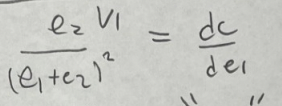
Two athletes compete in a contest. Athlete number 1 exerts effort e1 which costs C1(e1). Athlete number 2 exerts effort e2 which costs C2(e2). These costs are not necessarily monetary, but should be accounted for nevertheless. The probability that athlete 1 wins the contest is p = x1 x1+x2 . Exerting more effort makes it more likely that athlete 1 wins, but there is uncertainty due to bad calls, risk of injury, and so on. If athlete 1 wins the contest, they get a prize that they value at V1. The value for athlete 2 of winning is V2. The athletes select effort to maximize the net benefit of participating in the contest
b) Repeat for athlete 2.
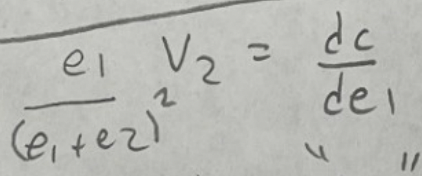
Two athletes compete in a contest. Athlete number 1 exerts effort e1 which costs C1(e1). Athlete number 2 exerts effort e2 which costs C2(e2). These costs are not necessarily monetary, but should be accounted for nevertheless. The probability that athlete 1 wins the contest is p = x1 x1+x2 . Exerting more effort makes it more likely that athlete 1 wins, but there is uncertainty due to bad calls, risk of injury, and so on. If athlete 1 wins the contest, they get a prize that they value at V1. The value for athlete 2 of winning is V2. The athletes select effort to maximize the net benefit of participating in the contest
c) Suppose that C1(e1) = e1 and C2(e2) = e2. Determine the ratio of efforts in the Nash (simultaneous) equilibrium. Is your answer consistent with the notion, sometimes expressed by the losers of a contest, that the other athlete “wanted it more than we did”.
e1/e2=v1/v2
Consider the market for electricity. Firm 1 generates electricity from renewable sources at a marginal cost of 0. Firm 2 generates electricity from coal at a marginal cost of 1. Firm 1 has a capacity of 50 and Firm 2 has a capacity of 100.
b) Let the demand curve be given by P = 2 − Q 50 , and assume the market for electricity is competitive. Find the equilibrium price and quantity.
P=1, Q=50
Consider the market for electricity. Firm 1 generates electricity from renewable sources at a marginal cost of 0. Firm 2 generates electricity from coal at a marginal cost of 1. Firm 1 has a capacity of 50 and Firm 2 has a capacity of 100.
c) Now suppose that the firms act jointly as a monopoly. What is the profit maximizing profit and quantity?
Pπ=1, Qπ=50
Consider a Stackelberg problem with two firms. The demand curve is given by p = 30 − (Q1 + Q2). Firm 1 is the leader and has marginal cost equal to zero. Firm 2 is the follower and has marginal cost equal to 2.
a) Find the reaction function of the follower (i.e. what is Q2(Q1)?)
Q2=(28-Q1)/2
Consider a Stackelberg problem with two firms. The demand curve is given by p = 30 − (Q1 + Q2). Firm 1 is the leader and has marginal cost equal to zero. Firm 2 is the follower and has marginal cost equal to 2.
b) Find the profit maximizing output for the leader.
Q1=16
Consider a Stackelberg problem with two firms. The demand curve is given by p = 30 − (Q1 + Q2). Firm 1 is the leader and has marginal cost equal to zero. Firm 2 is the follower and has marginal cost equal to 2.
c) Find the profit maximizing output for the follower
Q2=6
Consider a firm’s joint choice of price and advertising. The demand for the firms product is given by Q = A − P where A is amount of advertising, P is the price, and Q is the quantity sold. The cost of production is given by is C(Q) = kQ where k is a constant. The cost of advertising is given by 1 8A2 .
a) Set up the firm’s profit maximization problem. The choice variables are A and P.
Max P,A (A-P)P - K(A-P) - (1/8)A²
Consider a firm’s joint choice of price and advertising. The demand for the firms product is given by Q = A − P where A is amount of advertising, P is the price, and Q is the quantity sold. The cost of production is given by is C(Q) = kQ where k is a constant. The cost of advertising is given by 1/8A2 .
b) Take the first order conditions and find the optimal value for A and P.
A=2K, P=3/2K, Q=K/2
Consider a firm’s joint choice of price and advertising. The demand for the firms product is given by Q = A − P where A is amount of advertising, P is the price, and Q is the quantity sold. The cost of production is given by is C(Q) = kQ where k is a constant. The cost of advertising is given by 1 8A2 .
c) Does the “rule of thumb” discussed in class hold in this case? Why or why not?
No, in class cost of advertising was A, but here it is (1/8)A²
Consider a monopolist that owns a pool of oil with X units of oil in it. The costs of producing the oil is zero. The monopolist has a time horizon of two periods. They want to maximize profit given that they use up all the oil in the two periods. The production of oil is Q1 in period 1 and Q2 in period 2. The demand in period 1 is D1(Q1) = a − bQ1 and demand in period 2 is D2(Q2) = a − cQ2, with b > c.
a) Set up the monopolist’s problem as a maximization problem with a constraint.
Max Q1,Q2 (q-bQ1)Q1 + (q-cQ2)Q2 such that Q1+Q2=X
Consider a monopolist that owns a pool of oil with X units of oil in it. The costs of producing the oil is zero. The monopolist has a time horizon of two periods. They want to maximize profit given that they use up all the oil in the two periods. The production of oil is Q1 in period 1 and Q2 in period 2. The demand in period 1 is D1(Q1) = a − bQ1 and demand in period 2 is D2(Q2) = a − cQ2, with b > c.
b) Use the Lagrange multiplier method to solve the problem. Interpret the solution in terms of the marginal revenue in each period. Find the optimal Q1 and Q2 in terms of a, b, c and X
Q2=bx/(b+c), Q1=cx/(b+c)
There are two consumers, a private good, and a public good. Consumer 1’s utility function is U1(x1, G) = V1(G) + x1 and consumer 2’s utility function is U2(x2, G) = V2(G) + x2. Consider the optimization problem maxU1(x1, G) + U2(x2, G) such that x1 + x2 + G = I.
a) Use the Lagrange multiplier method to determine the first order conditions for the optimization problem. What is the value for the Lagrange multiplier λ?
λ=1
There are two consumers, a private good, and a public good. Consumer 1’s utility function is U1(x1, G) = V1(G) + x1 and consumer 2’s utility function is U2(x2, G) = V2(G) + x2. Consider the optimization problem maxU1(x1, G) + U2(x2, G) such that x1 + x2 + G = I.
b) Interpret the first order condition for G in terms of marginal benefit to consumer 1, marginal benefit to consumer 2, and marginal cost
dV1/dG + dV2/dG = λ = i
Sam has the following utility function for money: U(x) = { x − 10, 000, if x ≥ 10, 000 2(x − 10, 000) if x < 10, 000 Sam must choose between the following. Option A, he gets 10,000 for sure. Option B he gets a fifty-fifty chance of 10,003 or 9998.
a) Which option should Sam choose? Explain.
Pick A
Sam has the following utility function for money: U(x) = { x − 10, 000, if x ≥ 10, 000 2(x − 10, 000) if x < 10, 000 Sam must choose between the following. Option A, he gets 10,000 for sure. Option B he gets a fifty-fifty chance of 10,003 or 9998.
b) Now suppose we add 100 to each possibility. (Option A pays 10,100, Option B is fifty-fifty for 10,103 or 10,098). Which option should Sam choose? Explain.
Pick B
Sam has the following utility function for money: U(x) = { x − 10, 000, if x ≥ 10, 000 2(x − 10, 000) if x < 10, 000 Sam must choose between the following. Option A, he gets 10,000 for sure. Option B he gets a fifty-fifty chance of 10,003 or 9998.
c) What is the risk premium for the uncertain deal in part a)? What is the risk premium for the uncertain deal in part b)?
Part A RP=0.75, Part B RP=0
Firm 1 has cost function C1(q1) = 2q 2 1 . Firm 2 has cost function C2(q2) = q 2 2 . Demand is given by p = 24 − (q1 + q2).
a) Find the Cournot (simultaneous) equilibrium (specify the quantity produced by both firms).
q2=5.21, q1=3.16
Firm 1 has cost function C1(q1) = 2q 2 1 . Firm 2 has cost function C2(q2) = q 2 2 . Demand is given by p = 24 − (q1 + q2).
b) Find the Stackelberg (sequential) equilibrium (specify the quantity produced by both firms). Firm 2 is the leader.
q2=5.45, q1=3.04
Firm 1 has cost function C1(q1) = 2q 2 1 . Firm 2 has cost function C2(q2) = q 2 2 . Demand is given by p = 24 − (q1 + q2).
c) Find the collusion (joint profit maximizing) equilibrium (specify the quantity produced by both firms when they collude).
q2=4.8, q1=2.4
The demand curve for UNC is given by P(Q) = 100, 000 − Q where Q is the number of students. The marginal cost of educating an additional student is 10, 000.
a) Suppose UNC acts as a traditional monopolist. What price does it charge? How many students attend?
Q=45,000, P=55,000
The demand curve for UNC is given by P(Q) = 100, 000 − Q where Q is the number of students. The marginal cost of educating an additional student is 10, 000.
b) Suppose that UNC can conduct perfect first-degree price discrimination through the use of financial aid forms, scholarships, and a sticker price of $100,000. How many students attend? How much total financial aid does it give out?
90,000 students attend, 4.05 ×10^9 financial aid given
The demand curve for UNC is given by P(Q) = 100, 000 − Q where Q is the number of students. The marginal cost of educating an additional student is 10, 000.
c) Determine the change in CS and PS when we move from a) to b).
ΔCS = -1.0125 ×10^9
ΔPS = 2.025 ×10^9
A simple model of a fishery has the firm exerting fishing effort E to maximize profit. The harvest-effort curve h(E) denotes the harvest (how many fish are caught) as a function of effort. Each unit of effort costs v dollars, so that the cost of effort is given by C(E) = vE.
a) What is the marginal cost of effort?
MCE=V
A simple model of a fishery has the firm exerting fishing effort E to maximize profit. The harvest-effort curve h(E) denotes the harvest (how many fish are caught) as a function of effort. Each unit of effort costs v dollars, so that the cost of effort is given by C(E) = vE.
b) Suppose that the fishery is a price-taker and the market price of fish is p. Formulate the firm’s profit maximizing optimization problem (the choice variable is E). Determine the FOC for this problem.
Max E ph(E) - VE
FOC P(dh/dE)-V=0
A simple model of a fishery has the firm exerting fishing effort E to maximize profit. The harvest-effort curve h(E) denotes the harvest (how many fish are caught) as a function of effort. Each unit of effort costs v dollars, so that the cost of effort is given by C(E) = vE.
c) Suppose that the fishery is a monopolist facing a demand curve p(h). Formulate the firm’s profit maximizing optimization problem (the choice variable is again E). Determine the FOC for this problem
Max E ph(E)h(E) - VE
FOC dp/dh dh/de h(e) + p(h(e)) dh/de -v =0
Consider the decision by a consumer about how much insurance coverage to purchase. The probability of an accident, θ, is equal to 0.1. The loss if there is an accident, L, is equal to 500. We have p is the premium per unit of coverage and c is the amount of coverage. The consumer’s utility function is U(x) = (1 − e −x/100).
a) Formulate the consumers problem. The choice variable is c.
Max C φ U(-L+C-Pc) + (1-φ) U(-PC)
Consider the decision by a consumer about how much insurance coverage to purchase. The probability of an accident, θ, is equal to 0.1. The loss if there is an accident, L, is equal to 500. We have p is the premium per unit of coverage and c is the amount of coverage. The consumer’s utility function is U(x) = (1 − e −x/100).
b) Determine the first order condition for c. This expression should contain c and p. Solve the equation for c as a function of p. Hint: e x+y = e x e y .
500-100 ln(.9p/.1(1-p))
Consider the decision by a consumer about how much insurance coverage to purchase. The probability of an accident, θ, is equal to 0.1. The loss if there is an accident, L, is equal to 500. We have p is the premium per unit of coverage and c is the amount of coverage. The consumer’s utility function is U(x) = (1 − e −x/100).
c) If p = 0.1, how much coverage will the consumer buy?
500
Two ice cream vendors set up shop on a beach. Customers are uniformly distributed across the entire length of the beach (everyone likes ice cream) and they will buy ice cream from the vendor that is closest to their position on the beach. You can think of the beach as a straight line with length 1 and the customers are at different points on the line. Initially we assume the vendors simultaneously decide where to locate their shops. The shop location is a point on the straight line. For example, if vendor A locates their shop at location 0 (the left edge of the beach) and vendor B locates their shop at location 1 (the right edge of the beach), then everyone from location [0,1/2] will go to shop A and everyone from location [1/2,0] will go to shop B. Thus each ice cream shop will have 1/2 market share. The vendors can’t locate at exactly the same position, but they can be right next to each other with essentially no space between them.
a) Is the case in which vendor A is at 0 and vendor B is at 1 a Nash Equilibrium? Explain
No, A has an incentive to switch
Two ice cream vendors set up shop on a beach. Customers are uniformly distributed across the entire length of the beach (everyone likes ice cream) and they will buy ice cream from the vendor that is closest to their position on the beach. You can think of the beach as a straight line with length 1 and the customers are at different points on the line. Initially we assume the vendors simultaneously decide where to locate their shops. The shop location is a point on the straight line. For example, if vendor A locates their shop at location 0 (the left edge of the beach) and vendor B locates their shop at location 1 (the right edge of the beach), then everyone from location [0,1/2] will go to shop A and everyone from location [1/2,0] will go to shop B. Thus each ice cream shop will have 1/2 market share. The vendors can’t locate at exactly the same position, but they can be right next to each other with essentially no space between them.
b) Find the Nash equilibrium. Hint: think about the locations of car dealerships in your town.
A=B=1/2
Two ice cream vendors set up shop on a beach. Customers are uniformly distributed across the entire length of the beach (everyone likes ice cream) and they will buy ice cream from the vendor that is closest to their position on the beach. You can think of the beach as a straight line with length 1 and the customers are at different points on the line. Initially we assume the vendors simultaneously decide where to locate their shops. The shop location is a point on the straight line. For example, if vendor A locates their shop at location 0 (the left edge of the beach) and vendor B locates their shop at location 1 (the right edge of the beach), then everyone from location [0,1/2] will go to shop A and everyone from location [1/2,0] will go to shop B. Thus each ice cream shop will have 1/2 market share. The vendors can’t locate at exactly the same position, but they can be right next to each other with essentially no space between them.
c) Now suppose that the beach is a one-way street. Customers can go to a shop to the right of their position, but they can’t go to a shop to the left of their position. If more than one shop is to the right, they will go to the closest one. Find the Stackelberg equilibrium (sequential solution). Here vendor A picks their location first, but takes into account of how vendor B will behave, given vendor A’s choice.
Neither will change if
A at 1/2, B enters at 1, A gets ½ Market share
Suppose that person 1 has a demand for good x given by P = a − bQ and person 2 has a demand for good x given by P = c − bQ. Assume that a > c.
b) Assume that the good is a private good. Determine the aggregate (market) demand for the good. Sketch a picture of all three demand curves.
Q1+Q2= {
(q+c)/b -(2p)/b P<C
q/b - p/b P>C
Suppose that person 1 has a demand for good x given by P = a − bQ and person 2 has a demand for good x given by P = c − bQ. Assume that a > c.
c) Now assume that the good is a public good. Determine the aggregate (market) demand for the good. Sketch a picture of all three demand curves.
P1+P2= {
q+c-2bQ Q< C/B
q-bQ Q> C/B
In class the first day, we talked about penalty kicks in the game of soccer. In this game, the goalie has three possible strategies (Left, Middle, Right) and the kicker has three strategies (Left, Middle, Right). The table below shows the percent of successful penalty kicks from 1997-2000 in France and Italy as a function of these strategies. For example, when the kicker chooses Middle and the Goalie chooses left then 81 percent of the kicks were successful. The kicker wants to maximize the chance of a goal and the goalie wants to minimize the chance of a goal.
a) If the kicker selects the Left strategy, what is the best response of the goalie?
Left
In class the first day, we talked about penalty kicks in the game of soccer. In this game, the goalie has three possible strategies (Left, Middle, Right) and the kicker has three strategies (Left, Middle, Right). The table below shows the percent of successful penalty kicks from 1997-2000 in France and Italy as a function of these strategies. For example, when the kicker chooses Middle and the Goalie chooses left then 81 percent of the kicks were successful. The kicker wants to maximize the chance of a goal and the goalie wants to minimize the chance of a goal.
c) Is there a Nash equilibrium? Explain why or why not.
No, For any pair of choices at lease one player has incentive to switch
Consider Cournot competition between two firms, firm 1 and firm 2. Each firm produces output from labor and capital with the production function q = L 1/2K1/2 . You may assume capital is fixed at 1 unit for firm 1 and fixed at 2 units for firm 2. The price of labor and capital are both equal to 1. The demand curve is given by p = 100 − (q1 + q2) where q1 is the output of firm 1 and q2 is the output of firm 2.
a) Determine the cost function for firm 1 (what is the cost of producing q1 units of output?) Determine the cost function for firm 2.
C1(q1)= q1²/k1 + k1= q1²+1
C2(q2)= q2²/k2 + k2= (q2²/2) +2
Consider Cournot competition between two firms, firm 1 and firm 2. Each firm produces output from labor and capital with the production function q = L 1/2K1/2 . You may assume capital is fixed at 1 unit for firm 1 and fixed at 2 units for firm 2. The price of labor and capital are both equal to 1. The demand curve is given by p = 100 − (q1 + q2) where q1 is the output of firm 1 and q2 is the output of firm 2.
b) Formulate the profit maximizing problem for Firm 1 and Firm 2. Be sure to identify the choice variables and the objective function.
Max q1 (100-(q1+q2))q1-(q1²+1)
max q2 (100-(q1+q2))q2-(q2²/2)+1
Consider Cournot competition between two firms, firm 1 and firm 2. Each firm produces output from labor and capital with the production function q = L 1/2K1/2 . You may assume capital is fixed at 1 unit for firm 1 and fixed at 2 units for firm 2. The price of labor and capital are both equal to 1. The demand curve is given by p = 100 − (q1 + q2) where q1 is the output of firm 1 and q2 is the output of firm 2.
c) Find the Cournot equilbrium.
q2= 27.27
q1= 18.19