Phonology
 Call Kai
 Learn
 Practice Test
 Spaced Repetition
 Match
 Flashcards
 Knowt Play
1/61

There's no tags or description
Looks like no tags are added yet.
62 Terms
Why is phonetics not enough / what doesnt it tell us?
phonetics allows us to describe the sounds we are saying/hearing and explain how we are saying/hearing them
Phonetics doesnt tell us whether any given sound or combination of sounds is meaningfuo
It also doesn’t tell us how sounds pattern together in a given language -e.g. why do some sounds occur in some places but not others
what is the speech signal
continuous and rich in both information and variability
each time we produce a sound its not quite physically the same
what is categorisation
some differences in sound production matter and some dont
as listeners we seem to abstract away from the differences that dont matter - we impose structure
languages categorize different portions of this space differently (carved up differently)
what are we studying when we study phonology
studies higher level, abstract patterns of a language’s sound system, conceived in terms of discrete mental symbols
in contrast, phonetics studies how those mental symbols are manifested as continuous musuclar contractions and acoustic waveforms and how such waveforms are perceived as the discrete symbols that grammar acts upon
What is the implicit knowledge that phonology investigates
what are the sounds in a language (which differences are meaningful and which arent - what are the phoneme inventories)
the distribution/patterns of sounds (phonotactics)
how words/morphemes can be pronounced in different ways depending on context (phonological alternations)
what are phonotactic constraints
language specific limitations on the distribution of sounds and sound sequences at various points in a word
Captured through native speaker intuitions about possible vs impossible sound sequences
why are /p/ and /b/ two different categories of sounds (in english)
because substituting one for the other in a word, in the same position, changes meaning
what does it mean if we find a minimal pair
tells us that the two sounds that are different between the pairs are contrastive (can change the meaning of the word)
they are in contrastive distribution and therefore belong to different categories
They are different phonemes
what is a phoneme?
the minimal unit of contrast
changing a sound changes the meaning of a word
these are abstract mental categories - they exist in our mind
we write phonemes in / /
what are allophones
different physical realisations of the phoneme category
do not change meaning
phonemic/broad transcription vs phonetic/narrow transcription
phonemic transcription is in slashes and tries to capture only the crucial contrastive categories
Phonetic transcription is in square brackets and captures the phonetic, allophonic dtails including speech processes
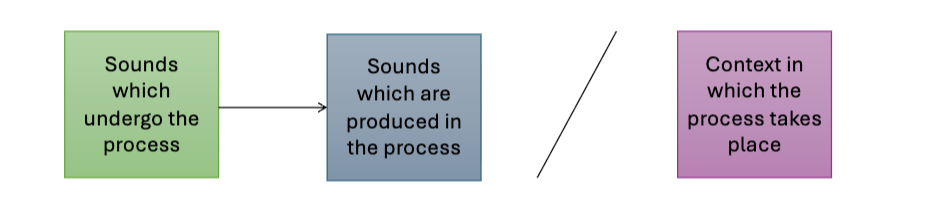
What is a phonological rule
the rule which transforms a word from its phonemic representation to an allophonic (phonetic) representation
How do you notate/represent phonological rules
X becomes Y in some context Z
We have an underlying representation/form (UR)
A surface representation/form (SR)
And phonological rules or constraints that act to derive the latter from the former
What is complementary distribution
when two sounds occur in differnt environments
evidence that these sounds are likely allophones of the same phoneme
(also requires phonetic similarity in order to be allophones)
What are near-minimal pairs
not all languages have a minimal pair for all of their phonemes
near minimal pairs or the fact that particular sounds occur in the same environments
Which allophone do you use as the phoneme label
the phone with the widest distribution as the symbol for the phoneme
the one that occurs in the most different types of environments and is therefore the least predictable
the ‘elsewhere’ phoneme
how would you notate the fact that p is aspirated at the start of a word
/p/ → [p^h] / #__
How is a derivation table structured
example words along the top
then underlying representation (phonological)
then phonological rule(s) e.g. aspiration
then Surface representation (phonetic)

What are natural classes
larger groupings of sounds by manner, place or voicing
e.g. all high vowels
or all low back vowels
how can consonants be grouped by voicing
voiced or voiceless
how can consonants be grouped by manner
obstruents
sonorants
Continuants
non-continuants
Approximants
What are obstruents
stops, affricates and fricatives
what are sonorants
nasals, approximants
what are continuants
fricatives and approximants
what are non-continuants
nasal and oral stops and affricates
what are approximants
liquids [l] and [ɹ] as well as glides [w] and [j]
how can consonants be grouped by place
labials
coronals
dorsals
glottals
what are labials
bilabials
labiodentals
what are coronals
dental
alveolar
postalveolar
(palatal)
what are dorsals
(palatal)
velar
uvular
why dont we used the phonetic features that already exist
phonological distinctive features allow for broader generalisations
e.g. if voiced stops and voiced fricatives become voiceless in a certain environment we can say that voiced OBSTRUENTS become voicless at the end of the word
how are phonological features represented in a matrix
features are binary
a segment is assigned a positive (+) or negative (-) value for each feature of its structure
what is feature theory
a theory that aims to provide a universal set of features that should be able to account for the contrasts between segments in all languages of the world
a language normally only uses a subset of the available features in the organisation of its phoneme inventory and languages differ in which features they select
what are the roots of feature theory
has its roots in structuralism
all linguistic objects are defined by their opposition to other objects in the system
Jakobson argued featural oppositions should be binary, every set of features is universal and that every feature should be unambiguously defined in both articultory and acoustic terms
what are the different types of features
laryngeal features
place features
major class features
tongue-body and lip features
manner features
what are the laryngeal features
Grouping consonants by voicing
[+voice] (vocal folds are vibrating)
[-voice] (vocal folds are not vibrating)
[± spread glottis]
[± constricted glottis]
what does [± spread glottis] determine
whether vocal folds are spread wide apart (although maybe not as wide as in breathing)
if not touching at all then you get [h] and aspirated consonants
if back end of folds are vibrating but front end is spread apart then you get breathy voice sounds
what does [± constricted glottis] determine
whether vocal folds are pressed together
if vocal folds are completely closed then you get glottal stop or ejectives
if vocal folds are pressed together but not enough to prevent vibration entirely then you get creaky voice sounds
how can features for manner and sonority be organised
on a scale from most to least open - the sonority scale

what are the major class features
[± syllabic]
[± consonantal]
[± approximant]
[± sonorant]
[± continuant]
[+ delayed release]
[+ nasal]
[+ lateral]
What does [± consonantal] mean
[+ cons]: complete closure, or close approximation
[- cons]: vowels and glides
what does [± approximant] mean
distinguisges vowels, glides and liquids from other consonants
what does [± sonorant] mean
[+son]: show clear formant pattern e.g. vowels, liquids, nasals, glides
[- son]: do not show clear formant pattern e.g. plosives, fricatives, affricates (i.e. obstruents)
What does [± continuant] mean
distinguishes stops from fricatives
[+ continuant]: airflow through oral cavity is not blocked
[- continuant]: airflow through oral cavity is blocked
what does [+ delayed release] mean
distinguishes affricates and fricatives from stops
what is the sonorant scale with the features shown as well

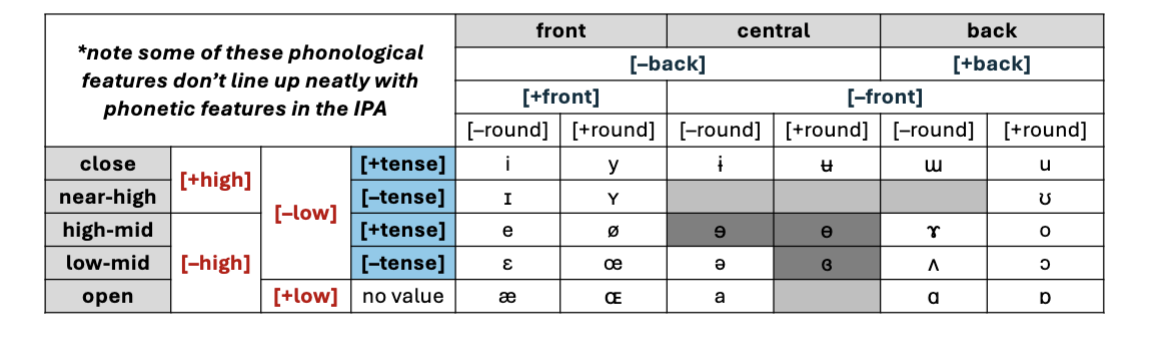
how are the vowel features divided up
two binary features form scales with three levels
frontness/backness: front/central/back
Height: high/mid/low
Can also be further distinguished by lip rounding and tense
what is the table for vowel features
what is tense?
the distintion between upper and lower high and mid
not sure what it is articulatorily
In english tense is a useful feature because only the [+ tense] vowels can occur at the end of a word (or before another vowel)
what is ATR
[± ATR] (Advanced Tongue Root)
Produced with greater muscular tension and/or the tongue root pushed forward
Used to distinguish higher and lower vowels within the general high and mid ranges sometimes instead of [± tense]
what are the 3 major classes of consonantd (in terms of place)
[+ labial]: active articulator is lip(s)
[+ coronal]: active articulator is tongue tip or blade
[+ dorsal]: active articulator is tongue body
what are the distinctions within the labials
just [± labiodental]
what are the distinctions within the coronals
[+ anterior]: passive articulator is alveolar ridge or further forward
[- anterior]: passive articulator is behind alveolar ridge
[+ distributed]: active articulator is tongue blade
[- distributed]: active articulator is tongue tip
[+ strident]: sibilant sounds such as [s, z, ts, dz, etc]
[lateral]: distinguishes /l/ from other coronal liquids/fricatives
what is the table for coronal features

what are the distinctions within dorsals
distinguished using the same features as vowels: advancement and height
Most of the time [+dorsal] is all that is required
what is the table for dorsals

binary vs unary features
many more recent versions of feature theory use unary rather than binary place features
the active articulator is specified by presence only of usually one of five features: labial, coronal, dorsol, radical, laryngeal