BIOL105 Lecture #6 (10/13/26)
 Call Kai
 Learn
Learn Practice Test
 Spaced Repetition
 Match
Match Flashcards
 Knowt Play
1/106

There's no tags or description
Looks like no tags are added yet.
Name | Mastery | Learn | Test | Matching | Spaced | Call with Kai | Chat |
|---|
No analytics yet
Send a link to your students to track their progress
107 Terms
What is one major thing we do with phylogenies?
Use it to study adaptation
What is an adaptation>
a feature which has evolved via natural selection because it enhances Darwinian fitness in a given environment
Aside from asking “What is adaptation?” What can we also ask?
How do we separate adaptations from other causes of trait variation, covariation, and evolution
What is Darwinian fitness? (think: fitness)
the ability of organisms to survive and/or reproduce (lifetime reproductive success)
What problem does the beaver example raise about calling long incisors an adaptation
(is that an adaptation for this species or…)
All rodents have long incisors, not just beavers, so how can we say it’s an adaptation of beaver specifically
What problem does the owl example raise about calling talons an adaptation of owls
(is that an adaptation for this species or…)
Talons may not be unique to owls - other major groups also have talons, so it’s unclear whether talons are truly an adaptation of owls specifically
What the two possible explanations for talons in owls, hawks, and falcons
1. Owls may have independently evolved talons as they’re not a sister group of hawks or falcons
2. Talons may be ancestral to these three groups, and they were lost in other species
Under which explanation would talons be considered an adaptation of owls?
Only if owls independently evolved talons — that is, if talons evolved separately in owls and were not simply inherited from a common ancestor
(if from common ancestor, then it’s an adaptation for the group and not for the owl)
What does the definition of adaptation exclude?
features that evolved from sexual selection such as the tails of male peacocks
What is adaptation defined as a process?
a process of genetic change within a population, because of natural selection, by which the average value of a character becomes improved with respect to a specific function
In other words, what do organisms evolve to become better at doing? (simplified process definition for adaptation")
particular things such as resisting the cold, finding food, avoiding predation
Adaptation can be perceived at various levels, from gene to population. What are the five levels of selection listed? (adapt levels = GIGIK) (gigs i know)
1. Gene selection
2. Individual (natural) selection
3. Group selection
4. Kin selection
5. Intragenomic selection
How do physiologists and behavioral biologists use the word “adaptation” differently? (physio = pheno)
They use it to mean an individual’s phenotypic adjustment to environmental conditions occurring during its lifetime (ontogeny)
What are examples of physiological adaptation
acclimation or acclimatization,
physical conditioning (learning, sensitization, habituation, “recalibration” of reward system, addiction)
What are some examples of physical conditioning which is an example of a physiological adaptation? (x → physical conditioning → physiological adaptation)
learning, sensitization, habituation, “recalibration” of reward system, addiction
Why do individuals not evolve?
no change in DNA sequence within an individual is passed on to their offspring (what they are born with is what they pass on)
What can modify the genetic material of an individual, including within its gametes?
epigenetic mechanisms
What are some examples of epigenetic mechanisms (used to modify genetic material of individual including its gametes)
DNA methylation,
histone modification
How long can epigenetic effects last (how long can they effect offspring?)
more than one generation
What is phenotypic plasticity, and is it itself adaptive?
The ability to physiologically adapt to changing conditions; Yes, it is itself adaptive in the evolutionary sense
Does the extent of phenotypic plasticity vary?
Yes; it varies among organisms
What specifically varies in plasticity in organims?
Traits
Which is more plastic —muscle or the lung?
muscle
How common is evolutionary adaptation, and why?
Very common. (natural) Selection is always occurring, and always has occurred, so all aspects of phenotype are constantly evolving towards state of better adaptation
What is the main exception to the common-ness of evolutionary adaptation?
No genetic variation. (selection can’t occur if there is no genetic variation)
Since Darwin, what has natural selection been seen as?
Most major directive force in evolution
Why has it been that, since Darwin, natural selection has been seen as the “major directive force of evolution”
because adaptive evolution by natural selection seems to be inevitable
What three conditions make adaptations expected to be exceedingly common? (think adap = me = VT)
1. phenotypic variation is always present (phenotypic var → ns → adap)
2. this variation often affects reproductive (Darwinian) fitness or at least correlates with it
3. most traits are heritable in narrow sense
What does the third aspect that makes adaptations common: “most traits are heritable in the narrow sense” mean?
have additive genetic variance
Where do many spectacular examples of adaptations come from?
extreme environments
What is the point of comparing an average bear (grizzly) with a polar bear?
Polar bears seem to be adapted for life in the snow and ice —
example of adaptation to an extreme environment
What is the point of comparing an average fox with an arctic fox?
another example of adaptation to an extreme environment
What useful product came from the thermophilic bacteria
DNA polymerase enzymes, which led to the development of polymerase chain reaction PCR
DNA → PCR
What are three examples of alkaloids from plants that are used as drugs and medicines?
altropine, cocaine, nicotine
What is the problem with assuming a priori that all features of organisms are adaptive?
It is contrary to the usual way of doing science. (It assumes the conclusion and just asks how a trait is adaptive, instead of testing whether it is)
(guilty until proven innocent rather than correct: innocent until proven guilty)
In the usual way of doing science, what is the null hypothesis vs. the alternative hypothesis for a trait (think null = bull = bs where b is first)
null hypothesis = any given trait is NOT an adaptation
alternative hyp = a trait IS an adaptation
Where should the burden of proof be?
on demonstrating adaptation
(determine if it is an adaptation rather than assuming)
In addition to natural selection, what are the three main factors that affect phenotypic evolution? (pe = riss = rizz)
1. random mutation and genetic drift
2. immigration/emigration and gene flow
3. sexual selection
How do these other factors relate to natural selection
random mutation and genetic drift = works against natural selection ½ time
immigration / emigration (gene flow) = works against n/s half the time
sexual selection = will often work against natural selection (sx always working against me)
At some points in evolutionary history, what may variation in some aspects of the phenotype be?
neutral
What example does the lecture give of a trait that may be neutral?
amount of hair on the back of your fingers
How should selection and adaptation be considered?
innocent until proven guilty; not guilty until proven innocent
What is often not easy to understand about complex adaptations?
Exactly how they come about
What are three things involved in demonstrating adaptation?
1. specifying the selective agent or agents that favor a trait (what specific thing in the environment is causing the selection)
2. showing trait has evolved via this putative natural selection (prefered separately)
3. elucidating the components of and sequence of steps to the final complex adaptive state
(meaning: show intermediate steps to get to adaptation)
What question does the eye example illustrate about complex adaptations?
What good is half an eye? (how can a complex adaptation evolve through intermediate steps)

What do the stages of eye complexity in mollusks suggest about how evolution proceeded?
Evolution may have proceeded in steps, with each intermediate stage being used for something
What is a preadaptation?
Possession of the necessary properties to permit a shift into a new ecological niche or habitat
(already having what it takes to survive in a new place)
When is a structure preadapted for a new function?
if it can assume that function without evolutionary modification (it can do the new function in the new environment without any changes)
What is the difference between adaptation and pre-adaptation?
An adaptation is when you have a trait that comes from natural selection and it improves the darwinian fitness in a specific location, and a preadaptation is when this happens but the organism that already has this trait can use it to survive in a separate environment
Why do some biologists dislike the term “preadaptation”?
it seems teleological (the fish evolved lungs in order to eventually walk on land)
What were lobe-finned fishes preadapted for?
Walking on land
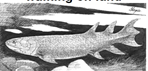
What is the name of the Denovian (360 mya) lobe-finned fish?
Eusthenopteron
What is the name of the extant lobe-finned fish shown, and what is it often called
Lamiteria chalumnae (the coelacanth), often considered a “"living fossil.”
What three features made “reptiles” preadapted for arid conditions?
(LPC - lizard preadapted arid/air conditions)
1. low evaporative water loss because of impermeable skin and low metabolic rate
2. produce uric acid
3. cleidoic (amniotic) eggs can be laid away from water
What is the kea, and what does it now sometimes do?
1 of 10 parrots endemic to New Zealand; uses its beak to rip through the skin of sheep and feed on fat, sometimes while they are alive
What are parrots in general morphologically preadapted for, and what do they generally lack?
carnivory (meat eating); lack predatory behavior
What three characteristics do coelurosaurs share with birds, and what are they considered?
1. Hollow bones
2. Fused clavicles (“wishbone”)
3. Strong forelimbs
Synapomorphies (shared derived traits) with birds and preadaptations for flight
Why do some researchers dislike the term “preadaptation,” and what term do they suggest instead?
too teological; exaptation
(a trait that evolved for a function but later-co-opted for a diff function
What is teleology?
The explanation of phenomena in terms of the purpose they serve rather than the cause by which they arise
(explaining something by its purpose or end goal, as if evolution planned ahead)
(the fish evolved lungs in order to eventually walk on land)
Even if disliked, what is the value of the term “preadaptation"?
it is often a useful heuristic
How many approaches are there to studying adaptation?
Four
What is an easy way to memorize the four approaches to studying adaptation?
1. Comparison of species
2. Biology of natural populations (natural → selection) (2 things previously so can run an experiment, and natural selection → evolution → exp evol)
3. Selection experiments and experimental evolution
4. Comparison of real organisms with predictions of theoretical models
(revert back to first one, kevin in the office dropped the pot, ROWPOT but now ROWPOT)
What is the first general approach to studying adaptation, and what does it show?
Comparisons of species (or populations)
What does the first approach to studying adaptation show?
shows what happened in past evolution
What is the second general approach to studying adaptation
biology of natural populations
What does the second approach to studying adaptation show?
present evolution in action
What does the second approach to adaptation (biology of natural populations) focus on?
Extent of individual variation (repeatability),
heritability, genetic correlation, natural and sexual selection, field manipulations, and introductions
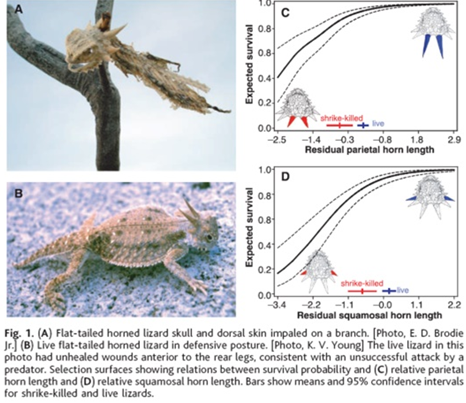
What did the horned lizards study demonstrate?
ongoing natural selection in action in one population of Phrynosoma mcallili, caused by predation by loggerhead shrikes

What was the selective agent, and which lizards were favored?
The selective agent was predation by loggerhead shrikes. Lizards with longer horns were favored as shrikes tended to kill lizards with shorter horns.
What is the third general approach to studying adaptation, and what does it show?
selection experiments and evolution
What does the third approach to studying adaptation show?
shows, experimentally, what might happen during future evolution
What is the fourth general approach to studying adaptation, and what does it show?
Comparison of real organisms with predictions of theoretical models
What does the fourth approach to studying adaptation show?
Shows how close selection can get to producing optimal solutions
What is an example of the fourth general approach to studying adaptation (comparing real organisms to predictions of theoretical models)
Aerodynamic optimality models of bird wings
What is the first step in the comparative method analysis (comparison of species)
Obtain phylogeny from independent source
What is the second step in the comparative method analysis (comparison fo species)
Obtain data on one or more phenotypic traits of interest (e.g. body size, social system, home range area, geographic distribution).
Can Steps 1 and 2 be reversed in the comparative method analysis (comparison of species)
Yes
What is an easy way to remember the 4 steps of the comparative method (comparison of species) as a way of studying adaptation?
1. Obtain phylogeny
2. Select phenotypic trait (steps 1 and 2 can be reversed)
3. Map phenotypic trait onto phylogenetic tree using maximum parsimony to see how many changes and where on the tree
4. Use statistical methods that incorporate phylogenetic information in order to compare species and/or traits
What are the final 2 steps in the comparative method analysis (comparison of species)
Map traits onto tree using maximum parsimony (or other method) to infer how many changes have occurred and where on the tree
Use statistical methods that incorporate phylogenetic information to compare species and/or traits
What is special about the last 2 steps of the comparative method analysis (comparison of species?)
You can do either one. Some studies do both.
What is an easy way to remember what I need to know about comparative method (comparison of species)?
Comparative = which species am I comparing = which of the 3 sampling schemes
Method = steps = steps 1, 2, 3a, 3b
What is the first sampling scheme for comparing species, and it adequate? (comparative method)
Do two species differ in the predicted direction?; No
What is the second sampling scheme for comparing species, and it adequate? (comparative method)
Do multiple sets of species pairs differ in predicted direction
(multiple pairs = multiple sets of 2 species)
Is the second sampling scheme for comparing species adequate?
Generally acceptable but does not make full use of the available data
What is the third sampling scheme for comparing species, and it adequate? (comparative method)
Does the expected relationship hold across many species?
(many years = expected to have relationship and hold across)
Is the third sampling scheme for comparing species adequate?
This requires phylogenetically informed statistical methods

What is a question that the physiologists comparing in this example
What are respiratory adaptations to living in burrows, where O2 levels can be low and CO2 levels can be high?
Which two species did they compare, and what made them suitable for comparison?
burrowing owls vs. bobwhite quail (they are roughly the same size)
Why is two-species comparison considered “ambiguous”?
Because any differences might be attributable to many factors other than burrowing, so you can’t tell which is responsible.
What are the five possible explanations for any differences between the owl and the quail?
1. Adaptations to a burrowing habit (owl)
2. Partial domestication (quail)
3. Nocturnality (owl) vs. diurnality (quail)
4. Carnivory (owl) vs. herbivory (quail)
5. any other aspects of “owlness” or quailness” -- shared derived features (synapomorphies) of the owl clade or the quail clade.
What is the first two possible explanations for any differences between the owl and quail
(2 species for sampling scheme → comparative method / comparing species → way of studying adaptation)
adaptation to a burrowing habit (owl)
partial domestication (quail)
What is the second two possible explanations for any differences between the owl and quail
nocturnality (owl) vs. diurnality (quail) (partial both)
carnivory (owl) vs. (herbivory (quail(
What is the last possible explanation for any differences between the owl and quail
any other aspect of “owlness” or “quailness” (i.e., shared derived features (synapomorphies) of the owl clade or the quail clade).
What is the first limitation of two-species comparative studies?
Independent variable is confounded with species (lineage membership)
What is an easy way to remember the first limitation of two-species comparative studies?
The independent variable = the thing you’re testing (burrowing vs. not burrowing)
The “burrowing” (indp variable) and “owlness” (species) are confounded, they’re tangled together. You can’t separate the effect of burrowing from the effect of all the other owl traits
What is an easy way to understand the first limitation of two-species comparative studies? (extra)
So the independent variable and species are confounded meaning that the burrowing and the owlness are confounded which makes it hard to separate the difference we are studying from other differences between the species that may be affecting the difference of interest that we are studying)
(YOU CANNOT SEPARATE THE DIFFERENCE YOU’RE STUDYING FROM ALL THE OHTER DIFFERENCES THAT COULD ALSO BE CAUSING THE TRAIT)
What is the second limitation of two-species comparative studies?
Species will almost always differ
Why might speciation itself cause differences between two species (two-species comparative studies)
The relationship between speciation and phenotypic evolution is poorly understood, but the process of speciation itself may result in genetic differentiation that affects various phenotypic traits
(think rip = reproductive isolation → phenotypic traits —> )
think us = differences between two species
think last day was gd = good day = genetic differentation) good day happen b4
Even with no other differences, why would two species differ? (two-species comparative studies)
Because the two species have experienced little or no genetic exchange since their evolutionary divergence, so at a minimum, they will have diverged somewhat by random genetic drift alone
(little genetic exchange since diverged so random genetic drift is enough to show that species will almost always differ)
What else will two species (or their ancestors) have experienced that causes differences?
different environmental conditions