CHM 260: The 12 Core Organic Chemistry Reactions
 Call Kai
 Learn
 Practice Test
 Spaced Repetition
 Match
 Flashcards
 Knowt Play
1/11

Earn XP
Description and Tags
Vocabulary flashcards covering the 12 core organic chemistry reactions, including reaction definitions and structural drawing blueprints.
12 Terms
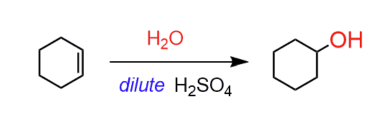
Hydration
Alkene —> Alcohol
The double bond is broken, an -H is added to one carbon, and an -OH is added to the other carbon, favoring the more substituted carbon for -OH.
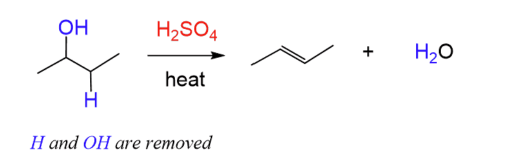
Dehydration
Alcohol —> Alkene
The -OH group and an -H from an adjacent carbon are removed, and a double bond is added between those two carbons.
Hydrogenation
Alkene/Alkyne —> Alkane
The double or triple bond is broken completely to a single bond, and H atoms are added to fill the empty valences.

Dehydrogenation
Alkane —> Alkene
Two hydrogen atoms are removed from adjacent carbons, and a double bond is added between them.
Carboxylation
A reaction that adds a CO2 group to a molecule. A -COOH (or −COO−) group is attached directly to a carbon atom, extending the molecule.
Decarboxylation
A reaction in which a molecule loses a CO2 group. The entire -COOH group is cut off the molecule and replaced with a single hydrogen atom (-H) on that carbon.

Hydrolysis
A reaction that cleaves a bond using H2O.
The single bond holding an ester, amide, or ether together is broken; -OH from water is added to the carbonyl/alkyl carbon, and -H is added to the leaving group (O or N).

Acid-Base Neutralization
A reaction where an acid and a base react to form a salt and water (Acid+Base→Salt+H2O). In carboxylic acids, H+ is removed from -COOH to form a negative −COO− ion; in amines, H+ is added to the nitrogen lone pair to form a positive −NH+ ion.
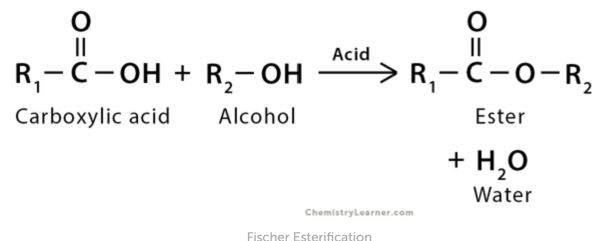
Esterification
Carboxylic Acid+Alcohol→Ester). The -OH from the acid and the -H from the alcohol's -OH are removed, connecting the remaining carbonyl carbon directly to the alcohol's oxygen (C-O-C).
Oxidation
A reaction characterized by an increase in C-O bonds and/or a decrease in C-H bonds. In alcohols, C-OH is converted to C=O by removing the H from -OH and an H from the carbon it sits on; in aldehydes, a C-H bond is converted into a C-OH bond to form a carboxylic acid.
Ether Formation
A reaction combining two alcohols to form an ether (Alcohol+Alcohol→Ether). An -OH is removed from one alcohol and an -H from the other, fusing the remaining fragments together via a central oxygen bridge (C-O-C).
Amidation
A reaction between a carboxylic acid and an amine that produces an amide (Carboxylic Acid+Amine→Amide). The -OH is removed from the carboxylic acid and an -H from the amine, connecting the carbonyl carbon directly to the nitrogen atom (C-N).