Week 6 Nursing management of patients with burn injury
 Call Kai
 Learn
Learn Practice Test
 Spaced Repetition
 Match
Match Flashcards
 Knowt Play
1/44

There's no tags or description
Looks like no tags are added yet.
Name | Mastery | Learn | Test | Matching | Spaced | Call with Kai | Chat |
|---|
No analytics yet
Send a link to your students to track their progress
45 Terms
Why are burns one of the most complex traumas?
usually involve multiple systemic trauma and mechanism of injury can be thermal, radioactive, electrical, chemical, or a mixture
Function of skin
protective barrier
thermoregulation
vitamin d synthesis
which layer of the skin produce pigment and protect immune system?
epidermis
which layer of the skin contains nerve endings, oil, swear glands, and hair follicles?
dermis
which layer of the skin is made up of fat, connective tissue and larger blood vessels?
subcutaneous tissue
Burn degree types
first, second, third, fourth
1st degree burn involves
superficial injuries that involve outermost layer of skin
ex: sunburn
2nd degree burn involves
entire epidermis and portions of the dermis
ex: painful with blisters
3rd degree burn (full thickness) involves
destruction of the epidermis, dermis, and underlying tissue, lack of sensation d/t nerve damage
4th degree burns (full thickness) involves
deep burn necrosis, extends into deep tissue, muscle, or bone
Methods to estimate Total Body Surface Area (TBSA) Burned
**Rule of Nines- most common; based on anatomic regions
Lund and Browder methods
Palmer method
Rule of Nines Adult
most common way to calculate body surface area burned
Head= 9%
chest= 9%
abdomen= 9%
left anterior leg= 9%
right anterior leg= 9%
besides head and arms, x 2 if back is burned too
left arm= 4.5%
right arm= 4.5%

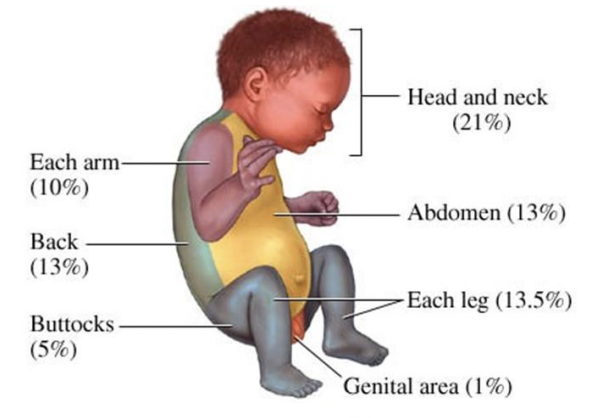
Rule of Nines infant
Head and neck= 21%
each arm= 10%
abdomen= 13%
back= 13%
buttocks= 5%
each leg= 13.5%
genital area= 1 %
Physiologic changes by burns
fluid and electrolyte shifts
fluid shifts and shock result in tissue hypoperfusion and organ hypofunction
cardiovascular effects
pulmonary injury
renal and GI alterations
immunologic alterations
effect on thermoregulation
release of cytokines and other mediators into the systemic circulation
Burns of more than __% may produce a local and systemic response and are considered major burns
30%
Burns can cause what type of pulmonary injury
upper airway
lower airway
carbon monoxide poisoning
restrictive defects
Phases of Burn injury
Emergent or resucitative phase
Acute or intermediate phase
Rehabilitation phase
Emergent or resuscitative phase of burn injury is
onset of injury to completion of fluid resuscitation
Acute or intermediate phase of burn injury is
from the beginning of diuresis to wound closure
Rehabilitation phase of burn injury is
from wound closure to return to optimal physical and psychosocial adjustment
On the Scene Care in Emergent or Resuscitative Phase
prevent injury to the rescuer
stop injury: extinguish flames, cool the burn, irrigate chemical burns
ABCs: establish airway, breathing, circulation
start oxygen and large-bore IVs
remove restrictive objects and cover the wound
do an assessment surveying all body systems and obtain a history of the incident and pertinent patient history
Emergent or Resuscitative Phase steps
pt is transported to emergency department
fluid resuscitation begins
foley catheter is inserted
pts with burns exceeding 20-25% should have an NG tube inserted and placed to suction
pt is stabilized and condition is continually monitored
pts with electrical burns should have ECG
address pain; only IV medication should be administered
psychosocial consideration and emotional support should be given to pt and family
Acute or Intermediate phase time frame
48-72 hours after burn injury
Acute or Intermediate phase focus
continuous pt assessment
GI & renal function checks
respiratory support
circulatory stability
fluid & electrolyte balance
infection prevention
burn wound management
pain management
control hypermetabolic response
positioning
early mobility
Rehabilitation Phase focus
rehab is begun in all stages
focus= wound healing, psychosocial support, self-image, lifestyle, and restoring maximal functional abilities
pt may need reconstructive surgery to improve function and appearance
vocational, psychological counseling, and support groups may assist the [t
include family as indicated
Nursing management of Pt: Acute phase
restoring fluid baalnce
prevent infection
modulating hypermetabolism
promoting skin integrity
relieving pain and discomfort
promoting mobility
strengthening coping strategies
Nursing management of Pt: Intermediate & rehabilitation phases
strengthening coping strategies
support patient and family processes
monitoring and managing complications
Why fluid resuscitation?
fluid shifts occur from intravascular to interstitial D/T inflammatory response
fluid shifts from cells and other areas to compensate for fluid loss, causing general dehydration s/s
fluid evaporates from burn injury
Management of fluids
required in adults with >20% burn
child > 10% burn
any burn in ages <2 or >60
Fluid replacement goals
BP >100 systolic
pulse <110 adult
urine output >30cc/hr adults
How do we decide how much fluid to give?
Burn surface area
first 8 hrs, most fluids lost to fluid shift & evaporation- 50% fluids needed replaced in that time
next 50% replaced in the following 16 hrs
usually isotonic solution- Lactated Ringers because cell stays the same
may replace blood loss with PRBCs
What do we want to see with fluid resuscitation?
appropriate BP and pulse
relief of nausea and ileus- 24 hrs
S/S Burn shock
decreased blood pressure
increased pulse
increased hematocrit
decreased level of consciousness
decreased urine output
edema at site of burn injury
Na+ deficit
K+ may be excess from cell destruction
metabolic acidosis
Management of Shock
maintain blood pressure >100 systolic and urine output of 30-50 mL/hr
maintain serum sodium at near-normal levels
Fluid and Electrolyte shift- Emergent Phase
generalized dehydration
reduced blood volume and hemoconcentration
decreased urine output
trauma causes release of potassium into extracellular fluid: hyperkalemia
sodium traps in edema fluid and shifts into cells as potassium is released: hyponatremia
metabolic acidosis
Fluid and Electrolyte shift- Acute Phase
fluid re-enters the vascular space from the interstitial space
hemodilution
increased urinary output
sodium is lost with diuresis and d/t dilution as fluid enters vascular space: hyponatrenua
potassium shifts from extracellular fluid into cells: potential hypokalemia
metabolic acidosis
4 Cs in Burn wound care are
cooling
cleaning
covering
comforting
Burn wound cleaning is done with
hydrotherapy
antibacterial products
wash solutions
topical agents
Debridement methods for Burn Wounds include
autolytic
mechanical
surgical
Burn wound closure & care
dressing application
dressing changes
skin grafting
Types of burn pain include
background or resting
procedural
breakthrough
Analgesics used for burn pain management
IV use during emergent and acute phases
morphine
fentanyl
Goal of nutritional support with burn wounds is
promote a state of nitrogen balance and match nutrient utilization
Routes for administering nutrition in burn wound patients
enteral route is preferred
jejunal feedings are frequently used for lower risk of aspiration