SN1/SN2, Sn1 and Sn2, E1 and E2, Organic Chemistry Sn1 vs Sn2
 Call Kai
 Learn
 Practice Test
 Spaced Repetition
 Match
 Flashcards
 Knowt Play
1/69

There's no tags or description
Looks like no tags are added yet.
70 Terms
SN2 reaction order
second order reaction
SN1 reaction order
first order reaction
SN2 minimum # of steps
1 or more steps
SN1 minimum # of steps
2 or more steps
SN2 intermediates
no
SN1 intermediates
carbocation
SN2 Stereochemical consequences
stereospecific inversion of configuration at the electrophile site.
SN1 Stereochemical consequences
racemization (full or partial) at electrophile site.
SN2 Importance of nucleophile strength
very important; no reaction for weak nucleophiles like water.
SN1 importance of nucleophile strength
unimportant
SN2 importance of leaving group
very important; no reaction for weak leaving groups like HO- .
SN1 importance of leaving group
very important; no reaction for weak leaving groups like HO- .
SN2 substrate structure dependence
avoid steric hinderance;
CH3 > 1 degree > 2 degrees (slow) > 3 degree (no); no reaction for aryl/vinyl.
SN1 substrate structure dependence
need carbocation stabilization;
3 degree > 2 degree (slow) > 1 degree (no); resonance stabilization helps; no reaction for aryl or vinyl.
SN 2 solvent
polar aprotic (its lacking , no protons).
SN1 solvent
polar protic (has acidic protons)
nucleophile strength: I
VERY GOOD
nucleophile strength: HS
VERY GOOD
nucleophile strength: RS
Very Good
I>Br>Cl>F
best leaving group to worst leaving group
ACN>DMF>DMSO>H2O>MeOH
best to worst aprotic solvents
rate=k[R-LG][Nuc]
Sn2 rate of reaction formula
rate=k[R-LG]
Sn1 rate of reaction formula
the sn1 reaction at a chiral center will produce ______ _______
2 steroisomers
H20>HCO2H>MeOH>CH2CO2H
Best to worst protic solvents
E1 structure substrate?
3>2>>1 substrate
E1 what about the leaving Grup?
usually needs to make an LG
doesn't need a strong base
E1
faster in polar protic solvent
E1
Zaitsev is the major product
E1
like high temperatures
E1 and E2
elimination 3>2>1 substrate
E1 and E2
good LG needed
E2
needs strong base
E2
no solvent preference
E2
H and Leaving Grp must be anti & periplanar to each other
E2
small bases (E2)
fits into tight spots. Removes proton from more substituted C to give more substituted alkene
bulky bases(E2)
go for most accessible proton. Removes proton from less substituted C to give a less substituted alkene
Weak Nucleophile
SN1
Strong nucleophile
Sn2
Sn1
which reaction is this?

Sn2
which reaction is this?

Tertiary carbocations yield what kind of stereochemistry? (Sn1)
Racemic mixture, 50% S and 50% R
Secondary carbocations yield what kind of stereochemistry? (Sn1)
It is a net inversion, therefore if it is originally S the major product will have a stereochemistry of R
Sn1
Tertiary carbocations and sometimes secondary
Sn2
Primary carbocations and sometimes secondary
The side the nucleophile attack for the Sn2 mechanism?
The backside (180 degrees)
Why can't a tertiary carbocations be apart of the Sn2 mechanism?
Because of the steric bulk, the tertiary R-X blocks the backside from attack
What is the stereochemistry after the SN2 reaction? (Secondary or primary)
Complete inversion
how does the leaving group effect the reaction rate?
stability of leaving group permits the reaction to occur faster
Why is Polar Protic Solvent better for Sn1?
Because The rate determining step involves charge separation (when the leaving group leaves) which the polar protic stabilizes by creating a shell, spreading out the positive charge. (Making it hard for any compound/molecule to come in until then nucleophile) it has lots of electrons and protons to give.
Why is polar aprotic more stable for Sn2?
Because the polar protic would solvate the nucleophile, therefore weakening it before the nucleophile could attack. The aprotic doesn't weaken the nucleophile/form the full shell around the nucleophile. But it can stabilize the charged species to some extent
Sn2
concerted process (nucleophilic attack occurs the same time as the leaving group leaves)
Sn1 Reaction Coordinate Diagram

Sn2 Reaction Coordinate Diagram
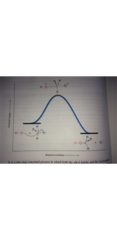
Why is R-I better for Sn1?
the rate determine step involves C+ formation and the breaking of the R-X bond, the weaker the R-X (C-X) bond the easier it is to break. R-I is the most reactive because it is the weakest R-X bond.
The conjugate base of strong acids
Is a better leaving group (I, Cl, Br, H2O, OTs)
Sn1
Stable Leaving group
Sn2
Polar protic solvents hinder the mechanism by solvating the nucleophile
why does SN1 favor a weak nucleophile?
Because a weak nucleophile permits the leaving group dissociation before the Nucleophilic attack
do relative reaction rates differ (RI>RBr>RCl>>RF) for SN1 and SN2?
no, but SN1 is better when the reaction rates are higher, and SN2 is better with lower reaction rates
SN2 transition state
identify the middle step

Sn1
Requires heat and stable leaving group
Sn2
requires stable leaving group, often occurs at room temperature or below
why do secondary carbocations result in net inversion for an Sn1 reaction?
they are less stable and the leaving group is in close proximity to the carbocation during nucleophilic attack, partially protecting one side from the attack
good leaving groups
weak (conjugate) bases
bad leaving groups
strong bases
hydride shift needs to be on neighboring carbons
1,2 hydride shifts
Sn2
Doubling the Alkyl Halides or nucleophile doubles the rate of reaction
Sn1
Rate is only dependent on the concentration of the Alkyl Halides