corticostriatal anatomy
 Call Kai
 Learn
 Practice Test
 Spaced Repetition
 Match
 Flashcards
 Knowt Play
1/62

There's no tags or description
Looks like no tags are added yet.
Name | Mastery | Learn | Test | Matching | Spaced | Call with Kai | Chat |
|---|
No analytics yet
Send a link to your students to track their progress
63 Terms
describe motivation
what we need, want, and like
describe action
coordinates how we achieve our goals
describe learning
what predicts and what works
what do motivation, action & learning help us with?
help us anticipate and proactively respond to the world to maximize reward
describe liking
actual pleasure component or hedonic impact of a reward
describe wanting
motivation for reward which includes incentive salience ‘wanting’ processes, and conscious desires for incentives or cognitive goals
describe learning
associations, representations, and predictions about future rewards based on past experiences which includes explicit and cognitive predictions, and associative conditioning
what is the hub for the corticostriatal circuit?
striatum
describe substantia nigra
where dopaminergic neurons originate
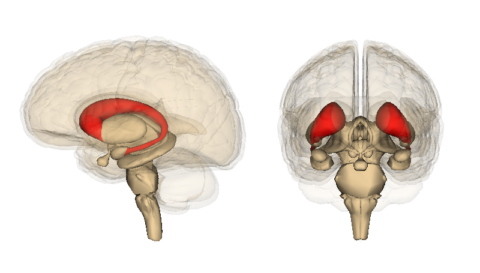
what is this structure?
basal ganglia
where does the ventral striatum project to in the PFC?
vmPFC and orbital PFC
describe the loop created through projections between ventral striatum and PFC
motivational loop, wanting and desire to pursue a goal
what makes up the dorsal striatum and their relative positions in the brain?
caudate and putamen
caudate: medial
putamen: lateral
describe the caudate
goal directed planning and behavior modification when we do not receive the reward we hoped to achieve
to which structure(s) does the caudate project to?
dlPFC and dorsal anterior cingulate cortex (dACC)
describe the loop created from the projections from the caudate
executive, higher order, planning loop
describe to which area(s) the putamen is connected/projected to
supplementary motor area and motor cortex
describe the loop between the putamen and its connections
reward related motor movement (including planning movements)

identify the white structure
internal capsule
describe the ic (internal capsule)
white matter connections/tracks that convey informations to & from the body to the brain
why should we think of the VS as a gate?
opens to generate motivation for pleasure and pursue a reward
the opening of the VS gate is dependent on what?
intrinsic and extrinsic cues
what cause the VS gates to remain closed
closed by the amygdala if there is a signal of danger in the environment even with present reward signals
the corticostriatal circuit is associated with what behaviors?
basic signs of pleasure, either immediate or long-term
describe VS dysregulation
overactive striatum: impulsive-like behaviors
underactive: anhedonic-like behaviors
to which area(s) does the BLC directly project to?
ventral striatum
what kind of information is projected from the BLC?
sensory information
what way(s) does sensory information get into the circuit?
only through the BLC
describe the transfer of sensory information out of the VS and to other structures
VS → outputs through ventral pallidum →
caudate & putanem→ outputs through dorsal pallidum →
→→ thalamus → mPFC, lPFC, singulate
does sensory information directly or indirectly leave the striatum?
indirectly since it first sends outputs to the pallidum
which structure has dense collections of opioid receptors?
ventral pallidum
describe how information leaves the PFC to the striatum
directly to striatum or through the thalamus to striatum

identify the following structures


identify the following structure
thalamus
how are the thalamus and striatum receiving sensory information?
the amygdala → thalamus → striatum
the thalamus is a hub for getting information ___ of the ___ and ___ the ___
the thalamus is a hub for getting information out of the striatum and into the PFC
describe how the pallidum is an intermediary
all the neurons from the VS and DS stop by the pallidum before going to the thalamus
what happens when the ventral pallidum is stimulated form the striatum?
generates a hedonic liking response
VS projects to which pallidum?
ventral pallidum
DS projects to which pallidum?
dorsal pallidum

identify the following structure
amygdala
describe the amygdala in relation to the corticostriatal circuit
BLC projects all of the sensory information to VS
contributes to learning cues in the environment that predict satisfaction
describe the optogenetic study
used optogenetics to stimulate and inhibit glutamatergic neurons projected from BLC into VS
the animal could stimulate the neuron itself by putting its nose through a hole which would activate the circuit
frequency of behavior (nose pokes) increased greatly compared to the the control group
they then conditioned animals to a cue and a reward and transiently inhibited projections from the BLC to the VS
in the control: animals learned the association and started licking when the cue was present
but in the group where they inhibit processing from BLC to VS right when the cue is presented, the animals do no learn the association between cue and reward
conditioned group showed increased lick rate of consumption over time whereas the inhibitory group does not

identify the following structure
hippocampus
describe the hippocampus
provides contextual information: who, what, where, when
learning of the context in which a specific action satisfies a specific motivation (with context facilitating or inhibiting opening of VS gate)
what is argued with rapid development of limbic regions but more slowly developing PFC?
brain more vulnerable to developing psychopathology especially in adolescence
how does sensory information get to VS?
BLC
how does context get to VS?
through hippocampus (both stimulatory of reward in appropriate context or inhibitory in an inappropriate context)
how does PFC regulation get to VS?
indirectly and directly through thalamus

identify the following structure
hypothalamus
describe the hypothalamus
a region that secretes hormones that regulate food and se_
what other structure is interconnected with the hypothalamus thats leads to secretion of hormones
striatum
describe orbitofrontal cortex
subjective evaluation of how rewarding something is or even how much we desire something
describe the mPFC
integrates bottom-up and top-down processing
for adaptive responses to environment
describe how the vmPFC is an integretory hub
where sensory info (thalamus & cortex), interoceptive info (insula), and contextual info (hippocampus) becomes integrated with motivational info from the VS
what happens to sensory information in the vmPFC after it becomes integrated with motivation info from the VS?
translated locally (along w/ projections to OFC) into subjective valuation of what we find pleasurable
the vmPFC allow you to become ___and form ___ ___ for ___
the vmPFC allow you to become aware and form subjective value for importance
where is info projected to after the vmPFC?
dlPFC
describe the dlPFC
forms complex plans for satisfaction
to where does the dlPFC communicate its info to?
the VS through vmPFC
how does the dlPFC put plans into action?
from VS to DS to support motor and motor cortex
describe the dACC
monitors conflict between expectations and actual outcomes
helps correct (modify) actions to achieve desired effect (goal) by projecting to dlPFC
monitors effectiveness of actions

identify the following structure
midbrain