Session 6: Staphylococci
 Call Kai
 Learn
 Practice Test
 Spaced Repetition
 Match
 Flashcards
 Knowt Play
1/32

There's no tags or description
Looks like no tags are added yet.
33 Terms
where are Staphylococcus sp. usually found?
most are harmless; found on skin and mucus membranes of humans
can Staphylococcus sp. cause disease?
can cause disease via toxin production or infection
how do Staphylococcus sp. cells look under a microscope?
cells divide in random planes to form clusters of cells
what kind of bacteria is Staphylococcus sp.?
salt and bile tolerant
facultative anaerobes
can ferment several sugars with acid as a by-product, no gas production
how does Staphylococcus sp. react to catalase?
catalase (+)
where are Microccocus sp. usually found?
found on human skin, animal and dairy products, beer
also found in water, dust, soil
is Microccocus sp. considered pathogen or non-pathogenic?
commensal organism but can be an opportunistic pathogen
how do Micrococcus sp. cells look under a microscope?
cocci shaped with tetrad (packets of 4) or sarcina (packets of 8) arrangement
how does Micrococcus sp. react to catalase?
catalase (+)
what kind of bacteria is Micrococcus sp.?
strict aerobes
what kind of medium is Tryptic Soy Agar?
enriched medium; many organisms can grow
(can be supplemented with blood to allow more fastidious organisms to grow)
what kind of medium is Fluid Thioglycollate Media?
soft, semi-solid enriched media used for growing aerobes, microaerobes, and anaerobes
what is Fluid Thioglycollate Media used to determine?
used to determine oxygen requirements needed by organisms
(oxygen concentration is different throughout)

interpret the results from Fluid Thioglycollate Media.
(in order; left to right)
facultative, obligate aerobe, anaerobe
(facultative → grows throughout tube; means can tolerate any concentration of oxygen
obligate aerobe → can only survive in places with high oxygen concentrations; why it’s only at very top
anaerobe → avoids oxygen-rich places; grows mainly where there is less oxygen present (at the bottom))
what occurs during the fermentation process?
glucose is metabolized by most organisms and is a source of energy
what allows the process of fermentation?
glucose (or other sugars and/or other organic molecules) are converted to pyruvic acid during glycolysis
can then continue on to the Krebs cycle or it can go through the process
what kind of medium is Mannitol Salt Agar?
selective and differential
(selective → due to 7.5% NaCl present (only high salt-tolerant organisms will grow
differential → due to presence of mannitol and phenol red)
what happens in Mannitol Salt Agar when the organism can ferment mannitol?
acidic byproducts are produced → results in drop of pH
phenol red turns YELLOW under acidic conditions (pH < 6.8)
what is Phenol Red (PR) sugar broth made of?
broths containing a sugar, pH indicator phenol red, and Durham tube
what happens in Phenol Red (PR) sugar broth when the organism metabolizes sugar?
if sugar is metabolized and acid is produced, pH will drop → broth turns yellow
if organism produces gas as well → Durham tube will contain it
what are the positive Phenol Red (PR) sugar broth results?
(+) fermentation with acid production
(+) fermentation with acid and gas production
what are the negative Phenol Red (PR) sugar broth results?
(-) fermentation with no alkaline products
(-) fermentation with alkaline products
what is DNA agar made of?
nutrient agar containing DNA
1N HCl is used as a developer to enhance zone of clearing
what reactions occur in DNA agar?
if organism produces enzyme DNAse → DNA in media will be broken down and a zone of clearing will form
what does DNAse do in DNA agar?
DNAse breaks down NETs (neutrophil extracellular traps)
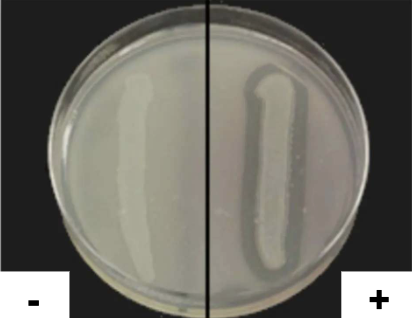
what does the image show?
DNA agar test; organism in (+) will produce DNAse enzyme
(with zone of clearing indicating a (+) result, no zone of clearing being (-))
what is Coagulase test (for free coagulase) made of?
rabbit plasma inoculated with heavy inoculum of organism
what does Coagulase test (for free coagulase) determine?
used to determine if organism produces coagulase enzyme; convert fibrinogen in plasma to fibrin → forms a clot
why does an organism form a fibrin clot?
(after converting fibrinogen in plasma to fibrin clot)
forms around itself and avoids attack by the host immune defenses
what bacteria reacts to the Coagulase test (for free coagulase)?
(+) reaction → causes clotting
most S. aureus strains are (+)

what does this image show?
Coagulase test (for free coagulase) tube test results
top → (+) test result; from S. aureus; formed a clot
bottom → (-) test result; from S. epidermidis
how long should Coagulase test (for free coagulase) incubate for?
test results should be read within 24 hours to avoid reversion of positive test results by staphylococcal fibrinolytic enzyme activity
how does coagulase provide protection?
protects against phagocytosis and antibodies by surrounding infecting organisms with a fibrin clot