FAH350 Minimalism
 Call Kai
 Learn
 Practice Test
 Spaced Repetition
 Match
 Flashcards
 Knowt Play
1/46

There's no tags or description
Looks like no tags are added yet.
47 Terms

Kazimir Malevich, Black Square, 1915
o beautiful corner" (krasny ugol, или красный угол) in Russian culture refers to the traditional sacred icon corner in a traditional Russian home
o Neither perfectly black nor perfectly square > sides are not parallel or equal in length, and shape isn’t quite centred on the canvas > form slightly off kilter, creating movement
o Canvas already used for two other paintings
o Craquelure reveals other colours
o Traces of hair and fingerprints
o Suprematism > feeling is supreme > achieved through non-objectivity > extreme simplification and abstraction > completely nonrepresentational

Kazimir Malevich, Black Square in 0.10: The Last Futurist Exhibition of Painting, 1915
o beautiful corner" (krasny ugol, или красный угол) in Russian culture refers to the traditional sacred icon corner in a traditional Russian home
o Neither perfectly black nor perfectly square > sides are not parallel or equal in length, and shape isn’t quite centred on the canvas > form slightly off kilter, creating movement
o Canvas already used for two other paintings
o Craquelure reveals other colours
o Traces of hair and fingerprints
o Suprematism > feeling is supreme > achieved through non-objectivity > extreme simplification and abstraction > completely nonrepresentational

Vladimir Tatlin, Corner Counter-Relief, 1915
o Foregrounding its structural qualities, not hiding them
o First exhibited during the Last futuristic paintings exhibition “0.10” in Petrograd in 1915
o Abstract volumetric and spatial composition
o Artist’s desire to abandon the traditional “painting plane” and to bring nonobjective constructions into space formed by two inclined panes
o Also important for the artist to show all abilities of the materials used by him. In this work they represent opposed yet inseparable notions – flexibility and rigidness, freedom and tension, movement and calmness
o No pedestals, no frames > no separation between it and viewer > they share the same space/world
o Non-objective art is a type of abstract art that has no connection to the real, physical world and does not try to show real objects, people, or places
o Constructivist art is an early 20th-century abstract art movement that originated in Russia, emphasizing industrial materials, geometric shapes, and a utilitarian purpose to serve a modern socialist society. Practitioners rejected traditional easel painting, viewing themselves instead as engineers and technicians constructing objects rather than painting illusions. Compositions relied on strict lines, planes, and bold geometric shapes that mirrored the efficiency of the machine age. The movement aligned closely with the Russian Revolution, favoring functional designs, posters, and propaganda over individualistic, bourgeois fine art. The constructivists believed art should directly reflect the modern industrial world

Marcel Duchamp, In Advance of the Broken Arm, 1915
o Readymades – mass produced objects. removing questions of manual craftsmanship, making point that it is about choice > act of designating an object as art makes it art
o Duchamp looked for aesthetic indifference > separating/decoupling art from visual pleasure
o To Duchamp, artwork is in a state of suspense and not completed until viewer looks at it. This pushed artists to make artworks that made viewers present
o Bought at store in 1915 and hung from ceiling of studio
o To make In Advance of the Broken Arm, Marcel Duchamp selected a snow shovel, hung it from the ceiling of his studio, and called it art. His Readymades—mass-produced, functional objects he designated as art—challenged many accepted assumptions and traditions, namely that art should reflect an artist’s skills, or even be handcrafted by the artist. Duchamp asserted that an artist could create simply by making choices. His Readymades also aimed at shifting viewers’ engagement with works of art from what Duchamp called the “retinal” (pleasing to the eye) to the “intellectual” (in “the service of the mind”), subverting the traditional notion that beauty is a defining characteristic of art.
o Duchamp frequently assigned humorous titles to his Readymades. In Advance of the Broken Arm refers playfully to the function of a snow shovel: to remove snow from the ground. It assumes that without the shovel to remove the snow, one might slip and fall and even break an arm.

Ad Reinhardt, Abstract Painting, 1960-61
o Bridge between Abstract Expressionists and Minimalists
o Stripping down art to its essential elements
o Not actually solid colours
o Grid of 9 squares, very slightly different colours, just on the edge of perception > working with sight and the biology of our bodies > engages with viewer’s body
o Oil on canvas
o At first glance this painting presents a flat black surface. But longer viewing reveals more than one shade of black and an underlying geometric structure. Reinhardt has divided the canvas into a three-by-three grid of squares. The black in each corner square has a reddish tone; the shape between them formed by the center squares is bluish-black in its vertical bar and greenish-black in its horizontal bar. Reinhardt tried to produce what he described as "a pure, abstract, non-objective, timeless, spaceless, changeless, relationless, disinterested painting—an object that is self-conscious (no unconsciousness), ideal, transcendent, aware of no thing but art."
o Presentness/presence
o Engages with time > prolonged viewing needed > must view for extended duration > makes viewer aware of the act of looking
o Reductive clarity

Frank Stella, Die Fahne hoch!, 1959
o Quite large > around 6/8 ft tall > around size of flag
o Black enamel paint
o Emphasizing flatness of canvas
o Letting canvas dictate composition
o Getting away from illusionism of space
o Basic elements of artwork > colour, shape, and composition
o 24 in larger grouping
o White lines are canvas left uncovered/unprimed canvas > black filled in, not white
o Objectness
o Manifestation of object’s materiality > ceases to be image and becomes an object
o What you see is what you see
o Title refers to German march called hoist the flag > Nazi anthem > Darkness of WWII and the Holocaust? > or meaning raising the banner of a new aesthetic?
o Proto Minimalist > precursor of Minimalism
o Die Fahne hoch! belongs to a group of twenty-four black paintings that brought the young Frank Stella instant art world notoriety. What appear at first to be white lines are actually bare, narrow spaces of unprimed canvas between the standardized black bands that the artist applied with a housepainter’s brush. Spanning a deep stretcher, the painting seems to project off the wall, asserting its presence, or what Stella called its “objectness.” There was nothing to this work, the artist declared, beyond the observable—as he put it in a now-famous maxim, “what you see is what you see.” While Stella insisted on the non-referentiality of his paintings, the German title Die Fahne hoch!, which translates as “hoist the flag,” is taken from the “Horst Wessel Song,” the Nazi Party’s marching anthem. Indeed the painting’s title, cruciform configuration, and flaglike proportions call to mind not only Nazi banners but the darkness and annihilation of the Holocaust. The phrase may also refer to raising the banner of a new aesthetic, one that marked a shift away from Abstract Expressionism and anticipated the geometry and rigor of Minimalism.

Anthony Caro, Midday, 1960
Who Michael Fried upheld as a good Modernist artist
Made from industrial steel objects > defeating its own objecthood > formed/arranged in a way that erases its own objecthood, making it purely a visual phenomenon
Not dependent on viewer’s body or its space
Clearly not site-specific because it has been in a number of different locations
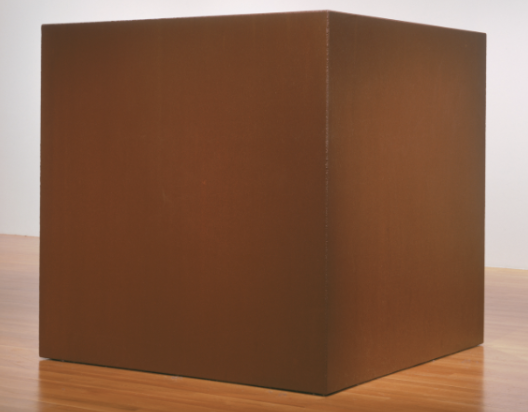
Tony Smith, Die, 1962
o Phenomenology - philosophical study of conscious experience and the way things appear to us from a first-person point of view. Influence on Minimalists (Phenomenologie de la perception 1945, translated to English in the 1960s) > minimalism demanded an embodied experience. Works like Tony Smith’s Die needed viewers to walk around to understand its form
o 6 ft x 6 ft x 6 ft > mimicking scale of human body (too large to be object, too small to be monument/architecture) > ideal proportions? > Vitruvian Man?
o Hollow
o Physical object that viewer must walk around
o Manufactured by company
o Notes on Sculpture II
o Michael Fried > ultimate example of theatricality > scale makes it dependent on physical viewer
o Title > die object, but also concept of death
o Weight is felt because we intrinsically know how heavy metal is

Dan Flavin, Pink out of a Corner (to Jasper Johns),1963
o Made the year Flavin began to use commercially available fluorescent light tubes, this work marries color and light, bringing them into three dimensions. In dialogue with the surrounding space, the vertical pink tube simultaneously illuminates and obscures the corner—a location not typically used for displaying art. Though the light emitted transcends its physical encasement and transforms the surrounding space, Flavin rejected any characterization of his work as sublime. "One might not think of light as a matter of fact, but I do," he stated. "And it is...as plain and open and direct an art as you will ever find." This work is dedicated to the artist Jasper Johns, who similarly blurred boundaries between real objects and their representation
o Light is temporary > around 2000 hours
o Owner/gallery is not supposed to keep it once the light runs out > instead, throw it out and buy a new one > rejecting the notion of unique artist’s work

Dan Flavin, “monument” for V. Tatlin, 1964
o Part of around 50 work series > 1964? - 1990
o Vladimir Tatlin, “Monument to the Third International”
o Anti-monument in a way > unsolid light, light, temporary, emitting glow and heat, buzzing, and drilled into the wall
o Tatlin’s monument was supposed to be sturdy, permanent, massive structure

Dan Flavin, The Nominal Three (to William of Ockham),1963
o Ockham > 14th century friar > Ockham’s Razor > simplest explanation is the best one (Flavin adopts this here) > pioneer of nominalism in philosophy

Agnes Martin, The Tree, 1964
o Not really part of New York crowd
o Viewed herself as closer to Abstract Expressionism
o Also influenced by Buddhism
o The Tree > like Ad Reinhardt, need prolonged/extended viewing > grid will start to vibrate
o Drew grid herself with ruler and graphite pencil > unlike other Minimalists, still about the artist’s hand
o Human repetition/mechanization instead of industrialization
o Peace and meditation > more transcendent, expressive, and spiritual

Robert Morris, Untitled (Three L-Beams), 1965
o Was originally supposed to be much bigger configuration, but Morris realised he could show all the possible orientations with just three l beams
o About body and space
o Although its three elements are identical in shape, they appear different from one another based on their varying orientations
o Makes viewer think about if l beams are all the same, like a perceptual puzzle
o allows us to view the same form simultaneously from multiple perspectives, so that the act of seeing becomes an implicit subject of Morris’s work
o The repeated elements of Morris’s sculpture invoke the processes of commercial manufacture, like so many products from an assembly line
o Originally plywood?
o Stainless steel
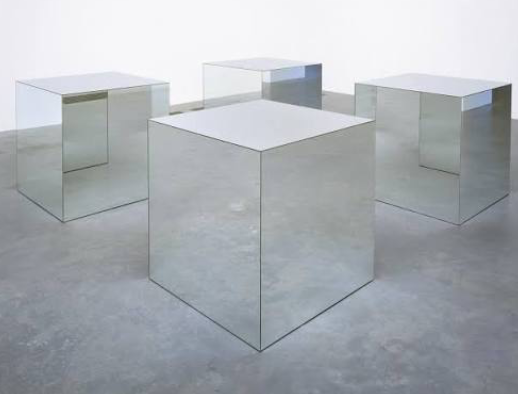
Robert Morris, Untitled (Mirrored Cubes), 1965
o Morris’s Minimalist sculptures of the mid-1960s consist of rigorously pared-down geometric forms. He typically arranged these into ‘situations’ where ‘one is aware of one’s own body at the same time that one is aware of the piece’. This work demonstrates the principle. As the viewer walks around the four cubes, their mirrored surfaces produce complex and shifting interactions between gallery and spectator. The cubes were originally installed in the garden at Tate for Morris’s 1971 exhibition, but were put on show in the galleries when the exhibition had to be re-made with substitute works.
o Mirror glass and wood
o Each cube: 914 x 914 x 914 mm (3ft cubes)- overall display dimensions are variable
o Inner structure of plywood
o Gestalt forms
o Not a sense of heaviness like Smith’s “Die”
o Phenomenological distortion
o Morris' first set of four mirror boxes was made in 1965 for his exhibition at the Green Gallery, New York, in February 1965, but he subsequently destroyed it because the boxes were made of perspex and the mirroring would not stick on
o As you walk around the four cubes, their mirrored surfaces reflect the surrounding gallery, the floor, other visitors, and the cubes themselves

Carl Andre, Lever, from the Primary Structures exhibition, 1966
o 137 unjoined standard fire/refractory bricks > refract heat > made for kilns, fireplaces
o the title which conjures up a language of machinery; a lever is a handle or switch or treadle > also, conceptual lever > levers make lifting a load easier
o Did nothing to bricks
o By laying an artwork on the floor, as Andre did with most of his work thus inviting viewers to experience it by walking on it, he violated one of the most sacred precepts of art: that it be revered, untouched, and taken in from a distance. By being on the floor, humbling itself
o Contesting/challenging the verticality of traditional sculpture
o placement of the work itself, extending outward from the wall as if it had fallen to the middle of the floor. Andre likened Lever to a toppled column. Viewer cannot avoid the work
o Repetition > one brick after another
o Routinely describing bricks as pertinent to his own identity—his grandfather was in fact a bricklayer—Andre’s work could also be regarded in terms that are phallic and hyper-masculine
o Some associations were intentionally cultivated by the artist; as a founding member of the Art Workers Coalition, part of a new leftist movement aligning artists with the struggles of workers, Andre saw his work in class terms, redolent of manual labor
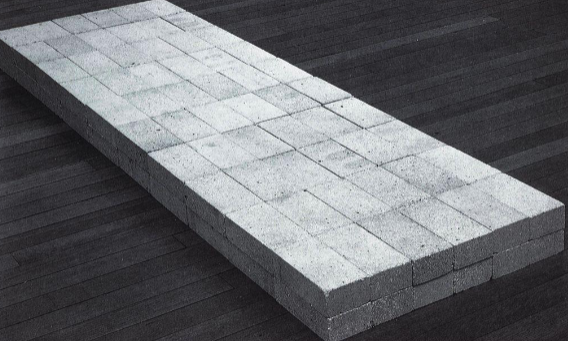
Carl Andre, Equivalent VIII, 1966

Carl Andre, 37th Piece of Work, 1969
realized sculpture could be flat, earthbound
flattening
objects only placed > never glued or bolted
almost 1300 pieces > 1ft squares
moves away from traditional verticality of art
phenomenological> forms the very ground the viewer walks on > different metals (zinc, magnesium, iron, etc.) have different qualities (sound, texture, oxidation, etc.) > you can feel/sense this when you walk on them
In Guggenheim Museum
In traditional art, cannot be touched > here, requires touch/to be worn down by viewers
democratizing materials > material equality > treating/showing/presenting them all the same
letting materials be as they are
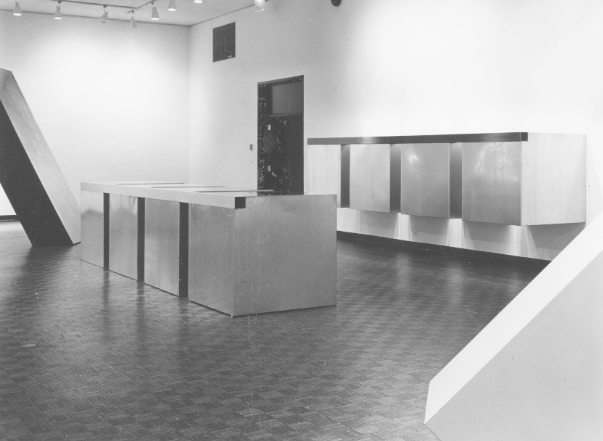
Donald Judd, Installations from the Primary Structures exhibition, 1966
o Breaking with Tradition: Judd exhibited floor- and wall-based works (such as his unpainted, hollow metal boxes and multi-unit configurations) that completely eliminated traditional pedestals, tying the physical object directly to the surrounding architectural environment.
o Despite his close association with the Minimalist art movement of the 1960s, Donald Judd did not consider his art minimal or reductive. In fact, the artist denounced labels like “painting” and “sculpture” altogether, claiming instead that he created “specific objects” in “real space.” These works often consist of boxes and cubes that are spaced in uniform intervals. Many are fabricated from materials like galvanized iron and Plexiglas, whose industrial appearances deny any trace of the artist’s hand. Unconventionally, Judd mounted these works on the wall or placed them directly on the floor. By collapsing the separation between viewer and art object, works such as Untitled challenge and expand traditional definitions of architecture, design and sculpture.
o Galvanized iron and painted aluminum

Donald Judd, Untitled, 1965
o Boxes are spaced out in a predetermined, mathematical way. Viewer may not know exactly what the pattern is, but can tell there is a pattern
o Judd hated composition
o Paint used was actually used for Harley Davidson motorcycles
o Colour is unstable > glossy
o Interior/negative spaces change as viewer moves > shadows > Judd claimed shadows were mainly incidental but are important part of the work

Donald Judd, Untitled, 1967
o Made of galvanized iron (not usually for fine art) + green lacquer
o Turtles all the way down?
o World is one thing after another
o Distances exactly the same
o Negative space is as important as positive space > becomes part of the work
o No trace of artist’s hand
o Interested in design of the system instead of craftsmanship > precursor to conceptual art
o Although it is hung on a wall like a painting, Untitled (Stack) projects nearly three feet from the wall and climbs like rungs on a ladder from floor to ceiling. It is made of galvanized iron boxes, all identical and of equal importance. The space around the boxes is also important. The sides are covered with commercially available green lacquer paint typically used to customize Harley-Davidson motorcycles. The tops and bottoms are bare metal. Each of the 12 boxes is nine inches high, and they are spaced nine inches apart. Depending on the height of the ceiling where Untitled (Stack) is displayed, the number of units may be reduced to maintain proper spacing between them. This flexibility reflects the importance of the whole work of art over its individual parts.
o Began his works with wood and paint and making them himself but became dissatisfied (wood warps, paint chips) > began handing plans over to fabricators and using industrial materials
o Donald Judd ignored traditional craft skills in favor of an overriding system or idea. He wanted his work to suggest an industrial production line. In fact, Judd had his works made in a factory in order to obtain a perfect finish without having to rework the material. The box was one of Judd’s favorite forms, because he felt it was neutral and had no symbolic meaning.

Richard Serra, One Ton Prop (House of Cards), 1969
Plates leaning against each other > balance > body intrinsically feels it
Looks heavy > body intrinsically feels it
Threat of collapse (in theory) > “visceral bodily threat”
Lead much softer than steel > will change over time > slow negotiation with gravity > leads to process art + post-minimalism

Sol LeWitt, Open Modular Cube, 1966
Logic
Negative space
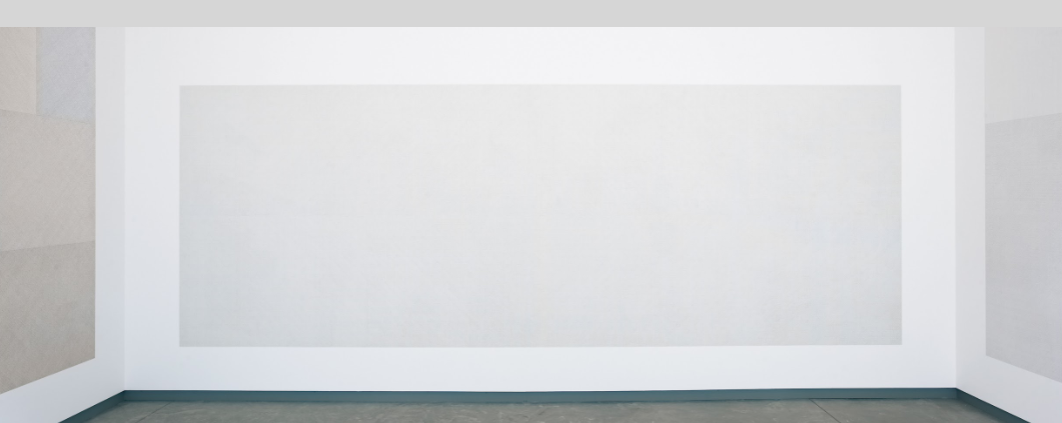
Sol LeWitt, Wall Drawing 11, 1969
o Conceptual art
o If bought, owner is given instructions (wall divided vertically, etc…) > each object will be slightly different depending on location and maker
o Like classical music > the composer writes the score, but musicians play the music
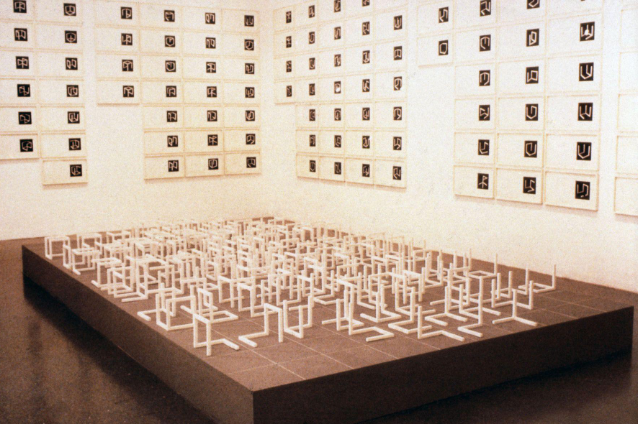
Sol LeWitt, Variations of Incomplete Open Cubes, 1974
o maps out every possible way a three-dimensional cube frame can be incomplete
o contains 122 rotationally unique skeletal structures
o cube has 12 edges (limbs). LeWitt removed between 1 and 9 edges, leaving combinations of 3 to 11 connected edges
o explores conceptual art and systems-based logic by mapping out every single mathematical possibility (122 unique variations) of a skeletal cube with edges removed
o Replacing Emotion with Logic
o Seriality and systems > like assembly line

Mel Bochner, et al., Working Drawings and Other Visible Things on Paper Not Necessarily Meant to be Viewed as Art, 1966

Joseph Kosuth, One and Three Chairs, 1965

1968
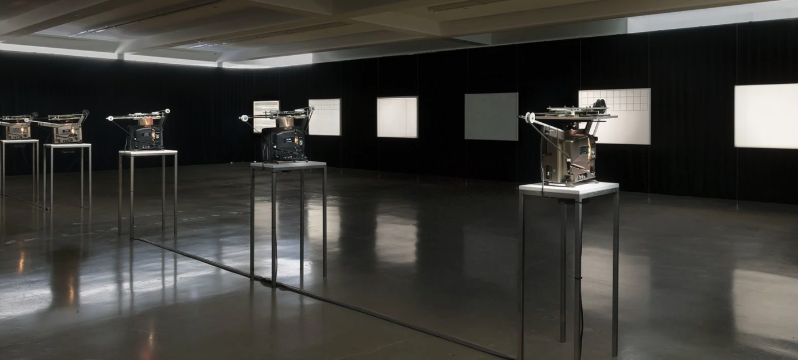
Hanne Darboven, 6 Filmstrips, or 6 Books on 1968, 1968

Robert Morris, Untitled, 1969
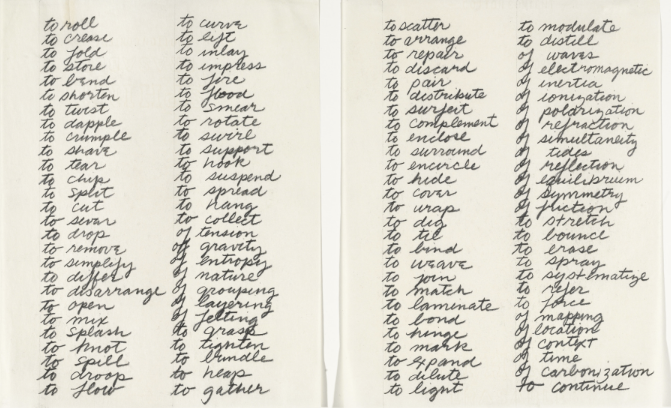
Richard Serra, Verb List, 1967

Richard Serra, Gutter Corner Splash, 1969/1995
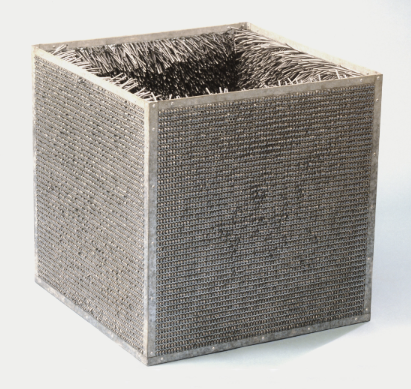
Eva Hesse, Accession II, 1969
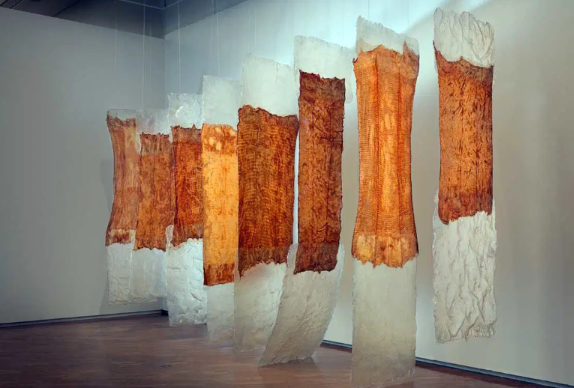
Eva Hesse, Contingent, 1969

Robert Morris, Steam, 1967

Lynda Benglis, Bounce, 1969

John Cage, Score for 4’33”, 1952/3

Barry Le Va, Untitled #10, 1967/2019

Robert Morris, Continuous Project Altered Daily, 1969

William Anastasi, Sink, 1963

Hans Haacke, Condensation Cube, 1963-65

Robert Smithson, A Non-site (Franklin, New Jersey), 1968

Robert Smithson, Spiral Jetty, 1970

Michael Heizer, Double Negative, 1969

Walter De Maria, The Lightning Field, 1977

Donald Judd, The Chinati Foundation, Marfa, Texas, 1986
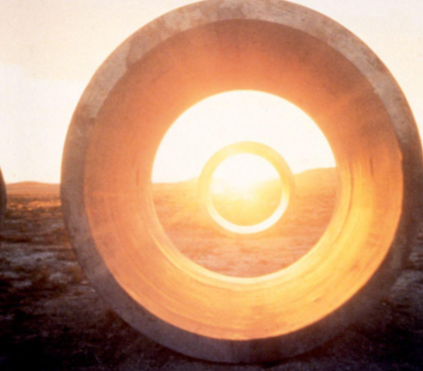
Nancy Holt, Sun Tunnels, 1973-1976