Cell Bio Exam III
 Call Kai
 Learn
 Practice Test
 Spaced Repetition
 Match
 Flashcards
 Knowt Play
1/40

There's no tags or description
Looks like no tags are added yet.
41 Terms
Covalent Modifications of Proteins: PHOSPHORYLATION
which amino acids
what is it catalyzed/ reversed by
adds (-) Phosphate to S, T, Y
Phosphate comes from ATP → ADP
catalyzed by “protein kinases”
reversed by “protein phosphates”
How does Phosphorylation alter protein structure and activity?
Each Phosphate adds 2 negative charges
change solubility
creates new recognition site (other proteins can bind to phosphorylated protein)
Covalent Protein Modifications: Ubiquitylation
Covalent addition of Ubiquitin (small cytosolic protein tag)
reversible
marks proteins for degradation
Directs proteins to specific location in cell
What is a Ligand
Molecule (enzyme, protein, etc) that binds to a protein
noncovalent
reversible
Strength of Ligand Binding
why is it important
where does it come from
Binding must be strong enough to withstand the jostling of molecular motion.
3D complementarity of binding
formation of several non-covalent bonds (strength in #s)
What is:
Ka
Kd
Ka: association constant
ratio of associated/ dissociated ligands
High Ka = strong binding
Kd: dissociation constant
1/Ka
how much ligand needed to get protein ½ saturated
Low Kd = strong binding
What is the role of GTP and GDP in cell signaling
They bind to regualting proteins and regulate whether they are ON or OFF
Draw the signaling by GTP binding protein
which (GTP/GDP) is on/ off
what do GEF and GAP do?
GTP: active protein (on)
GDP: inactive protein (off)

What are GEF and GAP
what do they stand for?
what do they do?
what is the GTP hydrolysis rxn
GEF: Guanine nucleotide Exchange Factor
switches protein ON - detaches GDP attaches GTP
GAP: GTPase-Activating Protein
switches protein OFF - hydrolyzes GTP → releases phosphate group

Why do Proteins have multiple modification/ integration sites?
allows proteins to act as “molecular integrators”
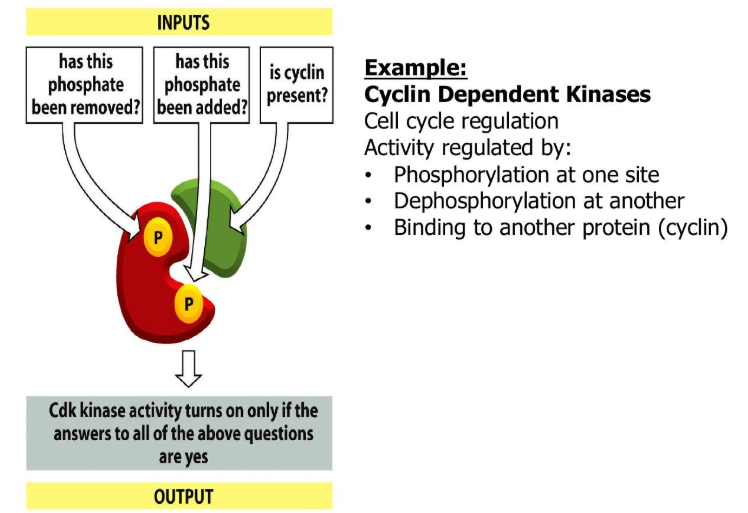
What are Cyclin-Dependent Kinases?
Enzymes that Control Progression of Cell Cycle
Controlled by:
phosphorylation
protein binding (cyclins)
Once active, they phosphorylate other proteins to push forward the cell cycle.

What is an Enzyme?
what do they DO/ DONT do
Biological catalytic proteins → speed up cellular rxns → allow life
DO:
lower activation energy (Ea of breaking bonds sets speed of rxn)
DONT:
alter dG
make nonspontaneous rxns spontaneous
change [equilibrium]
get MORE product, just FASTER

How do enzymes lower the Ea
STABILIZE TRANSITION STATE
Bind substrate to a stereo-specific active site forming the enzyme-substrate complex
Substrate converted to product forming enzyme-product complex
What is Vmax
What is Km
Vmax:
fastest rate an enzyme-catalyzed reaction can reach.
rate when enzyme is saturated with substrate
(sets upper limit)
Km:
approx = Kd for enzyme-substrate complex
low Km → enzyme has high affinity for substrate

What is the mechanism for transition state stabilization by enzymes?
KNOW COLD
Orient substrates correctly to promote rxn
Rearrange electrons to create partial charges that favor a rxn (using charged groups)
Strain substrate bonds to favor transition state (makes molecule more stable in rxn form)

What is a Prosthetic Group?
example
A non-protein molecule which aids in protein function
can be non/covalently bound by the protein
e.g. hemoglobin using heme
What is a Co-factor
example
ENZYME prosthetic group
e.g. Mg = cofactor for enzymes that join/cleave nucleic acids
What is a Coenzyme?
example
Organic molecule cofactor
e.g Vitamins, CoA
What is a Molecular Tunnel
why needed
what are they
what are they pros
Needed because:
Some enzymes perform multiple sub-rxns that occur @ distinct active sites.
They are:
tunnels used by these enzymes that direct intermediates from 1 active site to another w/out leaving the enzyme.
prevents diffusion of intermediates
prevents decomposition of intermediates
ensures toxic materials dont enter cell
ensures rxn happens in right order

What is a Multi-Enzyme Complex?
Sequential rxns
Product of 1st enzyme is passed to the 2nd & so on
prevents diffusion of products
allows for coordinated regulation of pathway
increases efficiency
NOT QUATERNARY STRUCTURE

What is Feedback Control?
downstream product regulates an upstream enzyme in a given pathway
example: High levels ATP inhibit the action of a key enzyme in glycolysis (phosphofructokinase)

What is a irreversible enzyme inhibitor
Covalently binds to an amino acid residue - lowering Vmax by inactivating and removing active enzyme molecules
e.g. Aspirin = irreversible inhibitor of COX1/2 enzymes
What is a Reversible enzyme inhibitor?
what are the different kinds
Non-covalent binding:
I. Competitive -
binds to active site with higher affinity than substrate
Increases Km (requires more substrate to reach Km)
same Vmax
Effect can be overcome w/ high [S]
II. Non-Competitive -
Lowers Vmax
same Km

Covalent Regulation of Enzyme function
Enzymes can also be phosphorylated.
Coded by short linear amino acid sequences
Rapid, Reversible
Allosteric Regulation of Enzyme Function
activate or inhibit
affect substrate binding and catalysis
allosteric site can be on 3ary and 4ary
NOT AN INHIBITOR!!!

What are the 3 general steps of cell communication
1.) Reception
2.) Transduction
3.) Response
Signaling Molecules
act over long or short distances or via axons
often secreted
Paracrine Signals
LOCAL effects
affects only cells in immediate environment of cell

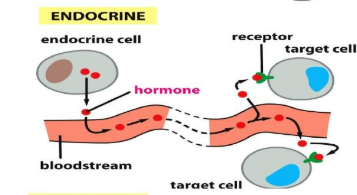
Endocrine Signaling
Travel long distance through the bloodstream
acts on distant targets
hormones
Autocrine Signaling
Cell sends signal to itself
e.g Embryonic development (morphogens diffuse developing tissues, cell fate determined by concentration)

Synaptic Signaling
Signal travels via axons
Neurons → synapse → target cell

Contact-dependent Signaling
Direct cell-cell contact
common with immune cells (targeting only unhealthy cells)

Speed of Cell Signaling
rapid vs slow
Rapid (seconds/minutes)
protein changes (function)
Slow (minutes/hours)
gene expression changes (synthesis)
Combining Signals
millions of possible message combinations.
Specific combinations determine outcome:
growth
differentiate
function
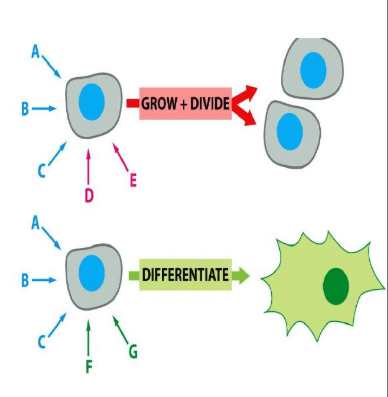
How can specific signals promote cell survival??
Different cells depend on a different specific combination of signals to survive (prevent apoptosis)
restricts cells to specific environment
Cell-Type Specific Receptors
how?
wut dat mean?
different receptors on cell surface
different intracellular machienery (integrating & interpreting signals)
SAME signaling molecule has DIFFERENT effects on different target cells
Concentration Dependence ‘
wuh det mean?
example?
different concentrations of signal → different outcomes
e.g
Morphogens secrete from developing tissues, creating concentration gradient.
cells adopt different fates depending on position
What are the types of signals cells respond to?
Light
Heat
Mechanical
adhesion to substrates
membrane distortion
sound
Chemical
What are the different forms of Chemical Stimuli
examples
how do they exit the cell
amino acids
peptides/ proteins
nucleotides
steroids
fatty acid derivatives
gases (NO, CO)
MOST secreted from signaling cell into extracellular space by EXOCYTOSIS
others do contact or simple diffusion
What are Lipid Soluble Signals
what are they
examples
how do they get to target cell
SIgnaling molecules that can simply diffuse across the plasma membrane
e.g Steroid molecules (synthesized from cholesterol)
Cortisol
Sex Hormones
vitamin D
Thyroxin
travel through blood to target cells using Carrier Protein
bind to intracellular receptor
cytosolic or nuclear
changes gene expression without signal transduction pathway (1-1 effect ratio)
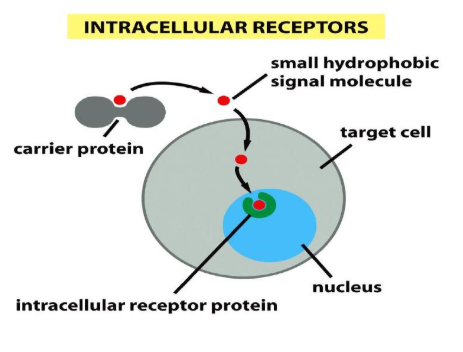
Mechanism of Lipid Soluble Signals
Receptor bound to inhibitor (inactive)
Ligand binds → conformational change
in
