positive regulation of the lactose operon
 Call Kai
 Learn
 Practice Test
 Spaced Repetition
 Match
 Flashcards
 Knowt Play
1/35

There's no tags or description
Looks like no tags are added yet.
36 Terms
unlike the trp operon, the lac operon is under both (?) transcription controls
positive and negative
component of positive lac operon regulation
Lac promoter -> relatively weak
CAP -> activator protein needed to help RNA polymerase bind to the promoter
It binds to DNA near the promoter
cAMP -> messenger molecule -> CAP must bind to cAMP before CAP (CAP-cAMP dimer) can bind to DNA
what does CAP stand for?
catabolite activator protein
(?) is the preferred sugar of E. coli
glucose
as long as glucose is present, the lac operon is switched (?)
off
cAMP responds to changes in (?) concentration
glucose
there is an (?) relationship between glucose levels and cAMP concentration
inverse
what happens when glucose concentration falls?
cAMP concentration rises
levels of CAP-cAMP dimer also rise (more cAMP available to bind to CAP)
CAP-cAMP dimer can bind to the lac operon DNA and activate transcription
why is the previous mechanism positive regulation of the lac operon
because there is an activator (CAP-cAMP protein), not a repressor protein, which increases DNA binding which activates transcription
what happens after cAMP binds to CAP
cAMP binds to CAP protein
causes change in shape which allows CAP to bind to the CAP site
the bound CAP-cAMP dimer interacts with RNA polymerase
activates transcription -> greatly increases the rate of transcription initiation
the operon is highly expressed only when (a) is present and (b) is absent
(a) lactose
(b) glucose
(?) binding turns on lac operon in positive regulation
CAP
Explain what happens when:
When both glucose and lactose are present
2. When glucose is present and lactose is absent
3. When both are absent
When lactose is present and glucose is absent
CAP is not bound → low expression of lac operon
Repressor blocks transcription → CAP is not bound
CAP is bound but repressor blocks transcription
CAP is bound and repressor is not bound → transcription activated

Glucose is present and lactose is absent
Glucose is present and lactose is present
Glucose is absent and lactose is present
Glucose is present and lactose is absent
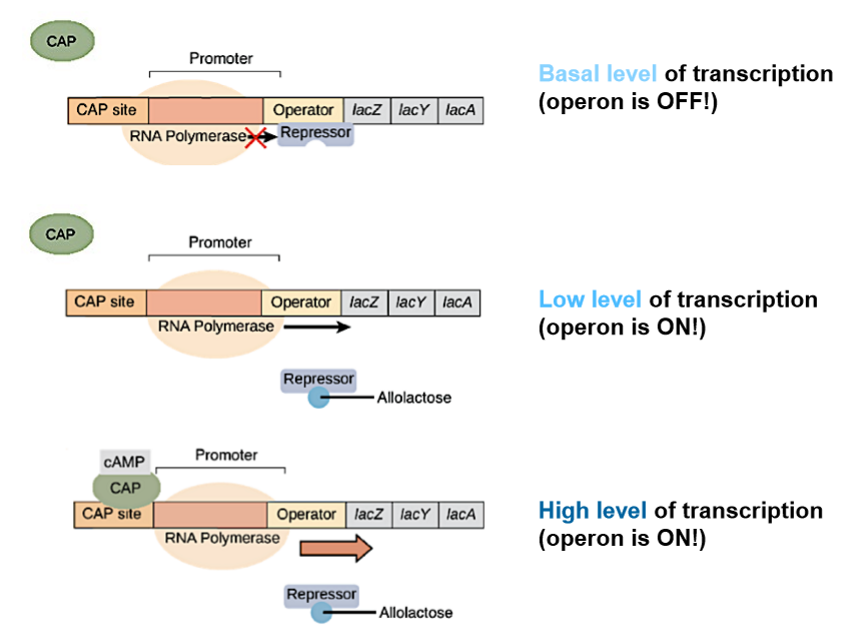
Operon is off -> repressor bound
Low levels of transcription
Glucose is present and lactose is present
Allolactose formed -> inducer
Operon is on
Low levels of transcription
Glucose is absent and lactose is present
CAP-cAMP dimer bound
No repressor bound
Operon is on
High levels of transcription
LacI is a (?) protein
repressor
allolactose binds to (a) to remove it from the DNA and prevent transcription, therefore allolactose is an (b)
(a) lacI
(b) inducer
CAP is an (?) protein
activator
cAMP is an (?)
inducer
cAMP binds to CAP, forming a cAMP-CAP dimer which binds to the lac operon and (?) transcription
activates

complete the table

negative vs positive regulation
Negative regulation
Repressor protein binds to DNA
Prevents transcription
Positive regulation
Activator protein binds to DNA
Activates transcription
negative vs positive regulation of the lac operon
Lac operon (negative)
Ligand binds to repressor protein
Repressor protein removed
Transcription activates
Allolactose (ligand) is an inducer
Lac operon (positive)
In the absence of glucose
cAMP must bind to CAP (activator protein)
cAMP is an inducer
CAP-cAMP dimer binds to promoter
Activates transcription
regulatory DNA binding proteins (list 3)
Trp repressor TrpR
Binds to trp operon in presence of tryptophan
Blocks transcription
Lac repressor LacI
Binds to lac operon in absence of lactose
Blocks transcription
CAP activator
Binds to lac operon in absence of glucose
Promotes transcription
repressors recognise (?) DNA sequence
operator
CAP recognises (?) binding site
CAP
in most cases, the protein inserts into the (?) of the DNA double helix
major groove
(?) or so bonds between the DNA binding protein and the DNA
20
helix-turn-helix motif
common DNA-binding motif made up of two alpha-helices
allows regulatory proteins to bind
DNA binding proteins bind as dimers
two copies in each major groove separated by exactly one turn of the DNA helix

lac repressor is a (?)
tetramer → two identical binding sites
how does the lac repressor prevent transcription of the lac operon
Lac repressor has 2 identical binding sites
Lac operator has three binding sites (O1, O2, O3)
Repressor binds O1 and either O2 or O3
Forms DNA loop
Loop contains the -35 and -10 binding sites (promoter regions) recognised by RNA polymerase
These sites are now inaccessible to RNA polymerase
where does CAP bind to in DNA?
CAP-binding site (major groove) adjacent to the promoter of the lac operon
upon binding, CAP-cAMP bends the DNA by (?) degrees
90 → stimulates transcription of the operon
trp repressor action
Trp present (co-repressor)
Binds to repressor protein
Changes shape -> can bind tightly to operator sequence
Blocks transcription of the enzymes required to synthesise trp
summary
