Exam 1
 Call Kai
 Learn
Learn Practice Test
 Spaced Repetition
 Match
Match Flashcards
 Knowt Play
1/114

There's no tags or description
Looks like no tags are added yet.
Name | Mastery | Learn | Test | Matching | Spaced | Call with Kai | Chat |
|---|
No analytics yet
Send a link to your students to track their progress
115 Terms
What is the Environmental?
The natural world, human societies, and the human-built world.
What is Environmental science?
The Interdisciplinary study of environmental problems and human
impacts on the environment
Examples of interdisciplinary studies
Geology
• Meteorology
• Climatology
Biology
• Ecology
Chemistry
Physics
Engineering
Examples of environmental problems
Flooding
• Deforestation
• Climate Change
• Pollution
• Ocean Acidification
• Soil Depletion
• Fresh Water Usage
Examples of human impacts
Carbon Emissions
• Deforestation
• Desertification
• Waste Disposal
• Wetland Destruction
• Energy Demands
What is sustainability?
The practical goal for people to co-exist on Earth over a long period of time.
The Environmentalist’s Paradox
Well-being is flawed, and is declining.
Advances to food production outweigh the effects of ecosystem decline.
Human technology makes us less dependent of ecosystems services.
A time lag between ecosystem decline and human well-being.
These explanations are examples of hypotheses
The scientific method
All science share a method of learning and understanding natural phenomena.
Observations / systematic collection of evidence that can be seen and tested by anyone with resources to do so.
The scientific method is…
A collective process and iterative (repetitive) process
Scientific research
Using the scientific method to make new discoveries and confirm old discoveries.
Hypothesis
A plausible but unproven explanation for the way things happen.
• Research either supports or does not support a
hypothesis.
A hypothesis is credible if…
It explains new data
• Predicts the outcomes of new experiments
• Confirmed by other scientists
Theory
A set of hypotheses that has been validated through repeated challenges of experimentation and empirical observation.
• Supported by substantial bodies of data
• Obeys physical laws
• Can be applied to nearly all situations
Example of a theory
Spherical Earth Theory
Supported by:
Mathematical Laws
• Look into GPS Calculations
Physical Laws
• Atomic Behavior
• Gravitational Forces
Direct Observation
• Lunar/Solar Eclipses
• Shadow Lengths
• Constellation Changes
• Satellite Imagery
• First Person Testimony (over 700)!!!!
Spherical Earth Theory in discipline studies
Repeated scientific experimentation over thousands of years in multiple disciplines of study!
• Geology
• Oceanography
• Geography
• Astronomy
• Physics
• Engineering
• Astrophysics
• Chemistry
• Business Logistics
• Risk Management
• Tourism
• Air Travel
• And on, and on….
Are hypotheses and theories proven?
Hypotheses and theories are NEVER completely proven. In science, no explanation is closed to questioning.
Sound Science
Hypotheses that have survived the rigors of the scientific method and are considered valid.
Sound science process
Peer Reviewed
• Published
• Results are not politically motivated
• Funding of research has no conflict of interest
• Eliminates bia
Junk science
Information that is presented as valid science but does no follow the rigorous methods legitimate science uses.
• Selective Results
• Politically Motivated
• Published without peer review
Examples of Junk science
Usually released by special interest groups attempting to influence public debate about scientific concerns.
• Tobacco Institute
• Vaccines cause autism
• Modern climate change are natural cycles
Scientific Model
A precise representation of how a natural process operates or how a natural system behaves.
• Models can be used to test consistency of knowledge or make predictions and compare results to observations.
Examples of Scientific Models
Weather Prediction
• Earthquake Hazard Prevention
• Mine Safety
Scientists present their findings to the public through scientific journals, professional meetings, and collaborative research efforts.
Population
A group of members of the same species living in an area.
People living in a city
Great white sharks in the world
Ants in an ant hill
Communities
The populations of different species living together in one area.
Oak and Cedar trees often co-inhabit the same space.
Dog Park
Coral Reef
Population growth
The change in the size of a population.
Births and Deaths
Immigration
Emigration
Human Populations
Worldwide:
8,171,092,031 (as of 8/18/2024)
What is the most populated country?
India:
1,452,628,629 (as of 8/18/2024)
China:
1,418,896,663 (as of 8/18/2024)
What will be the population by 2057?
10 Billion
Most growth is expected to occur in Africa and
Oceania
Exponential Growth
The population increases by a fixed % each year.
Assumes favorable conditions
Assumes unlimited resources
Calculating Exponential Growth
G= r * N
G = Population Growth
r = Rate of Population Increase
N = Population Size
r positive → population increases
r negative → population decreases
r is zero → no population growth
Logistic Growth
The population increases exponentially at first, but limited resources regulate growth.
Population can level off at the carrying capacity
Population can exceed the carrying capacity
Carrying Capacity
The upper limit to the population that an ecosystem can support without being degraded.
What would happen if a population exceeded the carrying capacity?

Environmental Resistance
All the factors that limit a populations growth and create a carrying capacity.
Water
Food
Air
Space
Other Species
Population Density
The amount of population that exists in an area.
Populations can be limited by other factors besides ecosystem limitations.
Limiting factors based on population density can be dependent or independent.
Density Dependent Limits
A limitation that increases/decreases as a direct result of the population density increases/decreases.
Disease
Predation
Competition
Waste
Density Independent Limits
A limitation that is not related to the density of a population.
Natural Disasters
Climate
Environment Modifications
Critical Number
Minimum base population required to for a species to survive.
Minimum Protection
Minimum Reproduction
Examples of independent ad dependent
Human Population:
Dependent Factor
Space/Land
Independent Factor
Pollution
We have developed technologies that allow us to eliminate limiting factors.
Energy and power
Current World Population:
~8.2 Billion
Population without Power:
~1.2 Billion
Energy resource
Something that can produce heat, electricity, or move a vehicle.
Examples of energy and power
Fossil Fuels are combustible materials derived from
organisms that lived in the past
Alternative Energy is energy generated in a way that
does not deplete natural resources or harm the
environment.
Energy
The ability to move matter.
• Light
• Heat
• Movement
• Electricity
Example of energy
Heat energy is produced by the vibrational motion of atoms and
molecules.
Kinetic Energy
Energy in action or motion.
• Burning fuel
• Water Whee
Potential Energy
Energy in storage.
• Stretched rubber band
Power
The amount of energy used over time.
• Home Electricity
• Playing a Sport
Why are we hooked on fossil fuels?
The potential energy from a single barrel of oil is very
high.
Very, very high…
Examples of energy from this
1 Gallon of Gasoline
• 116,000 BTU
• ~$3.30/Gallon
108 Slices of Pizza
• 116,000 BTU
• ~$220
Types of energy
Electric, Chemical, Thermal, and Kinetic
Electrical energy
The movement of electrons through a conductor.
Chemical energy
Energy stored in chemical bonds compounds
Energy conversion
Chemical, Thermal, Kinetic, and Electric
US energy sources
79% of US energy is sourced from fossil fuels!
• Petroleum (Oil) – 36%
• Natural Gas – 32%
• Coal – 11%
83% from Fossil Fuels- 2010
81% from Fossil Fuels- 2016
Electrical grids
Interconnected networks for electrical delivery
A grid that crosses state borders must follow federal
regulations
The US electrical network is separated into electrical grids.
So, what happened during the 2021 polar vortex freeze?
Texas’ power grid is not regulated by federal standards.
• Power companies lobbied to rewrite state regulations.
• The power grid was out of date and could not withstand the constant peak usage
Base load
The minimum electric output required in a 24-hour period.
• Coal and Nuclear
Renewable generation
Fills the gaps between the baseload and required
load.
• Wind and solar
Peak generation
The maximum electric load needed for a given time.
• Gas and Oi
Renewable energy
Comes from sources that are naturally replenishing
• Wind
• Solar
• Hydro
• Geothermal
• Bio
Non-Renewable energy
Comes from sources that do not replenish over short amounts of time.
• Gas
• Coal
• Oil
• Nuclear
Dispatchable
Power is power that can be used at any time.
• We can turn it on/off for near
instant demand.
• Gas
• Hydro
• Oil
• Geothermal
Non-Dispatchable
Power is power that cannot be regulated for
demand.
• Solar
• Coal
• Nuclear
• Wind
What do we need energy for?
• Electricity
• Transportation
• Heating/Cooling
What are hydrocarbons?
A hydrocarbon is a compound composed
mostly of hydrogen and carbon.
Why hydrocarbons?
The atomic bonds store a lot of energy!
• Easily reacts to release the energy as heat.
• Reaction also releases H2O and CO2
Which hydrocarbons have the most energy?
The ones with a short chain.
Methane, ethane, propane, butane, etc.
Long chains: Coal, plastic, motor oil, diesel, gasoline, etc.
Hydrocarbons are…
Flammable
• Easy to use
• Easily Transported
• Complete Combustion
• Releases maximum amounts of energy
• High Energy Potential
Hydrocarbon chemical formula
Ch4+O2→CO2+2H2O+Heat
Hydrocarbon conversion process
1. Burn the fuel
2. Steam spins turbines
3. Turbine spins generator
4. Electricity generated
Types of hydrocarbons; Petroleum
Petroleum – liquid mixture of hydrocarbon that can be refined to produce fuels and chemical feedstock.
Types of hydrocarbons, Natural Gas
Natural Gas – Flammable gas, consisting of methane and other hydrocarbons, that occurs naturally underground.
Types of hydrocarbons; Coal
Coal – Combustible rock of carbonized plant matter, found mainly in underground deposits
Why do we love hydrocarbons?
Cheap
Easy
Efficient
What happens when you burn hydrocarbons?
Ch4+O2→CO2+2H2O+Heat
• All hydrocarbons release CO2
1 gallon gas = 6.3 lbs → releases 20 lbs of CO2
All the added weight comes from oxygen
Which hydrocarbon releases the most and the least CO2?
CO2 emitted to create 293 kwh (1,000,000 BTUs)
Average US consumption = ~ 900 kwh /month
Coal = 33% world’s energy but 44% of CO2
Global CO2
Natural gas- 20%, Coal- 44%, and Oil- 36%
How do Oil and Gas Form?
Most are from algae and plankton
• Settle with clay minerals at ocean depths.
• Burial and Compaction causes Lithification = Shale
• Continued burial increases heat to 90°C and oil forms = Oil Shale
• Continued burial increases heat to 120°C = gas
• Temperatures past 250°C metamorphose = graphite.
Oil window
The temperature range from when oil starts to form to when gas stops forming, and graphite begins forming.
Global Distribution of Oil and Gas
1.) Venezuela- 300.9
2.) Saudi Arabia- 266.5
3.) Canada- 169.7
4.) Iran- 158.4
5.) Iraq- 142.5
6.) Kuwait- 106.5
Why is nearly 2/3 of the world’s oil in the Persian Gulf region?
The Middle Eats has 56% of the worlds oil reserves.
The Middle East was once an ocean, Pangea, were many algae/plankton died creating oil.
Creates the perfect environment for a reservoir
Source rock
The rock capable of generating hydrocarbons.
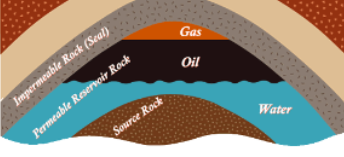
Reservoir rock
Porous rock that stores hydrocarbon
Seal
Impermeable rock that prevents hydrocarbons from moving.
Onshore drilling
70% of worldwide production
• Simple and quick setup
• 4,000 barrels/well/day
• Depreciated production
• Short lifespan (15-30 years)
• ~$20 million per rig

Offshore drilling
0% of worldwide production
• Specialized setup
• 50,000 barrels/well/day
• Consistent production
• Up to 50-year lifespan
• ~$650 million per rig

Conventional drilling
Pumping oil and gas directly from a reservoir rock.
• Porous and permeable
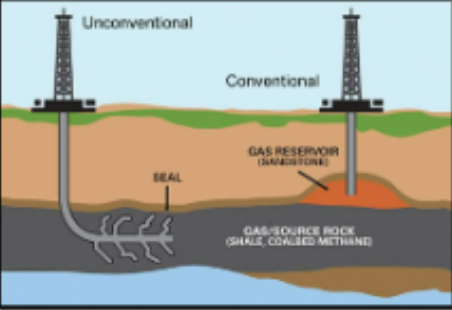
Unconventional drilling
Removing oil and gas from tiny pockets in the source rock.
• Porous, but impermeable
Porosity
The amount of space that exists between the grains or crystals of a rock.
• Shapes of grains (NOT size)
• Cementation
• Fractures
• Sorting of grains
Permeability
The ability for liquids and gases to flow through an object.
• Compactness
• Pore connectivity
• Grain Size
• Grain Sorting
• Cementation
How do we get oil and gas from an impermeable source?
FRACKING!
Hydraulic Fracturing
The fracturing of porous, but impermeable, source rock to remove hydrocarbons.
How does Hydraulic fracturing happen?
Drill horizontally through source rock
• Inject water and sand
• Pressurize to break the rock
• Less dense oil and gas move to well rig.
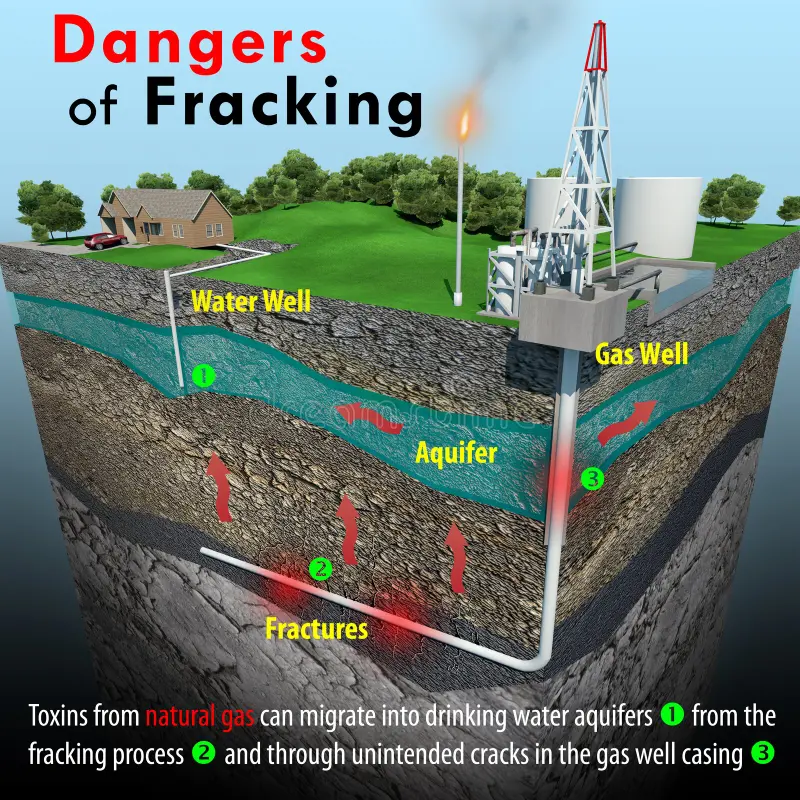
Issues with fracking?
Gas escape
• Water Usage
• Waste water leak
• Waste water disposal
What are Tar sands?
Petroleum soaked, partially consolidated, sandstones.
How are Tar sands extracted.made?
Large amounts of material are mined/crushed
• Petroleum is separated form the sands
• Cleaning/distilling of the petroleum
• Refining for use
Problem with Tar sands? ($$$)
1.70 trillion barrels of oil =1,700,000,000,000 x $80 = $136,000,000,000,000 (trillion!)
Must move 2 tons of earth to process 1 barrel = 1,700,000,000,000 x 4,000 lbs =
6,800,000,000,000,000 lbs of earth (quadrillion)
Need ~1.75 gallons of water per barrel 1.75 gallons x 1,700,000,000,000 = 2,975,000,000,000 gallons of water
Keystone Pipeline
An oil pipeline system in Canada and the United States, commissioned in 2010 by TransCanada.
Rejected by the Obama admin.
Approved by the Trump admin.
How are oil and gas transported?
Natural gas pipelines and Petroleum pipelines
Mostly come down to Texas.
How was coal formed?
Ancient plants died in a swamp millions of years ago.
These plants were buried under water and dirt.
Heat and pressure turned these dead plants into coal.