ME115 - Week 5
 Call Kai
 Learn
 Practice Test
 Spaced Repetition
 Match
 Flashcards
 Knowt Play
1/18

Earn XP
Description and Tags
Dislocations, Resolved Shear Stresses and Planar defects, Strengthening Mechanisms
19 Terms
Slip system
Slip plane + slip direction

Peierls-Nabarro equation
Describes the shear stress required to get a dislocation

Schmid’s Law
Describes the shear component of the applied force that then creates slip.
τ = σ*cos(λ)*cos(φ)

Critical resolve shear stress
τCRSS is the shear stress required to cause slip (Peierls-Nabarro eqn).
Material surface
At the surface, the material ends abruptly. This means that the surface atoms/ions have an improper number of bonds with the surrounding atoms (higher potential energy) and are more likely to bond with atoms in the environment.
Grain boundaries (GBs)
Grains are individual crystals within a material, each with its own lattice orientation. Grain boundaries occur where these crystals meet at different angles, resulting in a less ordered atomic structure.
GBs are high energy areas.
ASTM grain size numbers
The number of grains per square inch is determined from a photograph of the metal taken at a magnification of 100. N = 2n-1 where n is the ASTM grain size number and N is the number of grains per square inch. A higher ASTM grain size number means more grains in the same area, so the grains are smaller.
Hall-petch equation
This equation describes the relationship between grain size and yield strength. It shows that grain size and yield strength are inversely proportional thus the smaller the grain size is (larger ASTM number) the higher the yield strength is.
This makes sense because smaller grains means more grain boundaries means a higher chance of a dislocation being disrupted.

Measuring grain size

Importance of defects in strengthening
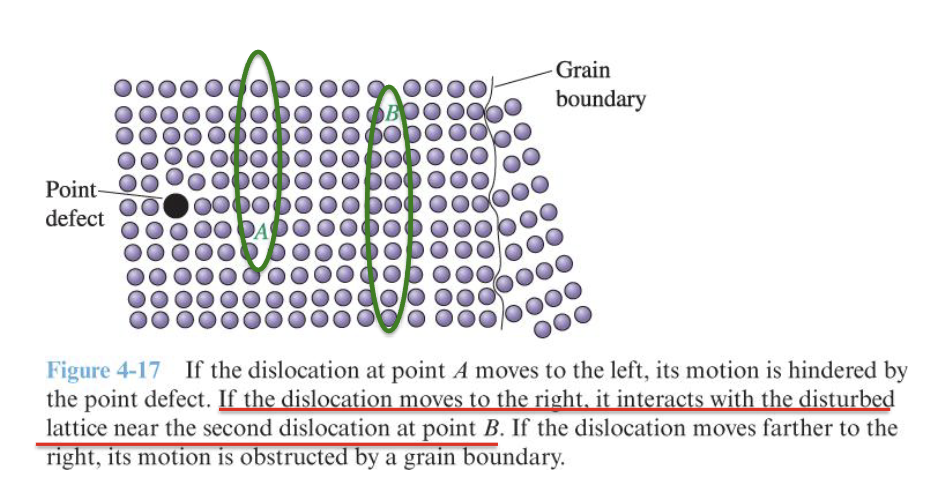
Because dislocation motion (slip) is responsible for plastic deformation and defects inhibit dislocation motion, this means that defects inhibit plastic deformation and increase yield strength. We can use this fact to control the strength of a material by introducing/removing defects.
Common strengthening mechanisms
Grain refinement - (dislocations can not pass grain boundary easily)
Solute - Strengthening (solute atoms impede dislocations)
Precipitation - (second phase particles which pin dislocation)
Strain hardening - (dislocations become entangled with each other)
Strain Hardening
Interacting dislocations impede each others motion and then more stress is required to make them keep moving. This means that having a higher dislocation density leads to having a stronger material. Strain hardening is when plastic deformation is intentional to increase dislocation density.
Solid-solution strengthening
Guest atoms are assimilated into the crystal, the stress induced by these defect inhibit dislocation as they can cancel out the dislocation motion

Grain-size strengthening
Reduce grain size to increase strength. Dislocations cannot pass through boundaries easily. Grain size can be reduced by specific temperature application, for example in the recrystallization zone in welding.

Precipitation strengthening
Similar to solid-solution strengthening however, in this case, the added atoms come together to form small particles in the matrix that are of a different phase from the surrounding material. These are obstacles that the dislocations must break through to continue and thus increase the overall yield strength of the material.
The process is that first the material is heated and the solute is dissolved, then the material is quenched to trap the solute into the matrix, and then the material is aged (slowly heated) to allow the solutes to clump together.
Low angle boundaries
An array of dislocations that produces a small misorientation between the adjoining crystals. If dislocations line up along a line they can form a lattice misorientation <15° Known as small angle grain boundaries that have much lower energy than large angle grain boundaries.

Tilt boundaries
Low angled grain boundaries that are formed by an array of edge dislocations.
A tilt boundary is a type of grain boundary in a crystalline material where two neighboring grains have the same crystal structure but are tilted relative to each other.

Twist boundaries
Low angled grain boundaries that are formed by an array of screw dislocations.

Twin boundaries
Twin grain boundaries are grain boundaries that separate two regions of a crystal with mirror-image lattice orientations across a common plane. Most common in FCC materials like copper, silver, and brass. Any time you see striped grains with straight edges to the stripes they likely to be twins.