Invertebrate Zoology Lecture Exam 1
 Call Kai
 Learn
Learn Practice Test
 Spaced Repetition
 Match
Match Flashcards
 Knowt Play
1/66

Earn XP
Description and Tags
Dr. Cook Tennessee Tech
Name | Mastery | Learn | Test | Matching | Spaced | Call with Kai | Chat |
|---|
No analytics yet
Send a link to your students to track their progress
67 Terms
Lentic
Refers to a standing or still freshwater ecosystem
Includes ponds, lakes, reservoirs, and some wetlands
Invertebrates include organisms such as aquatic insects, snails, clams, and crustaceans
Littoral Zone
The shallow area along the shoreline of a lake or other body of water where sunlight reaches the bottom and aquatic plants can generally grow
Especially important because it tends to have lots of habitat and food, making it highly diverse
Profundal Zone
The deep-water zone of a lake, below the depth where enough light reaches for significant photosynthesis
Typically inhabited by organisms adapted to low light and low-oxygen conditions
Paleolimnology
The study of ancient lakes and their history, usually by examining lake sediments
Researchers can use sediment layers to learn about past climate, pollution, vegetation, and environmental changes
Hemocoel
The main body cavity of arthropods and some other invertebrates where hemolymph (blood-like fluid) circulates through the organs
Metamerism
The body is divided into a series of repeated segments (metameres) along the length of the animal
Ex: annelid (earthworm)
Sternum
A ventral (bottom-side) structure that supports or protects internal organs; in many animals, it is specifically the breastbone
In arthropods, it is the ventral part of a segment, often associated with the legs
Osmoregulation
The process of maintaining the proper balance of water and dissolved salts (ions) inside an organism
Aquatic invertebrates constantly exchange water and ions with their environment
They have to prevent too much water from entering their bodies or too much water from leaving because of osmosis
Different animals have different strategies (freshwater vs. saltwater, etc. urine)
Nephridium
An excretory and osmoregulatory organ found in many invertebrates
Kidney-like
Protonephridium
An excretory and osmoregulatory system in invertebrates that is closed at the internal end and opens to the outside of the body
Typically contains solenocytes or flame bulbs
Solenocyte
A specialized excretory cell found in certain invertebrates that helps with waste removal and osmoregulation
Protonephridium
Has a flagellum that beats and helps move fluid through the excretory system
Like a tiny filter/pump cell
Flame Bulb
A ciliated, bulb-shaped structure found in the excretory system of some invertebrates, especially flatworms
Protonephridium
Has cilia that beat like a flickering flame
Helps remove excess water, with osmoregulation, and moves fluid through the protonephridium
Metanephridium
An excretory organ/system found in many invertebrates, including annelids (earthworms), unlike a protonephridium, it is open to the body cavity (coelom)
Excretion and osmoregulation
Nephrostome
The funnel-shaped opening of a metanephridium that opens into the body cavity (coelom) that collects fluid from the coelom and directs it into the metanephridium
Like a funnel
Often ciliated
Protostomes
Animals in which the blastopore develops into the mouth during embryonic development
Proto = first, meaning the mouth develops first
Ex: annelids, mollusks, arthropods
Deuterostomes
Animals in which the blastopore develops into the anus, and the mouth develops second in embryonic development
Deutero = second, meaning the mouth develops second
Ex: echinoderms and chordates (including humans)
Determinate Cleavage
A type of embryonic cell division in which the fate of each cell is determined early in development
Protostomes
Once the embryo starts dividing, each cell is already committed to becoming a certain type of tissue
Less ability to compensate for damage or cell loss
Indeterminate Cleavage
Early embryonic cells remain capable of developing into a complete embryo if separated; the cells' futures are not determined yet
Deuterostomes
Allows for possibility of identical twins
Spiral Cleavage
The cells divide at angles, so the cells in one layer sit between the cells of the layer below
Protostomes
Often associated with determinate cleavage

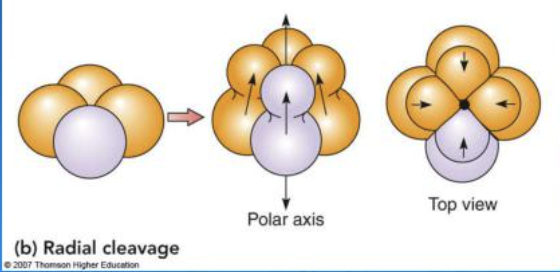
Radial Cleavage
The cells divide directly above or below one another, creating rows of cells that line up
Deuterostomes
Cells are arranged in a straighter, more straight/aligned pattern
Archenteron
The primitive digestive cavity that forms during gastrulation in the developing embryo
Early gut
The blastopore is the opening into the developing archenteron
Schizocoelous
An animal in which the coelom (body cavity) forms by splitting within the mesoderm
Protostomes
Pseudocoelomate
An animal that has a pseudocoel, a body cavity that is not completely lined by mesoderm
“false” body cavity
Partially lined by mesoderm
Detritivores
Organisms that feed on detritus, which is dead and decaying organic matter
Ex: earthworms, many insects/arthropods, some crustaceans
Help break down dead material and recycle nutrients through ecosystems
Shredders
Aquatic detritivores that feed on and physically break apart large pieces of dead organic matter, especially leaves
Especially important in streams and rivers
Specific type of detritivore
Ex: stonefly and caddisfly larvae
Filter Feeders
Animals that obtain food by filtering small particles or organisms out of water
They typically use specialized structures to trap things like:
Plankton
Bacteria
Detritus
Ex: some bivalves, sponges, and crustaceans
Exoskeleton
A hard skeleton on the outside of an animal’s body that provides support and protection
Found especially in arthropods (insects, crustaceans, spiders, etc.)
Primarily made of chitin
Because the exoskeleton is rigid, arthropods must molt it to grow
Exopod
The outer branch of a biramous (two-branched) appendage, especially in crustaceans
Arthropoda
A major animal phylum characterized by jointed appendages, a segmented body, and an exoskeleton made primarily of chitin
Ex: insects, crustaceans, arachnids, myriapods
Decapoda
An order of crustaceans that have five pairs of walking legs = 10 legs
Ex: crabs, shrimps, lobsters, crayfish
Crustacean, arthropod, protostome, determinate and spiral cleavage, schizocoelous
Copepoda
A major group/class of small crustaceans, many of which are important members of zooplankton
They are extremely common in aquatic ecosystems and are an important food source for fish and other animals
Cyclopoida
An order of copepods
Including many small aquatic zooplankton
Spindacaudata
An order of small freshwater crustaceans commonly called clam shrimp
They have a bivalved, shell-like carapace that makes them look somewhat like tiny clams
Paleomonidae
A family of shrimps within Decapoda
Arthropod, protostome, determinate and spiral cleavage, metamerism
Talitridae
A family of amphipod crustaceans
Ex: beach hopper/sand flea
Crustacean, arthropod, protostome, determinate and spiral cleavage, schizocoelous
Artemia
A genus of brine shrimp, small crustaceans that commonly live in very salty water
They are famous for surviving high-salinity environments and are commonly used as food for fish in aquaculture
Juvenile Hormone
A hormone in insects that helps control growth and development, particularly whether an insect remains juvenile or transitions to the adult stage
Specifically important for arthropods/insects
High = stay juvenile
Low = progression towards adulthood
Monoecious
An organism in which one individual has both male and female reproductive organs
Hermaphroditic?
One individual has both sexes
Diaptomus
A genus of freshwater copepod
Commonly found as part of zooplankton in lakes and ponds
They are an important food source for fish and other aquatic organisms
Ostracoda
A group/class of small crustaceans often called seed shrimp
Their bodies are enclosed in a two-part, clam-like shell
Found in both freshwater and marine environments
Cypridae
A family of ostracods
They are primarily freshwater ostracods
Mysidaceae
A family of small, shrimp-like crustaceans, commonly called mysids or opossum shrimp
Mostly aquatic and often found in marine environments
Asellidae
A family of freshwater isopods
They are often found on the bottom of streams, ponds, and lakes, where they feed on decaying organic material
Perinoteum
A thin membrane that lines the body cavity and covers internal organs
It is associated with the coelom
Blastocoel
The fluid-filled cavity inside the blastula during early embryonic development
It forms before the archenteron
Epiboly
A type of cell movement during gastrulation where one layer of cells spreads over and around other cells.
Marine to Freshwater
This refers to the evolutionary/ecological transition of organisms
A major challenge is osmoregulation:
Marine → freshwater means the organism enters a much more dilute environment.
Water tends to move into the body.
The organism tends to lose ions/salts.
It must prevent too much water from accumulating and conserve/replenish ions
Suspension Feeder
An animal that obtains food by filtering suspended particles from the water
Food can include plankton, bacteria, detritus, and other small particles
Ex: many bivalves
Bilateral Symmetry
A body plan in which the animal can be divided into two matching halves—a left and right side—by one plane
Animals have distinct anterior (front) and posterior (back) ends
Example: humans, earthworms, insects, and most crustaceans
Radial Symmetry
Body parts are arranged around a central point
The animal can be divided into similar sections by multiple planes passing through the center.
Ex: jellyfish, sea anemones
Pentaradial Symmetry
A type of radial symmetry with body parts arranged in five sections around a central point
Characteristic of echinoderms such as sea stars and sea urchins
Adult echinoderms have pentaradial symmetry, but their larvae are bilaterally symmetrical
Chitin
A strong structural polysaccharide that forms much of the arthropod exoskeleton
Also found in things like fungal cell walls
Cuticle
A nonliving protective outer layer covering the body of many invertebrates.
In arthropods, the cuticle forms the exoskeleton and contains chitin
Tergum
The dorsal (top/back) portion of an arthropod body segment
Pleura
The lateral (side) portion of an arthropod body segment
Think of the three main regions of an arthropod segment:
Tergum = top/back
Pleura = sides
Sternum = bottom/underside
Macromeres
The larger cells produced during early embryonic cleavage
Usually found toward the vegetal (bottom) pole of the embryo
Cephalized
Having a concentration of sensory organs and nervous tissue at the head/front end of the body
Common in animals with bilateral symmetry
Metameres
Repeated body segments that make up a segmented animal
Each repeated unit is called a metamere
Arachnoida
A group/class of arachnid arthropods, including spiders, scorpions, ticks, and mites
Characterized by four pairs of walking legs as adults
Uropod
A paired appendage at the rear end of many crustaceans
Often helps with swimming, steering, or creating a rapid escape response
Hyalella
A genus of small freshwater amphipod crustaceans
Commonly found in streams, ponds, and lakes, often associated with vegetation or leaf litter
Serial Homology
When repeated structures within the same organism are derived from the same basic developmental pattern
Ex: the different pairs of arthropod appendages are serially homologous
Acoelomate
An animal that does not have a coelom (a true body cavity)
The space between the digestive tract and the body wall is filled with tissue
Eucoelomate
An animal with a true coelom, meaning the body cavity is completely lined with mesoderm
Coelom
A fluid-filled body cavity completely lined with mesoderm
It provides space for internal organs and allows organs to move/grow independently of the body wall
Ostia
Small openings/pores that allow water to enter the body of a sponge
Water flows through the ostia into the sponge's internal canal system
Protopod
The basal (proximal) portion of a crustacean appendage from which the branches arise.
In a typical biramous appendage, the protopod gives rise to the endopod and exopod