AP Psych
 Call Kai
 Learn
 Practice Test
 Spaced Repetition
 Match
 Flashcards
 Knowt Play
1/188

There's no tags or description
Looks like no tags are added yet.
189 Terms
Psychology
The science of behavior and mental processes
was created in 1879 when University of Leipzig professor, Wilhelm Wundt created an apparatus to measure time lag between people's hearing and action.
This apparatus led to Wilhelm later creating the first psychology textbook
Structuralism
School of thought coined by Edward Bradford Titchener(EBT) that used introspection to reveal the structure of the human mind. Failed because the self reporting of subjects heavily varied.
How does the mind connect to a person's reaction to stimuli?
If someone was to do something, what is their sensations, what do they imagine, how do they feel? How do these things relate?
Functionalism
Schools of thought created by William James and influenced by Charles Darwin that tried to explain how mental and behavioral processes allowed an organism to adapt and survive.
How did we evolve to think and feel?
Thinking and smelling were adaptations that allowed humans to consider the past, adjust our present, and plan our future,
Behavioral psychology
viewpoint on psychology pushed by early psychologists that stated psychology to be a Objective science. Believes that behavior is shaped by the reinforcing of rewards and punishments by society.
Done by studying behavior without referencing mental processes.
Focused on stopping bodily responses instead of addressing cognition.
(No thought on biological processes)
Keywords: What you can observe. No free/ No cognition and thought process, reinforcement and punishments. Rewards and punishments shape behavior
Freudian (Psychoanalytic) Psychology
The psychological approach, pushed by Sigmund Freud, emphasized how unconscious thought processes and our emotional responses to child experiences affect our behavior.
Specializes in searching through childhood events to find answers to ongoing problems.
Why do I always quit before I suceed? or Why do I always date bad people?
Keywords: Unconscious drives/desire, childhood stages, fixation, no free will
Humanistic Psychology
Psychological approach Led by Carl Rogers and Abraham Maslow focused on how:
Current environmental influences nurture and limit our growth potential.
The importance of human beings' need for love and acceptance being satisfied.
Keywords: Free will, humans are mostly good, reaching full potential, opportunities to grow and change.
Cognitive Psychology-
Psychological approach that studies behavior and mental processes linked to cognition
(Thinking, memory, perception, and language)
For example Blinking,Sweating, Talking, and answering questions
How does stimuli affect how somebody thinks and sees the world?
Keywords: Thinking, judgement and memory
Evolutionary Psychology
The study of the evolution of behavior and the mind based on Natural selection.
Common tendencies in human behavior stem from our experiences as early humans living in prehistoric times
study is mainly based on human heterosexual behavior (male-female relationship behaviors) and how they have formed because of genetic evolution done to ensure survival
Key words: Ancestral past, Proceationg/ sending genes to the future, survival, ones genes and the survival of the species, and Hard wired.
Natural Selection
A Charles Darwin belief that nature selects the traits that best enable an organism to survive in its environment.
Behavior Genetics
Psychological perspective that states behavior is learned through environmental and sociocultural conditioning.
Rewards and punishments control how people behave
How do genetic personality traits interact with the environment
Also studies genetically induced illnesses (Alzheimer’s, Parkinsons)
Key Words: Genes and environment interaction
Culture
Shared behaviors, ideas, attitudes, values, and traditions shared by a group of people and passed down from one generation to the next.
While culture affects biological processes, most human beings share similar dyslexia symptoms, Communication through gestures, and reasons for loneliness
Positive Psychology
the scientific study of human functions to promote strengths and virtues that help people and communities thrive.
Use of scientific methods to explore the building of a “good life”.
Believers think happiness is a by-product of a pleasant, engaged, and meaningful life.
Levels of analysis
The differing and complementary Biopsychosocial approaches(biological, psychological, or social cultural) that can be used to analyze any phenomenon
If thinking from the neuroscientific perspective, one might study brain circuits that cause us to be red in the face.
If thinking from the evolutionary perspective, one might analyze how anger facilitated the survival of our ancestors’ genes.
If thinking from the behavioral genetics perspective, one might figure out how heredity and experience influence our individual differences.
Biosocialcutural psychology
an approach that integrates biological, psychological, and social-cultural perspectives.
Basic Research
pure science that aims to increase scientific knowledge.
Applied Research
Scientific study that aims to solve practical problems.
Counseling Psychology
a branch of psychology that assists people with problems in living(often related to school, work, or marriage) and achieving greater well-being.
Clinical Psychology
a branch of psychology that studies, assesses, and treats people with psychological disorders.
Psychiatry
a branch of medicine dealing with psychological disorders; practiced by physicians who provide medical treatments and psychological therapy.
Community Psychology
a branch of psychology that studies how people interact with their social environments and social institutions affect individuals and groups.
Testing effect
enhanced memory due to the retrieval of information instead of simply rereading.
Also referred to as the retrieval practice effect.
Intuition
an uncontrolled, effortless feeling or thought contrasted with conscious reason.
People overestimate their intuition because of Hindsight Bias, Overconfidence, and Pattern Perception.
Hindisght Bias
the tendency to believe something was foreseeable after already experiencing it.
Overconfidence
The tendency of people to believe they know more than they really do.
Pattern Perception
The tendency of people to create patterns in random events.
Critical thinking
Thinking that doesn’t blindly accept arguments and conclusions
Critical thinkers examine assumptions, appraise their sources, discern hidden values, evaluate evidence, and assess conclusions.
Theory
an explanation that organizes observations and predicts behaviors or events usually found through a set of principles.
A useful summary that, when expanded on, explains things.
Hypothesis
A testable prediction implied by a theory.
Operational Definition
a carefully worded statement of exact procedures done in a research study.
Turns broad terms into measurable ones
Replication
Repeating of a research study usually done with different participants or conditions.
Done to see if findings extend to other circumstances.
Scientific method
self-correcting process made to properly question and observe nature.
Theories lead to hypotheses, which can be measured by research that either confirms or contradicts the original theory
Case Study
one individual or group is studied in depth in the hope of revealing universal principles.
Case studies can lead to false conclusions because of outliers: people who either exhibit irregular behavior or get irregular results from their behavior.
Naturalistic Observation
a descriptive technique of observing and recording behavior in naturally occurring situations without trying to manipulate and control the situation.
Survey
a descriptive technique obtaining the self-reported attitudes or behaviors of a particular group, usually by questioning a representative who’s a random sample of a Population.
Population
all those who belong to a group that’s being studied.
Correlation Coefficient
a statistical index of the relationship between 2 variables.
Scatterplot
a graphed cluster of dots that represents the value of 2 variables whose correlation is measured by the direction of their relationship
Scatter determines how strong a correlation is.
Low scatter=high correlation; high scatter = low correlation.
Regression toward the mean
The tendency for extreme or unusual scores or events to fall back toward the average.
Experiment
A research method in which an investigator manipulates one or more independent variables to observe the effect on a dependent variable.
Control over relevant factors is achieved by Random assignment
Experiment Group
the group exposed to a version of the treatment or independent variable and observed in order to judge a hypothesis’s validity.
Control Group
the group not exposed to the independent variable and used as a benchmark that when measured against the experiment group, evaluates effects.
Random assignment
assigning participants to experimental and control groups by fair chance to minimize preexisting differences between groups.
Double-Blind procedure
a procedure where researchers and participants don’t know if participants have been given a real treatment.
Done in order to make sure data is valid, and effects of a variable aren’t overrepresented by researchers.
Placebo effect
experimental results caused by only expectations
Any effect on behavior caused by thinking a treatment was taken.
Independent variable
a factor that is being manipulated to create an effect that’s studied
Confounding variable
a factor other than the independent variable that creates an effect.
Dependent Variable
an outcome that is measured whose output may or may not be affected by the manipulation of an independent variable.
Descriptive Research Method
To observe and record the behavior of a subject
Weakness is that there is no control of variables and outliers may mislead
Correlational Research method
Collecting of data on two or more variables in order to detect naturally occurring relationships
Assesses how well one variable predicts another
Weakness is that it can’t specify cause and effect
Experimental Research method
Manipulating one or more variables to explore cause and effect.
All experiments use random assignment to ensure validity in results
Weakness is that it’s sometimes hard to do, results may not generalize to other conditions, and some variables are unethical to manipulate
Mode
Most frequently occurring number in a quantitative data set
Mean
The average of a quantitative data set found by adding all quantities and dividing by the number of scores
Median
The middle number in a quantitative data set
If a data set has an even number of values, find the average between the 2 middle most numbers
Range
The difference between the highest and lowest numbers in a set of data
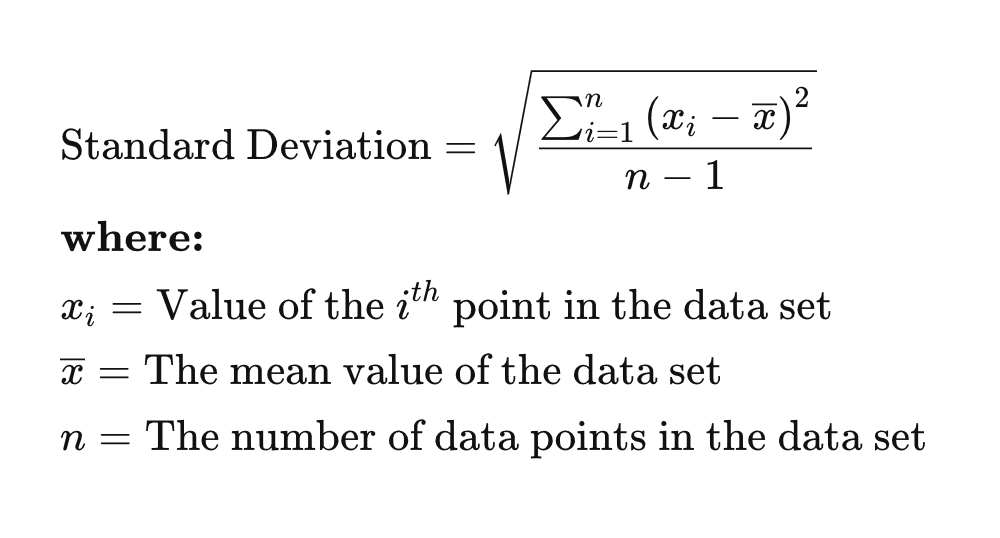
Standard deviation
a computed measure of how much values vary around the mean
Bell Curve
also known as the normal distribution, a symmetrical, bell-shaped curve that describes the distribution of various types of data.
Most scores fall around the mean (68% of data is 1 standard deviation away)
Statistical Significance
a statistical statement of how likely an observed result happened by chance.
Benefience
The ethical principle of acting to help others, promote their welfare, and do good.
Maleficence
the ethical principle of avoiding physical, mental, or emotional harm to others.
Research ethics
All experiments are approved by a board that determines if it follows both Beneficence and Nonmaleficence.
All experiments on animals must avoid as much harm as possible and be done for the public good
Informed Consent
all participants in an experiment must know about effects of any treatment.
Debrief
participants are told the specifics of their participation in the experiment after-the-fact.
Wilhelm Wundt
Father and creator of psychology in 1879
Edward Bradford Titchener(EBT)
Created Functionalism(Early school of thought)
Experiments involved the use of subjects introspection in order to find out brain functions
Wasn’t able to catch on because subjects often made things up in experiments due to lack of proper questioning
William James
1920’s philosopher who created functionalism based on evolutionary theory created by Charles Darwin
Confidentiality
participant information must be kept private
Random sampling
Subjects for any experiment are randomly selected out of a population to get rid of bias.
confirmation bias
tendency to confirm agreeable evidence and reject contradictory evidence.
Anchoring
The tendency to interpret new evidence only as a confirmation of existing theories.
Hindsight Bias
The tendency to say that something you didn’t know was known in retrospect.
Correlation
1 variable being affected by either the existance or amount of another variable
Positive correlation
as 1 variable is increased (Independent variable) a measurable action (dependent variable) Increases.
Negative correlation
as 1 variable is increased (Independent variable) a measurable action (dependent variable) Decreases.
BioPsych/Neuroscience
Study of how the brain's inner workings affect thoughts and behaviors.
Studies are used to treat brain damage and abnormalities
do genetics, brain chemistry, hormones, and nervous system activity change how you act?
Key words: Brain, Brain Chemicals, mentioning parts of brain/body
Sociocultural psychology
Psychology viewpoint that believes that behavior and thoughts are shaped by the culture, social norms, and environment of a persons surroundings.
effect of life on a persons thinking
Why do rural areas vote republican and urban areas vote democrat?
Key words: Culture, group/ social/ cultural influence, social norms
Illusory correlation
psychological phenomena where a correlation between 2 variables is when there really isn’t
Identical Twins
Twins that develop from a single fertilized egg, sharing 100% of their genetic material.
Fraternal Twins
Twins that develop from two separate fertilized eggs, sharing approximately 50% of their genetic material.
Genetically Predisposed Traits in Twins
Characteristics shown by twin studies to be heavily influenced by heredity, including personality, intelligence, abilities, attitudes, interests, fears, brain waves, and heart rate.
Parental Influence
Environmental factors primarily shaped by parents, including attitudes, values, manners, beliefs, faith, and political views, as well as learned fears acquired through mimicry.
Adoption Studies
Research comparing adopted children with their biological and adoptive relatives, showing that adopted children tend to share personality traits more with biological parents than adoptive parents.
Gene-Environment Interaction
The phenomenon where biological or genetic traits evoke specific social and environmental responses, demonstrating how nature and nurture interact.
Example: People respond differently to different individuals (such as Nicki Minaj vs. classical violinist Hilary Hahn) based on biological appearance and social presentation.
Interaction (Psychology)
The interplay that occurs when the effect of one factor (such as environment) depends on another factor (such as heredity).
Peer Pressure / Peer Influence
The impactful role that peers play in individual development as people learn social norms, behavior, and adaptation through playing and partnering with peers.
Individualism
A cultural perspective that prioritizes personal goals over group goals and defines identity in terms of personal attributes rather than group identification.
Example: Mainstream American culture is largely individualistic.
Collectivism
A cultural perspective that prioritizes group goals over individual goals and defines identity based on group membership and cultural traditions.
Example: Native American tribal cultures strongly exhibit collectivist values.
Sex (Biological)
The biologically influenced characteristics, such as anatomy, chromosomes, and physiology, used to define males and females.
Gender
The socially influenced characteristics, roles, and expectations that a culture associates with defining men and women.
Temperament
A person's characteristic emotional reactivity and intensity.
Identical twins demonstrate similar temperament levels, showing that temperament is largely hereditary.
Heritability
The proportion of variation among individuals in a group that can be attributed to differing genes.
Focuses on explaining the variance between individuals within a group rather than the individual trait itself.
Group Differences (Heritability)
Variations between groups that are strongly influenced by environmental factors.
Intragroup genetic comparisons cannot be directly applied to explain differences between different groups.
Heritability estimates (such as 50%) represent group averages rather than individual trait composition.
Genes
The biochemical units of heredity that make up chromosomes and code for all genetic traits.
Rosenzweig Experiment
An experiment demonstrating neuroplasticity, where rats raised in enriched environments developed a significantly thicker cerebral cortex compared to rats raised in impoverished environments.
Brain Development and Plasticity
The ongoing capacity of the human brain throughout life to form new neural connections and alter brain chemistry in response to experience.
Cultural Norms
Understood and accepted rules for expected behavior shared within a cultural group, often upheld through social influences.
Personal Space
The preferred physical buffer zone maintained around one's body to feel comfortable, which varies significantly by culture.
Memes (Cultural)
Shared cultural elements, such as fashion trends, ideas, or humor, that spread rapidly between individuals within or across cultures.
Gender Roles
A set of expected social behaviors, attitudes, and traits designated for men and women by a specific culture.
Gender Identity
An individual's personal, internal sense of their own gender.