psy
 Call Kai
 Learn
 Practice Test
 Spaced Repetition
 Match
 Flashcards
 Knowt Play
1/55

There's no tags or description
Looks like no tags are added yet.
56 Terms
Accidents
Studying people who have brain damage from unexpected injuries to learn what different brain areas do.
Lesions
Damage to or destruction of brain tissue; helps researchers understand brain functions.
EEG
Records electrical activity in the brain using electrodes placed on the scalp.
EEG Uses
Commonly used to study sleep stages and detect seizures.
CT/CAT Scan
Uses X-rays to create pictures of brain structure; helps find tumors, injuries, and bleeding.
CT Scan Limitation
Shows brain structure but not brain activity or function.
MRI
Uses magnetic fields and radio waves to create detailed images of brain structure.
MRI Use
Used when doctors need detailed pictures of brain tissue and possible damage.
PET Scan
Shows brain activity by tracking how much radioactive glucose different areas use.
PET Scan Use
Helps identify which brain areas are active during certain tasks.
PET Scan Limitation
Uses a radioactive tracer and does not show activity in real time.
fMRI
Measures changes in blood oxygen to show which brain areas are active.
fMRI Advantage
Shows brain activity and detailed brain structure without radiation.

Brain Stem
the stalk-like structure at the base of the brain that connects the cerebrum and cerebellum to the spinal cord. it includes overlaps with the hind brain and includes medulla, pons, Reticular Formation,
Medulla
Controls automatic functions like breathing, heartbeat, and blood pressure.
Reticular Formation
controls arousal (consciousness or not) and ability to focus our attention.
Pons
Helps control sleep, dreaming, breathing, and movement.
Cerebellum
Controls balance, coordination, posture, and learned movements.
Cerebral Cortex
Outer layer of the brain responsible for thinking, processing information, and complex behaviors.
Limbic System
(found in fore brain) Group of brain structures involved in emotion, motivation, and memory. includes hypothalamus, hippocampus, amygdala
Thalamus
Sensory relay station that sends most sensory information to the correct brain areas.
Hypothalamus
Controls hunger, thirst, body temperature, and other basic drives.
Pituitary Gland
Releases hormones and controls other endocrine glands; called the master gland.
Hippocampus
Helps form and organize new explicit memories.
Amygdala
Processes emotions, especially fear and aggression.
Corpus Callosum
Thick bundle of nerve fibers connecting the left and right hemispheres.

Occipital Lobes
the smallest pair of the four major brain lobes. They sit at the back of the head and their main job is to receive and process visual information from the eyes so you can understand what you see.
Temporal Lobes
two areas of the cerebral cortex on the left and right sides of the brain near the temples/ears. They help with hearing, understanding language, memory, recognizing objects and faces, and processing emotions.
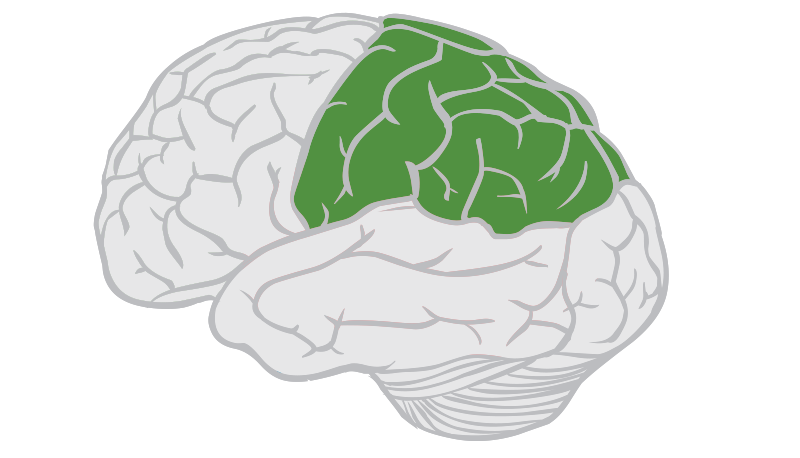
Parietal Lobes
a pair of brain regions located near the top and back of the cerebral cortex that process touch, body position, and spatial awareness
Association Areas
Brain areas that combine information and help with learning, memory, thinking, and problem-solving.
Somatosensory Cortex
Processes body sensations like touch, pressure, pain, and temperature.
Frontal Lobes
Involved in planning, decision-making, personality, and voluntary movement.
Prefrontal Cortex
Part of the frontal lobe responsible for planning, judgment, decision-making, and self-control.
Motor Cortex
Controls voluntary muscle movements.
Broca's Area
Brain area involved in producing speech.
Wernicke's Area
Brain area involved in understanding spoken and written language.
Gray Matter
Brain tissue containing mostly neuron cell bodies; processes information.
White Matter
Brain tissue containing mostly myelinated axons; carries messages between brain areas.
Linguistic Processing
The brain's ability to understand, process, and produce language.
Higher-Order Thinking
Complex thinking skills like reasoning, problem-solving, and decision-making.
Executive Functioning
Mental skills that help with planning, focus, self-control, and managing tasks.
Split-Brain Research
Research studying people whose corpus callosum has been cut to understand how the two hemispheres work.
Hemispheric Specialization
The idea that each brain hemisphere specializes in certain functions.
Left Hemisphere
Usually specializes in language, speech, logic, and analytical processing.
Right Hemisphere
The hemisphere that usually specializes in spatial awareness, facial recognition, and processing patterns.
Contralateral Hemispheric Organization
Each brain hemisphere controls the opposite side of the body.
Aphasia
Difficulty with language caused by brain damage.
Broca's Aphasia
Difficulty producing speech; a person knows what they want to say but struggles to speak.
Wernicke's Aphasia
Difficulty understanding language; speech may be fluent but lack meaningful content.
Plasticity
The brain's ability to change, reorganize, and form new connections.
H.M.
Famous patient who could no longer form new explicit memories after surgery involving his hippocampus.
Synaptic Pruning
The brain removes weaker or unused neural connections to make communication more efficient

Hind Brain
The lower part of the brain that controls vital functions such as breathing, heart rate, and reflexes these parts include: pons, medulla, cerebeilum

Fore Brain
What makes us human.
Largest part of the brain.
Made up of the Thalamus, Limbic System, Cerebrum ,hypothalamus (outside of cerebrum is Cerebral Cortex.)
Cerebrum
(also called the telencephalon) is the largest part of the brain, forming the upper and front regions that govern conscious thought, voluntary movement, sensation, language, and memory.

Midbrain
is the smallest part of the brainstem, located between the forebrain and hindbrain. includes Reticular Formation