Oxidative Phosphorylation
 Call Kai
 Learn
 Practice Test
 Spaced Repetition
 Match
 Flashcards
 Knowt Play
1/20

There's no tags or description
Looks like no tags are added yet.
21 Terms
Oxidative Phosphorylation (Overview)
Oxidative phosphorylation is a metabolic process that converts NADH and FADH2 that are generated by other metabolic pathways into ATP.

ETC
The oxidative part of oxidative phosphorylation depends on the electron transport chain. The electron transport chain accepts electrons from NADH or FADH2 and transfers the electrons O2 to generating water.
The movement of electrons through the electron transport chain provides energy to move protons from mitochondrial matrix into the intermembrane space resulting in the formation of an electrochemical proton gradient across the inner mitochondrial membrane.
phosphorylation
The phosphorylation part of oxidative phosphorylation involves ATP synthase. ATP synthase uses the energy from the proton gradient across the inner mitochondrial membrane to synthesize ATP.
table
structural components, substrates, products, purpose

Oxidative phosphorylation 2
Oxidative phosphorylation consists of two parts.
The oxidative part of oxidative phosphorylation depends on the electron transport chain. The electron transport chain accepts electrons from NADH or FADH2 and transfers the electrons O2 to generating water.
The movement of electrons through the electron transport chain provides energy to move protons from the mitochondrial matrix into the intermembrane space resulting in the formation of an electrochemical proton gradient across the inner mitochondrial membrane.
The phosphorylation part of oxidative phosphorylation involves ATP synthase. ATP synthase uses the energy from the proton gradient across the inner mitochondrial membrane to synthesize ATP.
Electron Transport Chain Components
The electron transport chain consists of four protein complexes located in the inner mitochondrial membrane. The electron complex has contained components including iron and copper atoms that can gain and lose electrons. Enzymes in the complexes catalyze oxidation and reduction reactions.
There are two mobile electron carriers, coenzyme Q and cytochrome C, that are also part of the electron transport chain. Electrons from NADH and FADH2 move through components of the electron transport.
In complex four, electrons are donated to O2 forming water. There are many copies of the electron transport chain components in the inner mitochondrial membrane.
It is important to note that the representation of electron transport chain component shown here does not accurately show the pathway of electron movement or the organization of the components.

Electron Transport Chain Components 1
The electron transport chain consists of four protein complexes located in the inner mitochondrial membrane.
The electron complex has contained components including iron and copper atoms that can gain and lose electrons. Enzymes in the complexes catalyze oxidation and reduction reactions.
Electron Transport Chain Components 2
There are two mobile electron carriers, coenzyme Q (in inner membrane) and cytochrome C (inter membrane space), that are also part of the electron transport chain.
Electrons from NADH and FADH2 move through components of the electron transport.
Electron Transport Chain Components 3 what does complex 4 do
In complex four, electrons are donated to O2 forming water. There are many copies of the electron transport chain components in the inner mitochondrial membrane.
It is important to note that the representation of electron transport chain component shown here does not accurately show the pathway of electron movement or the organization of the components.
Overall Electron Transport Reactions
The chemical equation shown here represent the overall electron transport reaction for NADH and FAD2.
Both reactions, start with two electrons and consume one-half an O2 generating one molecule of water. The reactions can be doubled to account for the fact that usually one O2 is reduced using four electrons to avoid generating any potentially damaging oxygen species.
The overall reactions both have a large negative delta G, which means the process is very favorable.
The electron transport chain can function with electrons from NADH, FADH2, or both.

Proton Gradient Formation
The movement of electrons through the electron transport chain drives the movement of protons across the mitochondrial inner membrane into the intermembrane space.
The source and pathways traveled by the protons are still not fully understood.
When electron transport is active, the pH of the intermembrane space is significantly lower than the pH of the mitochondrial matrix due to the accumulation of protons.
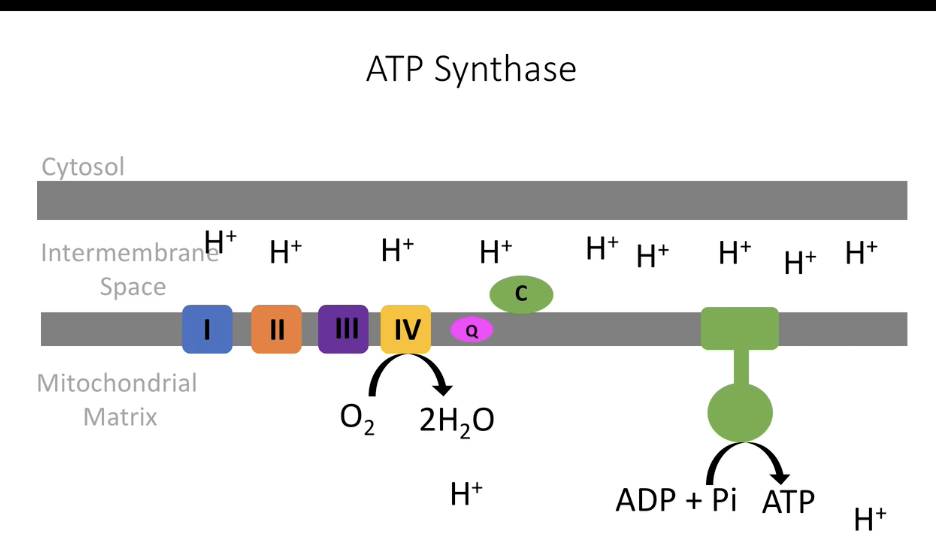
ATP Synthase
also called
where is it located
what does it do
ATP synthase represented here in green on the right is located in the inner mitochondrial membrane and is sometimes referred to as complex five.
ATP synthase moves protons across the inner mitochondrial membrane from the intermembrane space into the mitochondrial matrix.
ATP synthase uses the energy of the proton gradient generated by the electron transport chain to synthesize ATP from ADP and inorganic phosphate.
Proton Movement and ATP Yield
Two electrons donated by mitochondrial NADH to the electron transport chain, result in the movement of 10 protons across the inner mitochondrial membrane during electron transport which consumes one-half an O2 molecule.
Two electrons donated by mitochondrial FADH2 to the electron transport chain result in the movement of six protons during electron transport, which consumes one-half an O2 molecule.
Although there are some variation of the structure of ATP synthase, in a typical cell, the proton gradient results in the synthesis of 3 ATP per NADH and 2 ATP per FADH2 by ATP synthase. This is a theoretical maximum.
1 NADH
2 electrons, ½ O2
10 H+
3 ATP
1 FADH2
2 electrons, ½ O2
6 H+
2 ATP
ATP production by oxidative phosphorylation

Proton Leak and Uncoupling
The movement of protons out of the intermembrane space by ways that do not involve ATP synthase, which is referred to as proton leak, reduces the proton gradient.
Proton leak results in the uncoupling of electron transport and ATP synthesis, which means that the amount of electrons donated or oxygen consumed does not determine the amount of ATP synthesized.
Proton leak reduces the amount of ATP made for each molecule of NADH and FADH2 oxidize by the electron transport chain.
Estimates for the amount of the proton gradient loss under physiological conditions range from 20% to 50%.
Proton Leak and Uncoupling
what is it
The movement of protons out of the intermembrane space by ways that do not involve ATP synthase, which is referred to as proton leak, reduces the proton gradient.
proton leak result
Proton leak results in the uncoupling of electron transport and ATP synthesis, which means that the amount of electrons donated or oxygen consumed does not determine the amount of ATP synthesized.
Proton leak reduces the amount of ATP made for each molecule of NADH and FADH2 oxidized by the electron transport chain.
proton leak stats
Estimates for the amount of the proton gradient loss under physiological conditions range from 20% to 50%.
Types of Proton Leak
Proton leak is divided into two types, unregulated or basal proton leak, and regulated or inducible proton leak.
Protons loss through unregulated proton leak are loss continuously through mechanisms that are always active.
Protons loss through regulated proton leak are part of specific processes that are not always occurring. One example is the activity of membrane transporters that use the proton concentration gradient to move other molecules across the membrane.
The transport of charged molecules other than protons across the inner mitochondrial membrane can also reduce the energy of the electrochemical proton gradient.
The estimated realistic maximum ATP production 2.5 ATP per NADH and b per FADH2 accounts for the typical levels of proton leak.

Summary of Oxidative Phosphorylation
In summary, the electron transport chain transfers electrons from NADH and FADH2 to O2. Movement of electrons through the electron transport chain results in the movement of protons across the inner mitochondrial membrane forming an electrochemical gradient. The proton gradient generated by electron transport is used for the synthesis of ATP by ATP synthase. The theoretical maximum amount of ATP generated by oxidative phosphorylation is 3 ATP per NADH and 2 ATP per FADH2. The amount of ATP generated by oxidative phosphorylation is reduced by uncoupling of electron transport and ATP synthesis caused by proton lea
type of proton leak
