Neoplasia 1: Important Definitions and Cytological Features of Malignancy
 Call Kai
 Learn
Learn Practice Test
 Spaced Repetition
 Match
Match Flashcards
 Knowt Play
1/24

There's no tags or description
Looks like no tags are added yet.
Name | Mastery | Learn | Test | Matching | Spaced | Call with Kai | Chat |
|---|
No analytics yet
Send a link to your students to track their progress
25 Terms
Define Neoplasia
a process of ‘new growth’
continued proliferation (expands beyond normal anatomical boundaries)
Describe Neoplasia (what is it a result of, what is it unresponsive to, and what does it result in)
result of irreversible genetic change
unresponsive to intrinsic (the cell itself) or extrinsic (surrounding normal cells) growth control signals
results in macroscopic or microscopic neoplasm
List two other common terms of neoplasia
Tumor = swelling
Cancer = crab-like infiltrative appearance
Define ‘Onco’ and Define Oncology
Onco = mass/tumor
Oncology = study of neoplasia
What kind of growths do the generic terms ‘Neoplasm’ and ‘tumor’ describe?
Benign and Malignant
Is cancer benign of malignant?
malignant
Define benign (type of growth, what the growth does not do, curable? fatal?) and list the exceptions for it
HARMLESS growth
does not:
invade surrounding tissue
spread to new anatomic locations
frequently curable
rarely fatal (if treated appropriately)
Exceptions:
critical space-occupying lesion (cranial cavity or spinal canal)
non-invasive but compressive intracranial/CNS tumors
Define Malignant (type of growth, where does it invade and spread, is it fatal?)
HARMFUL growth
invades surrounding tissues
spreads to distant anatomical locations (metastasis)
frequently fatal
why are malignant growths usually fatal?
compromise critical body functions

Are all swellings/masses neoplasms?
NO
they can also be abscesses (inflammatory and necrotic processes)

What kind of process is tumor development?
stepwise process
What are preneoplastic changes a response to? Can preneoplastic changes resolve?
response to:
physiological demands
injury
chronic inflammation
irritation
resolve if cause is removed
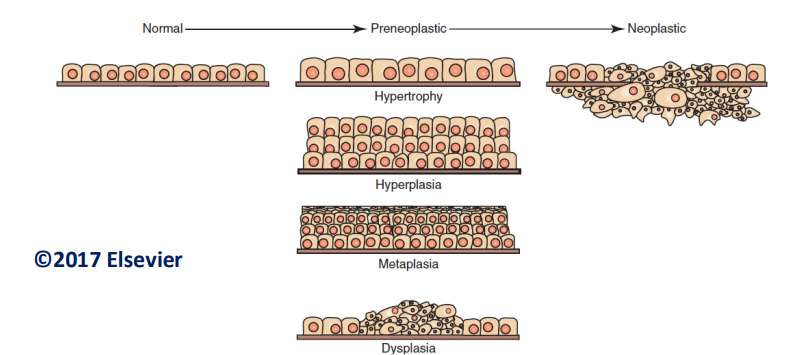
List preneoplastic changes
Hypertrophy
Hyperplasia
Metaplasia
Dysplasia
Anaplasia/Atypia
What does Anaplasia/Atypia indicate?
indicator of irreversible progression to neoplasia
Define Hypertrophy, Hyperplasia, Metaplasia, Dysplasia and Anaplasia/Atypia
Hypertrophy
increase in size of individual cells
Hyperplasia
increase in number of cells
Metaplasia
transformation of one differentiated type to another cell type
Dysplasia
abnormal growth pattern with disordered arrangement of cells
Anaplasia/Atypia
loss of cellular differentiation
List tumor types / cell of origin
Mesenchymal tumors
include “round cell” hematopoietic/lymphoid
Epithelial Tumors
Tumors of Neural Crest Cells
Tumors of Uncertain Origin
Mixed Tumors
Tumor-like Lesions
Describe Mesenchymal Tumors (what tissue do they arise from, what are they composed of, how are they arranged, what are they called if they are benign or malignant)
arise from embryonic mesodermal tissue
CT, adipose, cartilage, bone, epithelium + related tissues, muscle, etc)
composed of spindle-shaped cells
arranged in streams, bundles, and fasicles
Benign = cell type plus ‘oma’
Malignant = cell type plus ‘sarcoma’
What other two types of tissue do mesenchymal tumors “technically” include?
Hematopoietic and lymphoid tissue
Describe round cell tumors (mesenchymal tumor) (what tissue do they arise from, how are they arranged)
hematopoietic and lymphoid tissues
arranged in solid sheets
What is a lymphoma
type of round cell tumor
tumor of lymphoid cells
B or T lymphocytes derived
Define leukemia
type of round cell tumor
caused by abnormal blood cells/precursors in blood and bone marrow
presence of neoplastic cells in circulation
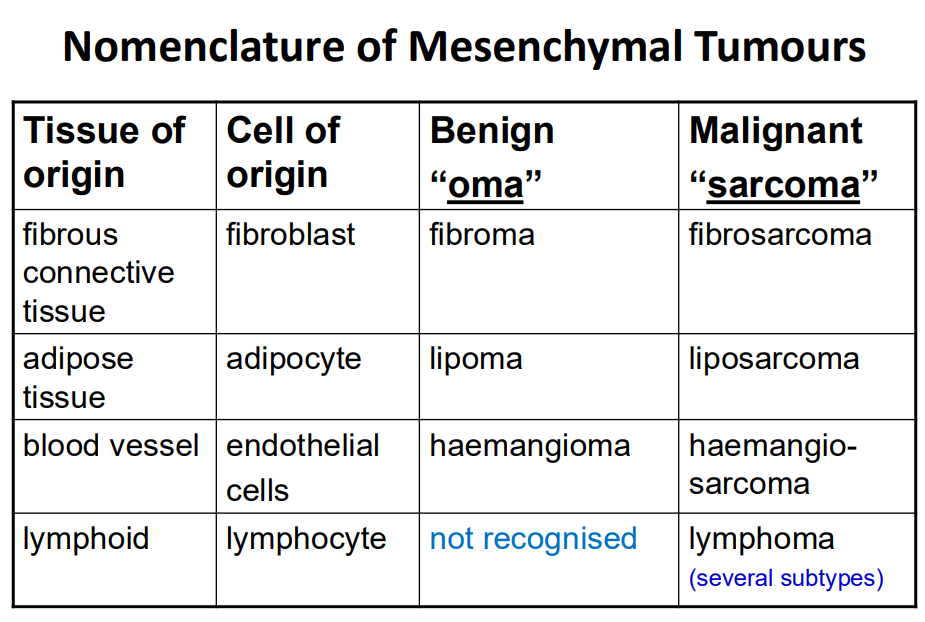
What are the benign counterparts for lymphomas and leukemias?
there are NO benign counterparts
all considered MALIGNANT
How are mast cell tumors (MCTs) distinguished?
low grade vs high grade