Equilibrium Law and Constant
 Call Kai
 Learn
 Practice Test
 Spaced Repetition
 Match
 Flashcards
 Knowt Play
1/19

There's no tags or description
Looks like no tags are added yet.
20 Terms
Define Equilibrium Law. What are its’ general and mathematical equations?
A mathematical description of a chemical system at equilibrium
General Equation: aA + bB ⇌ cC + dD
Mathematical Equation:

What does K stand for in the equilibrium law?
K – equilibrium constant, defines the equilibrium law for a given system
State some rules for the EQUILIBRIUM CONSTANT
Gives a measure of the equilibrium position of the reaction
K values are written WITHOUT units
The concentrations used in a K expression are at EQUILIBRIUM
The equilibrium constant of a forward and reverse reaction are RECIPROCAL quantities
What types of equilibria are there?
HOMOGENEOUS
HETEROGENEOUS
Explain a HOMOGENEOUS equilibria.
reactants and products are in the SAME state (e.g. gaseous or aqueous)
Explain a HETEROGENEOUS equilibria
reactants and products are NOT in the same state
State some rules associated with Heterogeneous Equilibria
The position of heterogeneous equilibria does not depend on amounts of pure SOLIDS or pure LIQUIDS present
The concentration of pure solids and pure liquids CANNOT change
THEREFORE
If pure liquids or pure solids are involved in a chemical reaction, DO NOT include them in the equilibrium expression
Give an example of a HETEROGENEOUS equilibria. Explain how it works.
The equilibrium involving CaCO3, CaO, and CO2, is a heterogeneous equilibrium
As long as some CaCO3, or CaO remain in the system, the amount of CO2, above the solid will remain the same.
The amounts of the solids are irrelevant in determining the value of K.
Relate how the K constant affects Equilibrium Position

Define the Reaction Quotient (Q)
The product of the concentrations of the products, divided by the product of the concentrations of the reactants for a chemical reaction that is not necessarily at equilibrium.
The equilibrium law is applied using instantaneous concentrations.

How can Q be compared to K to determine if equilibrium has been reached?
If Q is LESS THAN K:
The ratio of the concentrations of the products is LESS THAN the ratio of the concentration of the reactants.
The reaction will shift to the RIGHT until equilibrium is reached.
If Q is EQUAL to K:
The system is at equilibrium.
No shift will occur.
If Q is GREATER THAN K:
The ratio of the concentrations of the products is GREATER THAN the ratio of the concentrations of the reactants.
The reaction will shift to the LEFT until equilibrium is reached.
Define Le Chatelier’s Principle.
When a chemical system at equilibrium is disturbed, the system adjusts in a way that OPPOSES the change.
equilibrium → equilibrium shift → new equilibrium
EQUILIBRIUM SHIFT: a change in concentrations of reactants and products in order to restore an equilibrium state
Equilibrium Shift can be caused by a change in:
CONCENTRATION
TEMPERATURE
PRESSURE/VOLUME

How does Concentration affect Equilibrium Shift?
If you INCREASE concentration:
The system will shift to CONSUME some of the added reactant or product
If you DECREASE concentration
The system will shift to REPLACE some of the removed reactant or product
How does Temperature affect Equilibrium Shift?
If you INCREASE the temperature:
The system will shift to CONSUME some of the added thermal energy
Favours ENDOTHERMIC reactions
If you DECREASE the temperature:
The system will shift to REPLACE some of the removed thermal energy
Favours EXOTHERMIC reactions
How does Pressure and/or Volume affect Equilibrium Shift?
If you INCREASE the volume (or a DECREASE in pressure)
The system shifts toward the side with the LARGER total amount of gaseous entities
If you DECREASE the volume (or an INCREASE in pressure)
The system shifts toward the side with the SMALLER total amount of gaseous entities
What are factors that do NOT affect equilibria?
Catalysts
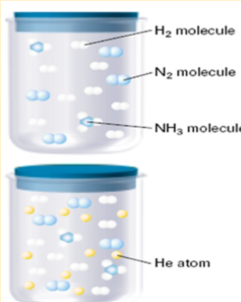
Inert gases
A substance in a different state of matter
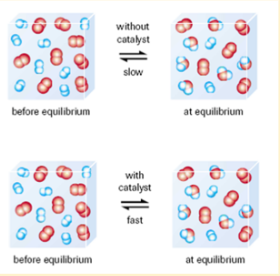
Why dont Catalysts affect equilibria?
DO NOT change the equilibrium position
DO NOT change the concentration of reactants and products
INCREASE the reaction rate forward and reverse equally
ALLOW the reaction to reach equilibrium much faster
Why dont Inert Gases affect Equilibria?
CANNOT react with the other entities in the system
CHANGES probability of successful collisions for both the reactants and products equally, resulting in no shift in the equilibrium system
Why doesnt the State of Reactants affect equilibria?
Equilibrium is ONLY affected by changes in concentration of entities that are in the SAME state
EXAMPLE:
H2 (g) + I2 (s) ↔ 2 HI (g)