Exam 3- Analytical Chemistry
 Call Kai
 Learn
 Practice Test
 Spaced Repetition
 Match
 Flashcards
 Knowt Play
1/113

There's no tags or description
Looks like no tags are added yet.
114 Terms
Kw =
[H+][OH-]
the larger the Ka
the stronger the acid
Acid dissociation constant
(Ka) equilibrium constant for a weak acid reacting with water
a weak acid will…
not completely dissociate
Ka =

base hydrolysis constant
(Kb) equilibrium constant for a weak base reacting with water
a weak base…
does not completely dissociate
Kb =

pKa =
-log (Ka)
Ka x Kb =
Kw
as K increases…
pK decreases
Fraction of dissociation symbol
α
Fraction of dissociation α (definition)
fraction of acid in form A-
α = (equation)
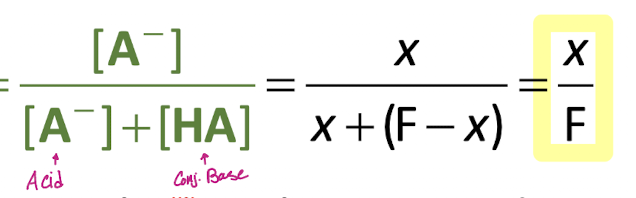
Weak electrolytes dissociate more as…
they are diluted
Buffer
solution of an acid and its conjugate base that resists changed in pH when acids or bases are added or when dilution occurs
Henderson-Hasselbalch equation

if [A-] = [HA] then…
pH = pKa
Buffer capacity β
measure of how well a solution resists changes in pH when a strong acid or base is added
Which pair of compounds will make a buffer in an aqueous solution?
HCN and NaCN
Which equation shows the correct relationship between the Ka and Kb values for a diprotic species?
Ka1 x Kb2 = Kw
The amino acid valine pK1 = 2.29 and pK2 = 9.71. What is/are the principal species at pH 6.00
HV
True or False:
When both a strong acid and a weak acid are titrated with a strong base, the pH at the equivalence point is equal to 7
false
Consider the titration of a monoprotic acid with a strong base. A buffer solution is formed…
before the equivalence point of a weak-acid-strong-base titration.
A 30.00-mL aliquot of 0.1500 M weak acid (HA) solution is titrated with 0.1000 M NaOH. Calculate the pH of the solution when 15.00 mL of 0.1000M NaOH has been added. HA has a Ka = 4.75e-6
5.02
The titration solution essentially only contains a weak acid…
at the equivalence point of a weak-base-strong-acid titration.
Select the TRUE statement about the properties of light.
the shorter the wavelength, the higher the frequency
True or False:
Transmittance is directly proportional to concentration.
False
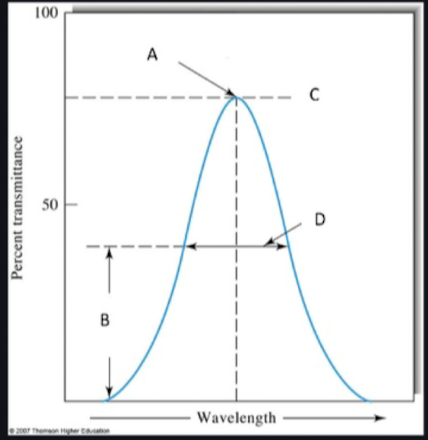
Label D refers to…
effective bandwidth
Ultraviolet-visible absorption spectroscopy is widely used because it is…
a) widely applicable to organic and inorganic compounds
b) simple
c) inexpensive
all of the above
Identify the oxidizing agent in the following redox reaction.
2H+(aq) + Zn(s) → H2(g) + Zn2+(aq)
H+

Identify the anode in the galvanic cell shown.
Fe(s)

Identify the line diagram for the cell shown
Cd(s)ICd(NO3)2(aq)IIAgNO3(aq)IAg(s)
Which is NOT a function of a salt bridge in an electrochemical cell?
providing electron transfer from the cathode to the anode

Use the table to identify the strongest oxidizing agent
MnO4-

Consider the following half-reactions and standard reduction potentials:
Ag+ can oxidize Ni to Ni2+
Diprotic Systems
have 2 acidic or basics sites
When a diprotic system is in its acidic form….
it is fully protonated and cannot accept more protons
When a diprotic system is in its basic form….
it is fully deprotanated and has no more protons to give
When dealing with a diprotic system
Kw =
Ka1 x Kb2 OR Ka2 x Kb1
In regards to diprotic Acids
H2L+
fully protonated form
In regards to diprotic Acids
HL
intermediate form
In regards to diprotic Acids
L-
fully basic form
In regards to diprotic bases
L-
can undergo two hydrolysis reactions & it behaves as a monobasic system with Kb = Kb1

For the diprotic system given, define the pH for each major species
H2A, HA-, A2-
H2A : pH < pK1
HA- : pK1 < pH < pK2
A2-: pH > pK2
When titrating a strong base with a strong acid, the pH before the equivalence point is determined by…
excess OH- in the solution
When titrating a strong base with a strong acid, the pH at the equivalence point is
determined by the dissociation of water (usually 7)
When titrating a strong base with a strong acid, the pH after the equivalence point is determined by…
the excess H+ in the solution
When titrating a weak acid with a strong base, how do you determine the pH when you are at the half equivalence point?
pH = pKa
When titrating a weak acid with a strong base, before titrant is added how do you determine the pH of the solution?
solution only contains weak acid (HA), so use Ka and the quadratic equation to find [H+] to solve for pH
When titrating a weak acid with a strong base, once you start adding titrant but have not reached equivalence how do you determine pH?
the mixture is a buffer whose pH can be calculated with the Henderson-Hasselbalch equation using the pKa of your weak acid
When titrating a weak acid with a strong base, when you have reached equilibrium how do you determine pH?
All of weak acid has been consumed, so pH is determined by the Kb equilibrium and you must find the new concentration of A-
When titrating a weak acid with a strong base, when you have passed equilibrium how do you determine pH?
there is an excess of OH-, so find [OH-] and plug into pH = -long (Kw/[OH-])
spectroscopy
science that deal with the interaction of various types of radiation with matter
Frequency (v) (definition)
number of oscillations of the field that occur per second
Period
the time in seconds required for the passage of successive maxima or minima through a fixed point in space
wavelength (λ)
linear distance between any two equivalent points on successive waves
propagation velocity (vi) (definition)
depends on the composition of the medium it passes through & is slowed by the interaction of the electromagnetic field and the bound electron of the medium
Diffraction of radiation
process in which a parallel beam of radiation is bent as it passes by a sharp barrier or through a narrow opening
constructive interference
when two opposing waves meet that are in step ( a and b) they form an additive wave (a+b)

Destructive Interference
when two opposing waves meet that are out of step, they cancel each other out

Photoelectric Effect
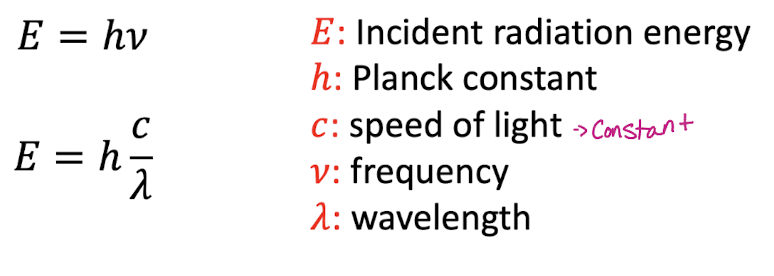
electromagnetic radiation is composed of particles called photons which carry energy
E equation
Absorption Spectroscopy
finding how much energy a sample absorbs when light is run through it
Incident radiation
P0
Transmitted radiation
P
Transmittance (T) formula
transmitted radiation / incident radiation

Absorbance (A) formula
-log (transmittance)
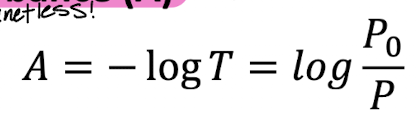
Beer’s Law

When using spectroscopic instruments your source needs to…
generate sufficient power for easy detection and be stable for reasonable periods of time
advantages of using a single-beam spectrophotometer
cheaper, faster, and uses the same detector
disadvantages of using a single-beam spectrophotometer
time consuming and venerable to any instability in source or detector
How is the ‘double-beam’ in a double-beam spectrophotometer acheived?
by splitting the initial beam into two
advantaged of using a double-beam spectrophotometer
faster and compensation for source fluctuations and drift in detector and amplifier
as effective bandwidth gets narrower
better performance is expected
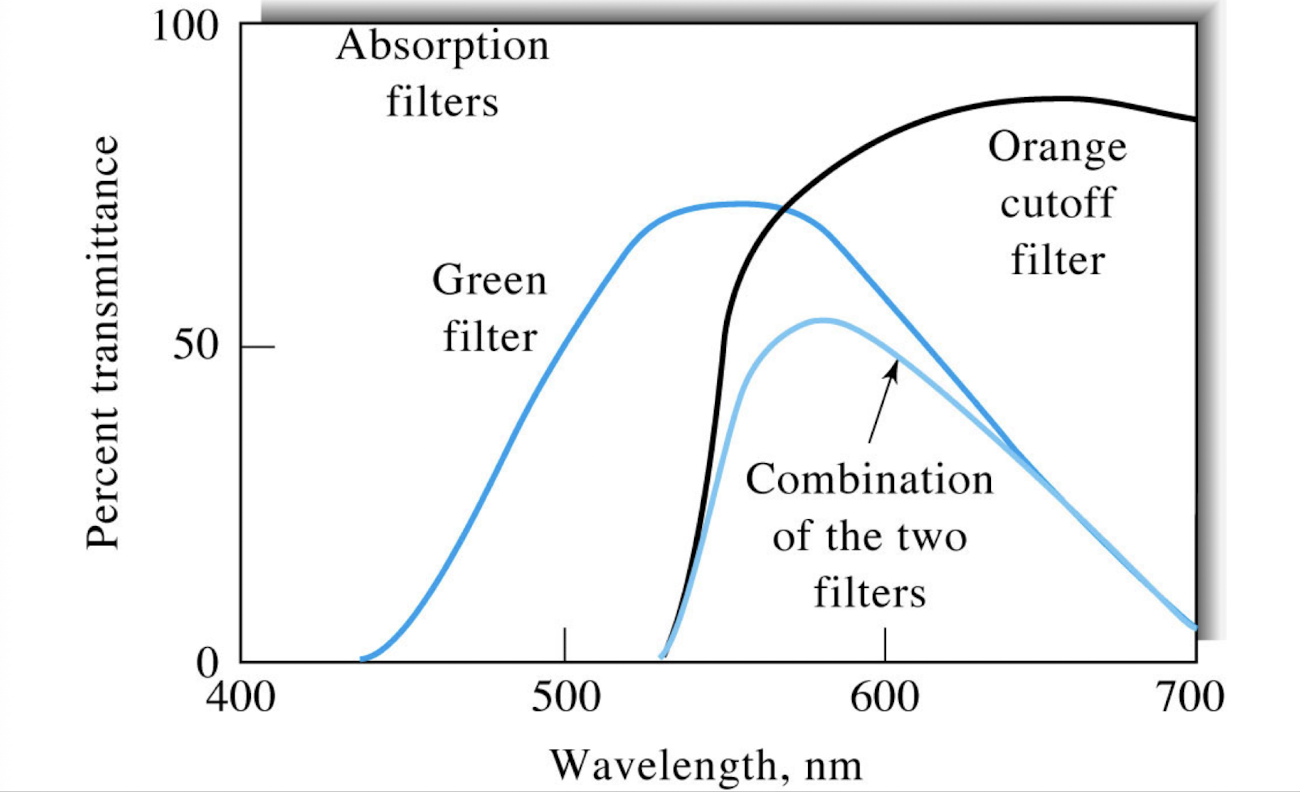
absorption filters
wavelength selector that is less expensive and functions by absorbing selected proportions of the spectrum
cutoff filters
type of absorption filter that has 100% transmittance over a proportion of the visible light and 0% over the remainder of the spectrum, which causes a combination that has a smaller bandwidth
Monochromators
Wavelength selectors that allow you to continuously vary the wavelength over a broad range
the number of electrons ejected from the cathode surface in a vacuum phototuble is…
directly proportional to the radiant power
A photomultiplier tube acts as a radiation detector by
allowing radiation to strike multiple dynodes, which leads to 10e6 - 10e7 electrons/incident photon which is converted to voltage that can be measured
the advantages of photomultiplier tubes are
extremely fast response and used in UV and Visible regions
the limitations of Photomultiplier tubes are
sensitivity is limited by dark current (often caused by thermal emission) so they must be cooled & limited to low power radiation to avvoid damage to photoelectric surface
UV-Vis spectroscopy benefits
fast, simple, & inexpensive
UV-Vis spectroscopy can be used for
analytes that can be dissolved in solvents like water, ethanol, and hexane
analytes that absorb UV or visible light
quantitative measurements of a single analyte in solution
UV-Vis spectroscopy is unsuitable for
analytes that have a photochemical reaction at the wavelength range of interest
unclear or colloidal samples
Chromophore
molecule containing a functional group that is capable of absorbing UV-Vis radiation
Intensely absorbing compounds bust be examined in
dilute solutions
Wavelength of 200 - 400 nm
UV
Wavelength of 400 - 800 nm
Visible
Most commonly used solvents for UV-Vis spectroscopy
water, ethanol, hexane, and cyclohexane
Electrochemistry
use of electrical measurements of chemical systems for analytical purposes that is relatively inexpensive equipment, has potential for miniaturization and requires little sample preparation
redox reaction (electrochemical reaction)
transfer of electrons from one reagent to another
Oxidizing agent (oxidant)
takes electrons from the reducing reagent and is reduced
reducing agent (reductant)
gives electrons to the oxidizing agent and is oxidized
oxidization is
loss of electrons & charge becomes more positive
reduction is
gain of electrons & charge becomes more negative
electrical charge
measurable property of the electrons that are transferred in a redox reaction, measured in coulombs (C)
Faraday constant (F)
magnitude of the charge on a mole of electrons
= 9.649 × 10⁴ C/mol
electric current
quantity of charge flowing each second through a circuit, measured in ampere (A)
unit for ampere
C/sec