Lipid Metabolism
 Call Kai
 Learn
Learn Practice Test
 Spaced Repetition
 Match
Match Flashcards
 Knowt Play
1/35

There's no tags or description
Looks like no tags are added yet.
Name | Mastery | Learn | Test | Matching | Spaced | Call with Kai | Chat |
|---|
No analytics yet
Send a link to your students to track their progress
36 Terms
nutrient lipids
soluble in organic solvents
may serve as an energy source
constituent of cell and organelle membranes
fat-soluble vitamins
corticosteroid hormones
mediators of e- transport (coenzyme Q)
simple lipids
fatty acids (FA)
mono-, di-, tri-acylglycerides (MAG, DAG, TAG)
compound lipids
combined with another molecule, major class
phospholipids, glycolipids, lipoproteins
derived lipids are obtained from simple or compound lipids that still possess the property of lipids (ex. sterols)
fatty acids
important in energy metab, length ranges from 4-24 carbons
saturated, monounsaturated, polyunsaturated
FA notation
Delta: 18:2/\ ^9,12
Omega: 18:2n-6; dbl bonds separated by 3C

fatty acid characteristics
most important nutritionally and functionally are 14+C
palmitic acid (16:0), stearic acid (18:0), oleic acid (18:1) and linoleic acid (18:2) combine for >90% of FAs in the american diet
fat deficient diet → delayed growth, dermatitis, kidney lesions, early death
essential FAs
linoleic acid and a-linolenic acid
only found in plants (vertebrates cannot desaturate past delta 9 carbon, lack delta12 and delta15 desaturase)
vertebrates can further desaturate 18:2delta9,12 (18:2n-6) in the delta 6 position
FAs can elongate in increments of two carbons
lipid: functions
supply metabolic energy by oxidation of FA to CO2
structural component of cell membranes (phospholipids/sphingolipids)
lubricants
signaling molecules: regulatory roles in metabolism
lipid metabolism: fed

lipid metabolism: fasted

TAG metabolism

de novo FA synthesis
glu → pyruvate, transported to mitochondria
acetyl-CoA formed via PDH complex
acetyl CoA is substrate for citrate
citrate transported back to cytoplasm

acetyl CoA → palmitate (16:0) (de novo FA synthesis)
first and rate limiting reaction is carboxylation of acetyl CoA to malonyl CoA by acetyl CoA carboxylase (ACC)
down regulated by
palmitoyl CoA (endproduct regulation)
phosphorylation of the enzyme
up regulated by
citrate (allosteric)
dephosphorylation of the enzyme (influenced by insulin:glucagon)
FA synthase (FAS) (de novo FA synthesis)
second and final committed step in FA synthesis
FA synthesis from acetyl CoA and malonyl CoA
FAS catalyzes a series of reactions
v large polypeptide that includes an acyl carrier protein (ACP)
ACP: carrier of acyl intermediates during fatty acid synthesis
control - low in fasted state, increases in fed state
substrates of one palmitate (16:0) molecule by FA synthase
7 malonyl CoA
1 acetyl CoA
14 NADPH
14 H+
FA elongation
occurs in ER +/or mitochondria
ER enzymes lengthen FA produced by FAS as well as dietary polyunsaturated FA
involves condensation of acyl CoA groups with malonyl CoA → product is 2 C longer
catalyzed by Fatty Acid Elongases
FA desaturation
occurs in ER membranes
involves 4 fatty acyl desaturase enzymes (delta 9,6,5, and 4) and delta 4 fatty acyl-CoA desaturase
mammals cannot incorporate a dbl bond beyond delta 9, plants can
FA synthesis hormonal control
insulin - high in fed state, up regulates FA synthesis
glucagon - high in fasted state, down regulates FA synthesis
FAs: inflammation, disease, immunity
FAs are crucial to the immune system - provide structural basis of cell membranes, act as signaling molecules, provide major energy substrate
FA-derived eicosanoids contribute to the inflammatory response
n-6 PUFA → arachidonic acid: precursor of most important pro-inflammatory eicosanoids
n-3 PUFA derivatives, eicosapentaenoic acid (EPA) and docosahexaenoic acid (DHA) metabolites are considered less inflammatory
eicosanoids
prostaglandins (PG), thromboxanes (TX), leukotrienes (LT) and lipoxins (LX)
produce a wide range of biological effects
on inflammatory responses
on the intensity and duration of pain and fever
on reproductive function
important roles in —| gastric acid secretion, regulating BP through vasodilation and constriction, and —| or +→ platelet aggregation and thrombosis
equine exercise induced pulmonary hemorrhage (EIPH)

TAG synthesis
main storage of FAs in body
esters of glycerol (backbone) and 3 FAs
substrates: glycerol-3-phosphate and fatty acids
most FA synthesized or ingested have two fates
incorporated into triacylglycerols for the storage of metabolic energy (in all cells, predominantly in adipocytes)
incorporation into the phospholipid components of membranes
TAG function
storage of metabolic energy
high energy content
synthesized from excess carbohydrates
liver, intestine, and adipose most active
sources of glycerol-3-phosphate
dihydroxyacetone phosphate (glycolytic/gluconeogenic intermediates)
glycerol (recycled by liver)
fatty acid sources
de novo synthesis
hydrolysis of TAG in cell
FA from circulation (diet)
monoacylglycerol pathway

TAG catabolism
hormones signal the release of FA from adipose tissue (insulin, glucagon, epinephrine)
FA are metabolized from adipocytes in response to hormone messengers
adipose triglyceride lipase (ATGL) - rate limiting, induced by PPAR agonists, glucocorticoids, fasting
hormone sensitive lipase
monoacylglyceride lipase

overview of FA degredation
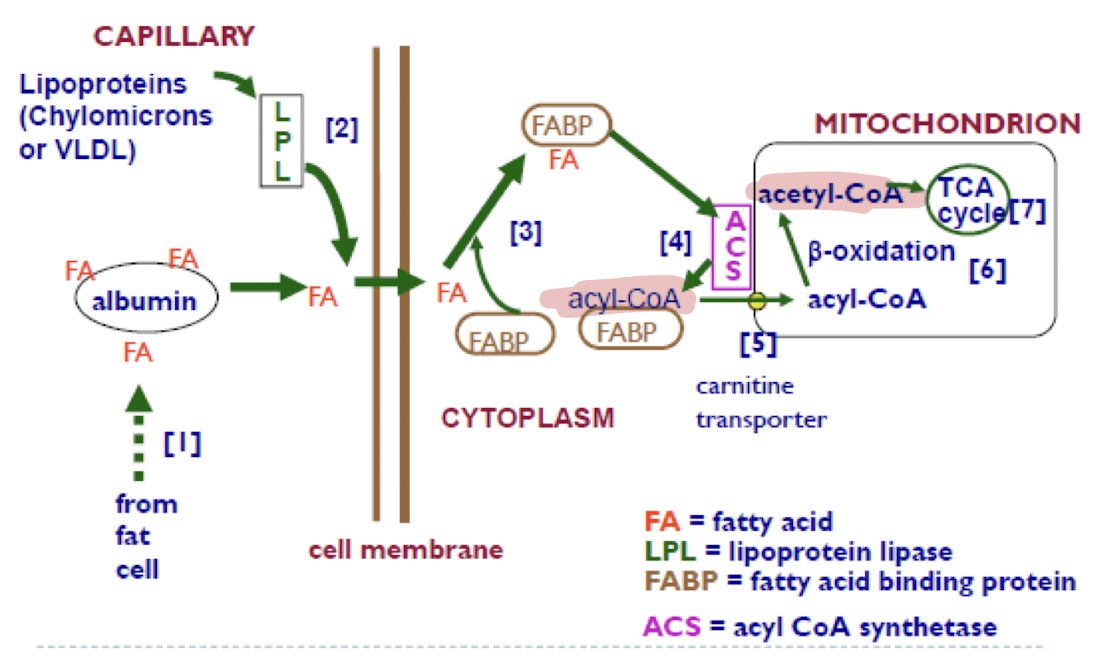
FA released from adipose into circulation bound to albumin
dissociation of FA from albumin is first step of cellular uptake
uptake of fatty acids by cells involves membrane proteins
fatty acid translocase (FAT/CD36)
plasma membrane associated fatty acid binding protein (FABPpm)
at least six fatty acid transport proteins (FATPs)
B-oxidation of FA
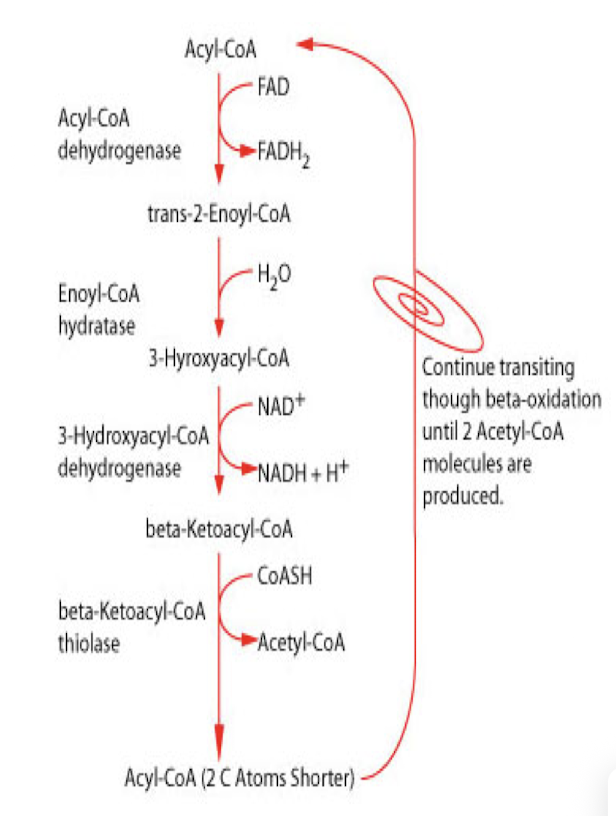
cyclic degradative pathway
2C units (acetyl CoA) cleaved from carboxyl end
RXN 1: acyl CoA dehydrogenase
products of 1 cycle: acetyl CoA, 1 FADH2, 1 NADH
FA oxidation energy considerations
palmitate (16:0)
7 carbon cleavages: 7×5=35 ATP
8 acetyl CoA oxidized: 8×12=96 ATP
total ATP = 131
2 ATP req. for activation
NET ATP = 129
Unsaturated produce less ATP (dbl bonds require extra enzymes)
odd numbered FA - produce less ATP (last one → propionyl CoA → extra steps to enter TCA cycle)
ketogenesis
during high rates of fatty acid oxidation, primarily in the liver, large amounts of acetyl CoA are generated (build up)
exceeds capacity of TCA cycle
synthesis of ketone bodies
ex. acetoacetate, B-hydroxybutyrate, acetone
production is low during normal conditions, increases during CHO shortage
untreated IDDM is most significant disruption
dec. glu supply (present by can’t be uses in cells)
inc in FA oxidation
inc production of acetyl CoA leads to ketone body production in excess of peripheral tissue ability to oxidize them
sources and fates of acetyl CoA
sources
oxidative decarboxylation of pyruvate from glycolysis
oxidation of long chain fatty acids
oxidative degradation of certain AAs
fates
fatty acid synthesis
ketone body/cholesterol synthesis
oxidation in TCA cycle
lipid metabolism - fed
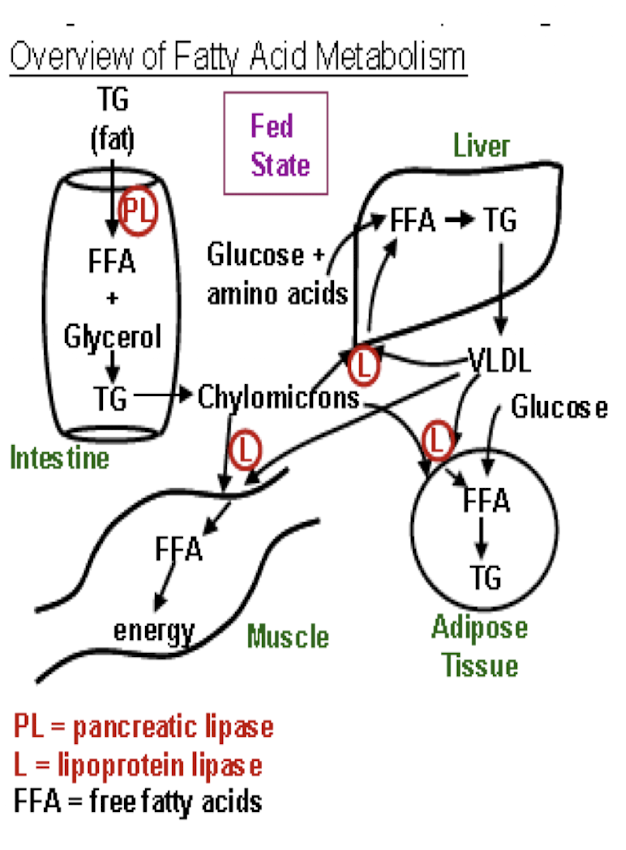
dietary fat (triglyceride) hydrolyzed to FFAs and glycerol in the intestine by pancreatic lipase (PL)
SCFA can enter circulation directly
most are re-esterified in epithelial cells and incorporated into chylomicrons
triglycerides in chylomicrons can be cleared by lipoprotein lipase at endothelial surfaces of capillaries (liver, muscle, adipose), resulting FAs can be
stored as fat in adipose tissue
used for energy
reesterfied to triglycerides in the liver and exported as VLDL
VLDL has essentially the same fate as chylomicrons
insulin stimulates
lipoprotein lipase
fatty acid and triglyceride synthesis in liver and adipose
insulin inhibits adipose triglyceride lipase/hormone sensitive lipase
lipid metabolism - fasted
glycogen breakdown → glucose; protein breakdown → alanine which is converted to glu in the blood
blood glu used by brain and RBC
other tissues rely primarily on FAs as energy source, exercising muscle uses both FAs and glu
hormone sensitive lipase is activated by glucagon (fasting) or epinephrine (exercise); fat in adipose tissue is hydrolyzed to give glycerol and FAs during fasting and exercise
FAs can be used directly as an energy source by most tissues with mitochondria
glycerol can be converted to glu in the liver (minor glu source)
glucagon and epinephrine stimulate hormone-sensitive lipase and inhibit lipoprotein lipase, FA synthesis and triglyceride synthesis
during prolonged starvation, the FAs can also be converted to ketone bodies in the liver, brain adapts slowly to the use of ketone bodies during prolonged starvation

hepatic lipidosis
normal liver contains ~5% lipid (TAG, FA, PL, cholesterol, and chol esters)
hepatic lipid arises from multiple sources - diet, mobilization of peripheral fat stores, endogenous FA synthesis in the liver
if the rate at which FA are brought to the liver exceeds the ability to metabolize or excrete them back into the circulation, storage of FA as TAG (lipidosis) occurs
what leads to it?
inc delivery of FA to the liver
dec hepatic FA oxidation
dec ability to secrete VLDL back
causes
starvation, diabetes, obesity, drug injury, toxicities
idiopathic feline lipidosis
idiopathic feline lipidosis
overwhelming majority of cases with severe, clinically apparent liver failure, the cause other than the association with starvation is unknown
often fatal
in starvation
lack of availability of dietary glu causes increases in growth hormone secretion and sympathetic activity, decreased insulin release
leads to accelerated peripheral lipolysis and massive free FA release into the circulation
FAs are taken up by the liver and converted to triglycerides
hypothesis - arginine deficiency, carnitine deficiency, endocrine abnormalities (related to insulin deficiency)
clinical signs - anorexia (>7d), depression, jaundice, weight loss, muscle wasting, occasional v/d
treatment - supportive fluid/nutritional therapy, tube feeding