Unit 6 Cell Division
 Call Kai
 Learn
Learn Practice Test
 Spaced Repetition
 Match
Match Flashcards
 Knowt Play
1/67

There's no tags or description
Looks like no tags are added yet.
Name | Mastery | Learn | Test | Matching | Spaced | Call with Kai | Chat |
|---|
No analytics yet
Send a link to your students to track their progress
68 Terms
Parent cell
The cell that divides to give rise to two daughter cells
Daughter cell
A daughter cell is a new cell that forms when an original cell (called a parent cell) divides
DNA replication
The biological process where a cell makes a complete copy of its DNA before it divides
Nuclear division
The process where a cell's nucleus divides to separate its duplicated genetic material (chromosomes) into new nuclei
Cytokinesis
The physical process of cell division that divides the cytoplasm of a parent cell into two daughter cells
Mitiosis
A process of cell division where a single cell splits into two genetically identical daughter cells, each with the same number of chromosomes
Somatic
Any normal body cell in a multicellular organism that is not a sperm or egg cell
Gamete
A reproductive cell (x cell) of an animal or plant that unites with another cell during sexual reproduction
Germline cell
A germline cell is any biological cell in a multicellular organism that gives rise to gametes (eggs and sperm) and passes genetic information on to the next generation
Myosin filament
A bundled polymer of myosin motor protein molecules that converts chemical energy into mechanical force to drive muscle contraction and cellular movement
Cleavage furrow
Groove that pinches an animal cell in two during cytokinesis.
Centrifugal
A laboratory technique that uses high-speed rotation to separate components of a biological sample based on their size, shape, and density using centrifugal force
Equatorial plane
The imaginary center line or flat region inside a dividing cell where chromosomes line up during the metaphase stage of cell division
Cell plate
Structure that forms during the division of plant cells
Oogenesis
The biological process of forming a mature female gamete (ovum or egg cell)

Budding
A type of asexual reproduction where a new, genetically identical organism develops as a small outgrowth, or bud, from the parent organism

Binary fission
A form of asexual reproduction where a single-celled organism or organelle copies its genetic material and splits into two identical daughter cells
Sexual reproduction
A biological process where two parent organisms combine their genetic material through the fusion of specialized sex cells (gametes) to create a genetically unique offspring
Asexual reproduction
A type of reproduction where a single parent creates genetically identical offspring without the fusion of sex cells or gametes
Meiosis
A specialized type of cell division that reduces the chromosome number by half, turning one diploid cell into four haploid genetics
Anucleate
A cell that does not have a cell nucleus
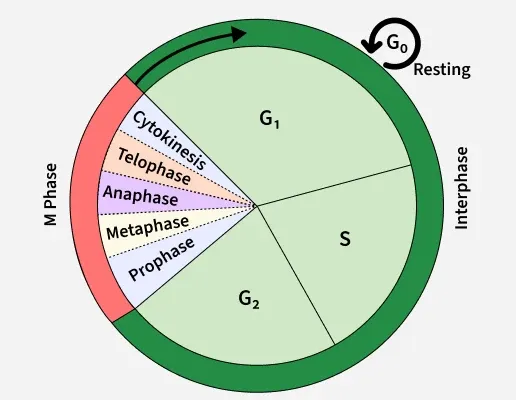
Cell cycle
An ordered series of events where a cell grows, copies its DNA, and divides into two new daughter cells
Chromosome
A thread-like structure made of a long DNA molecule tightly coiled around support proteins called histones, which package and protect genetic information inside cells
Histones
A family of basic, positively charged proteins found in the nucleus of eukaryotic cells that package and order DNA into structural units called nucleosomes
Chromatid
One of the two identical halves of a replicated chromosome that stays joined together before cell division
Sister chromatids
Two identical copies of a single replicated chromosome that are joined together at a region called the centromere
Centromere
The specialized, constricted region of a chromosome that links sister chromatids and attaches to spindle fibers during cell division
Nucleosome
A basic unit of DNA chromatin in eukaryotic organisms.
Interphase
The long preparatory phase in the Cell Cycle where a cell grows, copies its DNA, and gets ready to divide into two new cells
Chromatin
A highly organized condensed structure made up of DNA, RNA, and proteins that forms the chromosomes in the nucleus of a cell
Microtubules
Microscopic, hollow tubes made of protein subunits that give eukaryotic cells their shape and help transport internal materials
Kinetochore
A large protein structure that assembles on the centromere of a chromosome during cell division
Motor proteins
convert chemical energy from ATP into mechanical work, moving along the cell's cytoskeletal filaments
Prophase
the first stage of cell division in both mitosis and meiosis, where chromatin condenses into visible chromosomes
Metaphase
the stage of cell division (mitosis or meiosis) where condensed chromosomes line up in the middle of the cell
Anaphase
the stage in cell division where replicated chromosomes split and are pulled apart to opposite ends of the cell
Telophase
the final stage of cell division in both mitosis and meiosis where separate sets of chromosomes reach the opposite poles of a cell and new nuclear membranes form around them
Meiosis I
the first round of a special type of cell division called meiosis that reduces the number of chromosome sets from two (diploid) to one (haploid)
Meiosis II
the second part of cell division in sexually reproducing organisms, where sister chromatids separate to produce four unique haploid gametes
Homologous
sharing a similar physical structure, anatomical position, or genetic origin due to descent from a common ancestor, even if the current function is different
Haploid
means a cell has only one complete set of chromosomes (written as n)
Diploid
has two complete sets of chromosomes (written as 2n)
Non-disjunction
the failure of homologous chromosomes or sister chromatids to separate properly during cell division (mitosis or meiosis)
Aneuploidy
a cell division error where a cell has an abnormal number of chromosomes that is not a clean multiple of the basic haploid set
Germ-line cells (gametes)
the specialized population of cells in a multicellular organism that pass on genetic material to the next generation, encompassing both the actual sex cells (gametes) and their precursor stem cells
Oocytes
an immature female reproductive cell produced in the ovaries that develops into a mature egg
Ovulation
the biological process in which a mature egg (ovum) is released from an ovary into the fallopian tube
independent assortment
the alleles of two or more different genes are sorted into gametes (sex cells) independently of one another
Crossing over
the biological process where paired homologous chromosomes swap matching segments of their DNA
Bivalent (tetrad)
a pair of joined homologous (matching) chromosomes that comes together during the first division of meiosis
Chiasma
the X-shaped physical points of contact where non-sister chromatids of homologous chromosomes exchange genetic material during meiosis
Differentiation
the process where less specialized cells undergo changes to develop specialized structures and functions
Differential gene
a gene whose activity level—measured by how much RNA or protein it produces—changes significantly between two different biological conditions
Expression
the process by which the information encoded in a gene is used to direct the assembly of a protein molecule.
Stem cells
cells with the potential to develop into many different types of cells in the body
Stem cell niche
a local microenvironment that directly promotes or protects a population of stem cells
Totipotent
having the ability to differentiate into all cell types
Pluripotent
a cell can divide and turn into almost any type of specialized cell in the body
Multipotent
a type of stem cell that can develop into a limited range of specialized cells within a specific tissue, organ, or family of cells
Zygote
the single, diploid cell that forms when a sperm cell fuses with an egg cell during fertilization
Blastocyst
an early stage of a mammalian embryo, consisting of a hollow ball of about 100 to 200 cells that forms roughly five to six days after an egg is fertilized
Morula
a solid, spherical ball of 16 to 32 cells (called blastomeres) that forms during early embryonic development after a fertilized egg (zygote) undergoes rapid cell division
Fertilization
the fusion of male and female gametes (sperm and egg) to form a single diploid cell called a zygote
Morphogen
a signaling molecule that spreads through developing tissue from a localized source to form a concentration gradient, instructing cells to develop into different specialized types based on its local concentration
Morphogen gradient
a varying concentration of signaling molecules in developing tissues that tells cells where they are located and what type of cell to become
Ectoderm
the outermost of the three primary germ layers that forms in an animal embryo during early development
Mesoderm
the middle layer of the three primary germ layers in a developing animal embryo, sitting between the outer ectoderm and the inner endoderm.
Endoderm
the innermost of the three primary germ layers in an early animal embryo