Cellular Respiration and Fermentation, Cellular Respiration & Fermentation, Cellular Respiration and Fermentation
 Call Kai
 Learn
 Practice Test
 Spaced Repetition
 Match
 Flashcards
 Knowt Play
1/78

There's no tags or description
Looks like no tags are added yet.
79 Terms
What is the Overall purpose of Cellular Respiration and Fermentation?
To make energy for the cell (ATP or cellular energy)
Fermentation
Anaerobic process by which ATP is produced by glycolysis
Anaerobic Respiration
The process by which cells obtain energy from an energy source without using oxygen at the end of the electro transport chain.
Aerobic Respiration
Metabolic process in which pyruvate is broken down and electron-carrier molecules are used to produce ATP through electron transport chain.
Cellular Respiration
Catabolic pathway for the production of ATP, by breaking down glucose and other food molecules in which oxygen is consumed as a reactant.
Redox Reaction
A chemical reaction involving the transfer of one or more electrons from one reactant to another; also called oxidation-reduction reaction.
What is Oxidation and Reduction
LEO the lion says GER (Lose Electrons:Oxidation. Gain Electrons:Reduction) The reducing agent loses electrons and thus is oxidized in reaction.
The oxidizing agent gains electrons and thus is reduced in the action.
NAD+/NADH
An organic molecule that serves as an electron carrier by being oxidized (losing electrons) to NAD+ and reduced (gaining electrons) to NADH
Electron Transport Chain
A sequence of enzymes that act as electron carrier molecules that transfer electrons and release energy during cellular respiration to produce ATP from ADP.
Electron Transport
The movement of electrons from one electron carrier to another in a series of oxidation-reduction reactions, with each electron transferred to a slightly lower level of energy, so that energy is released. Electron transport is used in the light reactions of photosynthesis and in the final stage of cellular respiration to produce ATP from ADP and phosphate.
Glycolysis
A metabolic process that breaks down carbohydrates and sugars through a series of reactions to either pyruvic acid or lactic acid and release energy for the body in the form of ATP. (Glyco=Sugar; Lysis=Breaking)
Pyruvate Oxidation
2nd step in cellular respiration (After Glycolysis) occurs on the way to the mitochondrial matrix. Two three-carbon molecules of pyruvate are oxidized to two two-carbon molecules of acetyl CoA and two molecules of CO₂. This process links glycolysis to the citric acid cycle (Krebs Cycle).
Citric Acid Cycle
A chemical cycle involving eight steps that completes the metabolic breakdown of glucose molecules to carbon dioxide; occurs within the mitochondrion; the second major stage in cellular respiration
Chemiosmosis
Is a mechanism that uses energy stored in the form of a hydrogen ion gradient across a membrane to drive cellular work. Most ATP synthesis in cells occurs by chemiosmosis.
Oxidative Phosphorylation
Is when the ETC releases energy that creates a Hydrogen gradient by pumping them in the outer compartment, then this H+ want to go back into the matrix by ATP synthase creating ATP.
fermentation
the breakdown of carbohydrates by enzymes, bacteria, yeasts, or mold in the absence of oxygen

saccharomyces cerevisiae
The scientific name for yeast. Yeast is a microscopic fungus consisting of single oval cells that are capable of converting sugar into ethanol and carbon dioxide

ethanol (alcohol) fermentation
An anaerobic process which converts sugars such as glucose, fructose, and sucrose into cellular energy, producing ethanol and carbon dioxide as by-products.

EtOH
The chemical formula for ethanol. Ethanol is a product of the fermentation of yeast.

carbohydrate
an organic compound occurring in foods and living tissues and including sugars, starch, and cellulose. They contain hydrogen and oxygen, and typically can be broken down to release energy in the animal body.

C6H12O6
Glucose is a simple sugar with the molecular formula C₆H₁₂O₆.

anaerobic respiration
It is used when there is not enough oxygen for aerobic respiration. It can be summarised by the following equation: glucose + enzymes ==> carbon dioxide + ethanol or lactic acid, depending on the type of fermentation.

glycolysis
Glycolysis is the metabolic pathway that converts glucose into pyruvate. The free energy released in this process is used to form the high-energy molecules ATP and NADH

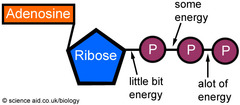
ATP
Adenosine triphosphate, or ATP for short, is a high-energy molecule found in every cell. Its job is to store and supply the cell with needed energy.
lactic acid fermentation
A type of anaerobic respiration, where our muscles break down glucose into pyruvate which is converted into lactic acid. This is what makes our muscles sore after exercise.

pyruvate
Pyruvate is the end product of glycolysis, which is converted into acetyl coA that enters the Krebs cycle when there is sufficient oxygen available. When the oxygen is insufficient, pyruvate is broken down anaerobically, creating lactate in animals (including humans) and ethanol in plants.

cellular respiration
the process by which cells break down organic compounds to produce ATP

NAD+
NAD+ is a coenzyme that picks up a H+ ion and 2 electrons (a redox reaction) from glucose, at which point it becomes NADH and onto ATP.

NADH
the reduced form of NAD an electron-carrying molecule that functions in cellular respiration
aerobic
a process that requires oxygen

anaerobic
a process that does NOT require oxygen

aerobic respiration
the process in which pyruvic acid is broken down and NADH is used to make a large amount of ATP. The type of respiration that is carried out in the presence of oxygen.

kilocalorie
a unit of energy equal to 1000 calories (it is denoted by a C ... so the calories you see labeled on packaged food are actually kilocalories!)

what fuels life in cells
nucleotide adenosine triphosphate (ATP). ATP has high potential energy and allows cells to overcome life's energy barriers
glucose
the most common source of chemical energy used by organisms
what happens as cells process sugar
the energy that is released is used to transfer a phosphate group to adenosine diphosphate (ADP) generating ATP
what is the result of ATP having a lot of high potential energy
ATP is unstable and is not stored so most cells are making ATP all the time
Much of the ATP our cells use come from the
chemical energy from glucose
how do cells obtain glucose
photosynthetic organisms can produce glucose from the products of photosynthesis, where the sunlight is used to reduce Carbon Dioxide (CO2). these organisms will use the glucose to make ATP or store it in energy rich molecules like starch
when photosynthetic organisms are eaten or decompose,
their glucose molecules are obtained by animals, fungi, and many bacteria and archaea
storage carbohydrates such as _____ and _____ act like _____ for chemical energy. ATP in contrast is like _____. to withdraw chemical energy from the accounts to get cash_________-
starch and glycogen---- cash----- storage carbohydrates are first hydrolyzed into their glucose monomers. then the glucose is used to produce ATP through cellular respiration or fermentation
what is the primary difference between cellular respiration or fermentation
the degree in which glucose is oxidized
when glucose undergoes the uncontrolled oxidation reaction called burning, + formula
some of the potential energy stored in its chemical bonds is converted to kinetic energy in the form of heat and light---- glucose+oxgen---> carbon dioxide + water + energy
how many kilocalories (kcal) of heat are released when one mole of glucose is oxidized
685 kcal
what happens to glucose in cells
it is oxidized through a series of controlled redox reactions. instead of releasing the energy as heat, the released free energy is used to synthesize ATP from ADP and Pi
how does fermentation differ from cellular respiration
cellular respiration (like burning) results in the complete oxidation of glucose into CO2 and water. fermentation does not fully oxidize glucose- instead small, reduced organic molecules are produced as waste. Cellular respiration releases more energy from glucose than fermentation
glycolysis
one six-carbon molecule of glucose is broken into two molecules of the three-carbon compound pyruvate. During this process, ATP is produced from ADP to Pi, and NAD+ is reduced to form NADH.
Pyruvate processing
Pyruvate is processed to release one molecule of CO2, and the remaining two carbons are used to form the compound acetyl CoA. The oxidation of pyruvate results in more NAD+ being reduced to NADH
citric acid cycle
each acetyl CoA is oxidized to two molecules of CO2. during this sequence of reactions, more ATP and NADH are produced and FAD is reduced to form FADH2
electron transport and oxidative phosphorylation
electrons from NADH and FADH2 move through a series of proteins called an electron transport chain (ETC). Energy released in this chain of redox reactions is used to create a proton gradient across a membrane; the ensuing flow of protons back across the membrane is used to make ATP. This mode of ATP production links the phosphorylation of ADP and the oxidation of NADH and FADH2, thus is called oxidative phosphorylation.
redox reactions
When there is a transfer of one or more electrons from one reactant to another.
oxidative phosphorylation
The production of ATP using energy derived from the redox reactions of an electron transport chain; the third major stage of cellular respiration.
What is cellular respiration?
any set of reactions that uses electrons harvested from high-energy molecules to produce ATP via an electron transport chain
cells produce ATP from ____ via a series of 4 processes
glucose---1) glycolysis 2) pyruvate processing 3) the citric acid cycle 4) electron transport and oxidative phosphorylation
glycolysis, pyruvate processing, the citric acid cycle all_____
oxidize glucose to produce NADH and FADH2 which then feed the electron transport chain
catabolic pathways
sets of reactions that break down molecules. these reactions often harvest stored chemical energy to produce ATP
anabolic pathways
sets of reactions that synthesize larger molecules from smaller components. these reactions often use energy in the form of ATP
Does the process of cellular respiration interact with other catabolic and anabolic pathways?
yes
Using enzyme-catalyzed reactions, cells can
break down and transform these other carbohydrates to produce glucose or intermediates in cellular respiration.
what do enzymes do in the cell
routinely break down fats to release the glycerol and convert the fatty acids into acetyl CoA molecules. the Glycerol can be further processed and enter glycolysis and acetyl CoA enters the Citric Acid Cycle
how can proteins be catabolized
they can be broken down and used to produce ATP. Once they are hydrolyzed to their constituent amino acids, enzyme catalyzed reactions remove the amino (-NH2) groups. the amino acids are excreted in urine as waste and the remaining carbon compounds are converted to pyruvate, acetyl CoA or other intermediates in the glycolysis and the citric acid cycle
How does glycolysis work?
A single glucose molecule in glycolysis produces a total of 2 molecules of pyruvate, 2 molecules of ATP, 2 molecules of NADH and 2 molecules of water.
how does glycolysis start
it starts by using ATP
fermentation
a metabolic pathway that regenerates NAD+ by oxidizing stockpiles of NADH. The electrons removed form NADH are transferred to pyruvate, or a molecule derived from pyruvate, instead of the electron transport chain
what happens when fermentation takes place in the cells
the pyruvate produced by glycolysis then begins to accept electrons from NADH (lactic acid fermentation) regenerates NAD+ by forming lactate
the lactic acid produced by _____ can be converted back to ___ and used as a source of ____ to drive ___ ___ when oxygen is present. however what can happen
fermentation; pyruvate; energy; cellular respiration. however in most cases the cell cannot use the molecule that's formed when pyruvate (or another electron acceptor) accepts electrons from NADH. This by-product may be toxic and excreted from the cell as waste even the it has not been fully oxidized
alcohol fermentation
Glycolysis followed by the reduction of pyruvate to ethyl alcohol, regenerating NAD+ and releasing carbon dioxide.
Approximately how many molecules of ATP are produced from the complete oxidation of one molecule of glucose (C6H1206) in aerobic cellular
respiration?
30-32
What happens to a glucose molecule when it loses a hydrogen atom as the result of an oxidation-reduction reaction?
The glucose molecule is oxidized.
What is the oxidizing agent in the following reaction?
Pyruvate + NADH + H+ > Lactate + NAD+
a) NADH
b) pyruvate
c) NAD+
d) lactate
b) pyruvate
Substrate-level phosphorylation accounts for approximately what percentage of the ATP formed by the reactions of glycolysis?
100%
Starting with one molecule of glucose, glycolysis results in the net production of which of the following sets of energy-containing products?
2 NADH, 2 pyruvate, and 2 ATP
Which of the following statements about NAD is true?
a) NAD+ can donate electrons for use in oxidative phosphorylation.
b) NAD+ is reduced to NADH during glycolysis, pyruvate oxidation, and the citric acid cycle.
c) NAD+ has more chemical energy than NADH.
d) In the absence of NAD*, glycolysis can still function.
b) NAD+ is reduced to NADH during glycolysis, pyruvate oxidation, and the citric acid cycle.
When a molecule of NAD* (nicotinamide adenine dinucleotide) gains a hydrogen atom (not a proton), the molecule becomes...
reduced
Which of the following processes generates a proton-motive force in mitochondria?
a) the reduction of NAD* by the first electron carrier in the electron transport chain
b) the flow of protons through ATP synthase down their concentration gradient
c) pumping of hydrogen ions from the mitochondrial matrix across the inner membrane and into the intermembrane space
d) lowering of pH in the mitochondrial matrix
c) pumping of hydrogen ions from the mitochondrial matrix across the inner membrane and into the intermembrane space
Where are the proteins of the electron transport chain located?
a) mitochondrial outer membrane
b) mitochondrial matrix
c) mitochondrial intermembrane space
d) mitochondrial inner membrane
d) mitochondrial inner membrane
In glycolysis, for each molecule of glucose oxidized to pyruvate...
a) four molecules of ATP are used, and two molecules of ATP are produced
In glycolysis, for each molecule of glucose oxidized to pyruvate,_
b) two molecules of ATP are used, and four molecules of ATP are produced
c) two molecules of ATP are used, and two molecules of ATP are produced
d) two molecules of ATP are used, and six molecules of ATP are produced
b) two molecules of ATP are used, and four molecules of ATP are produced
A cell has enough available ATP to meet its needs for about 30 seconds. What is likely to happen when an athlete exhausts his or her ATP supply?
Catabolic processes are activated that generate more ATP.
Which of the summary statements below describes the results of the following reaction?
C6H1206 + 602 > 6 CO2 + 6 H20 + Energy
a) O2 is reduced and CO2 is oxidized.
b) O C6H1206 is oxidized and 02 is reduced.
c) 02 is oxidized and H20 is reduced.
d) CO2 is reduced and O2 is oxidized.
b) O C6H1206 is oxidized and 02 is reduced.