Marine bio lab practical
 Call Kai
 Learn
 Practice Test
 Spaced Repetition
 Match
 Flashcards
 Knowt Play
1/92

There's no tags or description
Looks like no tags are added yet.
93 Terms
What is salinity?
The amount of dissolved salts in water. 35 ppt means about 35 g of salt per 1,000 g of seawater.
How do salinity and temperature affect seawater density?
More salt generally makes water denser. Colder seawater is generally denser than warmer seawater.
Which water sinks when warm freshwater meets cold saltwater?
The cold saltwater is denser and tends to remain below the warm freshwater.
What is stratification, and what can break it down?
Layering by density, with lighter water over denser water. Wind, tides, storms, and surface cooling can promote mixing.
Which water holds more oxygen at saturation: cold or warm?
Cold water, at the same salinity and pressure.
Which holds more oxygen at saturation: fresh or salty water?
Freshwater, at the same temperature and pressure.
Why are dissolved gases important to marine life?
Oxygen supports aerobic respiration. Carbon dioxide supplies carbon for photosynthesis and affects seawater chemistry.
What do aeration and 100% oxygen saturation mean?
Aeration moves water toward equilibrium with air. 100% saturation means the equilibrium oxygen concentration for that temperature, salinity, and pressure.
How do you recognize a diatom?
A silica cell wall called a frustule. Cells may be round, elongated, solitary, or in chains.
How do you recognize a dinoflagellate?
Look for cell shape and grooves, and plates in armored forms. Living forms often use two flagella; these may not be visible on preserved slides.
How do cyanobacteria differ from diatoms and dinoflagellates?
They are photosynthetic bacteria, not eukaryotes. They may appear as tiny individual cells, colonies, or filaments.
What distinguishes the two live cultures in your packet?
Tetraselmis is a motile green flagellate. Thalassiosira weissflogii is a centric diatom with a silica frustule.
How are phytoplankton collected and studied?
Plankton nets collect samples. Microscopes reveal cell shape, coverings, chains, and size. Cultures allow observation of living cells.
How do 20-micrometer and 363-micrometer nets differ?
The finer 20-micrometer mesh retains smaller organisms. Many small cells pass through the larger mesh. Compare filtered volume before judging abundance.
Why are phytoplankton important?
Photosynthesis produces organic matter that supports marine food webs and releases oxygen.
Why are small size and motility useful to phytoplankton?
Small size increases surface area relative to volume and generally slows sinking. Motility helps cells reach favorable light and nutrients.
Name the three macroalgal groups and their main identifying pigments.
Green: Chlorophyta, chlorophylls a and b. Brown: Phaeophyta in the packet, fucoxanthin. Red: Rhodophyta, phycobilins such as phycoerythrin.
Can you classify seaweed by visible color alone?
No. Color varies and preservation changes it. Use body form, the lab key, and the names recorded with your specimens.
What is the thallus?
The whole seaweed body, without true roots, stems, leaves, or vascular tissues.
Identify the holdfast, stipe, and frond, and give their functions.
Holdfast: anchors seaweed. Stipe: flexible support. Frond/blade: photosynthesis and exchange with surrounding water.
What is a pneumatocyst?
A gas-filled bladder that adds buoyancy and helps expose photosynthetic tissue to light.
What are coralline algae?
Calcifying red algae containing calcium carbonate. Some green algae also calcify, so calcification alone does not identify the group.
What makes seagrass different from seaweed?
Seagrass is a vascular flowering plant with true roots, stems, and leaves. Seaweed has a thallus with a holdfast, stipe, and fronds.
Identify seagrass roots, rhizomes, and leaves.
Roots anchor and absorb nutrients. Rhizomes are horizontal stems allowing spread. Leaves photosynthesize.
Which local seagrass is explicitly assigned in your packet?
Eelgrass, Zostera marina: long ribbonlike leaves. Other local species must be confirmed from your own lab notes.
Should you prioritize turtlegrass and manatee grass for the local-species topic?
They are tropical packet examples. Prioritize eelgrass and any other local species actually examined. Widgeon grass occurs regionally, but the packet does not confirm it was shown.
Why are seagrass meadows important?
They provide food and nursery habitat, bind sediment, reduce erosion, and support carbon storage in sediment. Macroalgae also provide food, habitat, and primary production.
How do you recognize Porifera?
Sponges: porous bodies, usually asymmetrical, sessile suspension feeding, no true tissues, and no nervous system.
Identify ostia and oscula in sponges.
Ostia are small openings where water enters. Oscula are larger openings where water exits.
Compare asconoid, syconoid, and leuconoid forms.
Asconoid: simple wall. Syconoid: folded wall. Leuconoid: many chambers. Folding increases feeding surface. These are body forms, not classes.
Compare the skeletons of three common sponge classes.
Calcarea: calcium carbonate spicules. Hexactinellida: six-rayed silica spicules. Demospongiae: spongin fibers and/or silica spicules. Confirm which classes were shown in your lab.
What are spicules and spongin for?
Spicules are hard skeletal elements providing support and protection. Spongin is a flexible structural protein.
How do you recognize Cnidaria?
Usually radial symmetry, true tissues, tentacles, a gastrovascular cavity, and stinging cells called cnidocytes.
How do polyp and medusa forms differ?
Polyp: usually attached, cylindrical, mouth/tentacles upward or outward. Medusa: usually swimming, bell-shaped, mouth downward.
Identify Obelia and explain its colony.
A hydrozoan, class Hydrozoa. A branching colony has feeding polyps and reproductive structures that specialize and share resources.
Give the Aurelia life-cycle sequence.
Medusa → planula → scyphistoma → strobila → ephyra → medusa. Fertilization and development connect the adult to the planula.
Which Aurelia stages are attached, and which swim?
Attached: scyphistoma and strobila. Swimming: planula larva, ephyra juvenile, and adult medusa. The strobila releases ephyrae asexually.
What separates Anthozoa from the other cnidarian groups studied?
Anemones and corals are anthozoans with a polyp stage and no medusa. Anemones are generally solitary; many corals are colonial.
How do you recognize Platyhelminthes?
Flatworms have bilateral symmetry and a dorsoventrally flattened body. Some are free-living; others are parasites.
Identify a planarian and its major feeding structures.
A free-living flatworm, placed in Turbellaria in the packet. A muscular pharynx takes in food; a branched gut digests and distributes it.
Identify Clonorchis and explain its attachment structures.
A parasitic fluke, class Trematoda. Suckers help it maintain attachment within the host.
Identify Taenia, its scolex, and its proglottids.
Taenia is a tapeworm, class Cestoda. The scolex is the anterior attachment region. Proglottids contain reproductive structures.
How does tapeworm feeding differ from planarian feeding?
A tapeworm lacks a conventional gut and absorbs digested nutrients across its surface. A planarian uses a pharynx and branched digestive cavity.
How do you recognize an annelid?
A segmented worm. Use parapodia, setae, suckers, and the clitellum to distinguish the groups studied.
Identify a polychaete and the lab's scale worm.
Polychaetes are mainly marine worms with many setae and paired parapodia. Lepidonotus also has dorsal scales.
What are parapodia and setae for?
Parapodia are paired lateral appendages aiding movement and gas exchange. Setae are bristles that help traction.
How do you identify a leech?
Class Hirudinea: anterior and posterior suckers, no parapodia, generally no setae. Leeches are segmented, even if true segment boundaries are not obvious.
How do you identify an earthworm?
Class Oligochaeta: obvious segments, few setae, no parapodia, and a clitellum in mature specimens.
Identify the clitellum and prostomium.
Clitellum: thickened reproductive band that produces cocoon material. Prostomium: small anterior lobe over the mouth.
How do annelid lifestyles differ?
Polychaetes include predators and particle feeders. Leeches can be parasitic or predatory. Earthworms ingest organic material while burrowing through soil.
Identify Bivalvia and its main shell structures.
Molluscs with two hinged valves, such as clams, mussels, and scallops. The shell protects; adductor muscles close the valves.
Identify the mantle and ctenidia in a mussel.
Mantle: tissue lining the shell and secreting it. Ctenidia: folded gills used for gas exchange and suspension feeding.
How does a mussel suspension-feed?
Water enters the incurrent region and passes over gills. Mucus traps particles; cilia move suitable food toward the mouth. Water exits the excurrent region.
Identify the mussel foot and byssal threads.
The muscular foot positions the animal and produces/places attachment threads. Byssal threads anchor the mussel to hard surfaces.
Compare mussels, burrowing clams, and swimming scallops.
Mussels attach on surfaces with byssal threads. Many clams burrow with a foot. Some scallops swim by closing valves and expelling water.
Name the four echinoderm classes studied.
Asteroidea: sea stars. Ophiuroidea: brittle stars. Echinoidea: urchins and sand dollars. Holothuroidea: sea cucumbers.
What key traits identify echinoderms?
Marine animals with calcareous internal skeletons and a water vascular system. Five-part adult organization is common; some groups have secondary bilateral features.
How do sea star oral and aboral surfaces differ?
Oral: mouth, ambulacral grooves, tube feet. Aboral: opposite the mouth, with madreporite, spines, and usually the small anus.
Identify the madreporite and explain its function.
A sievelike aboral plate connecting to the water vascular system and helping regulate water entry.
How do tube feet and the water vascular system work together?
Fluid pressure and muscles operate the tube feet, which support movement, attachment, prey handling, and gas exchange.
Distinguish spines, dermal gills, and pedicellariae.
Spines protect. Dermal gills are thin projections for gas exchange. Pedicellariae are tiny pincers that remove debris and settling organisms.
Identify the cardiac stomach and explain sea star feeding.
It can evert through the mouth and begin digestion outside the body, including through a narrow gap in a bivalve shell.
Identify the pyloric stomach and digestive glands.
Pyloric stomach: internal digestion region. Digestive glands/pyloric caeca: paired branching structures in arms that aid digestion, nutrient absorption, and storage.
Identify gonads and explain why their size varies.
Reproductive organs producing eggs or sperm. They may enlarge during breeding season. Gross appearance alone does not reliably identify sea star sex.
Identify a sea urchin and its test.
An arm-free, rounded echinoid with spines and tube feet. The test is the rigid skeleton of joined calcareous plates.
What is Aristotle's lantern?
The sea urchin's toothed jaw apparatus, used by many species to scrape or graze food such as algae.
How does a sand dollar differ from a sea urchin?
A flattened body and very short spines suit life in sand. Both are Echinoidea and have tests; the sand dollar retains five-part features with secondary bilateral organization.
Identify a sea cucumber and its feeding/skeletal features.
An elongated, leathery holothuroid with feeding tentacles around its mouth. It collects particles and retains small ossicles instead of a large rigid test.
How do brittle stars differ from sea stars?
sea stars have tube feet, Brittlestars dont
Identify Cephalopoda and its phylum.
Squid, octopuses, cuttlefishes, and nautiluses belong to Mollusca. They have a prominent head and appendages surrounding the mouth.
Compare squid and octopus appendages.
Squid have eight arms and two longer feeding tentacles. Octopuses have eight arms without the squid's specialized pair of feeding tentacles.
Compare cephalopod shells and identify nautilus structures.
Nautilus: external chambered shell; septa divide chambers and the siphuncle helps regulate fluid and buoyancy. Squid: internal pen. Cuttlefish: cuttlebone. Octopus: generally no substantial shell.
Identify the squid mantle, fins, head, and eyes.
Mantle: muscular body wall enclosing organs. Fins: steering and stability. Head: region bearing eyes and appendages. Eyes: vision.
Distinguish squid arms, tentacles, and suckers.
Arms are shorter, with suckers along much of their length. Longer tentacles have terminal clubs with suckers. Suckers grip prey.
Identify the siphon and explain jet propulsion.
Mantle contractions expel water through the siphon/funnel. The squid moves opposite the expelled water; the funnel helps direct movement.
Identify the beak and radula and explain feeding.
Tentacles capture prey; arms position it. The hard beak bites and tears; the toothed radula helps process food.
Identify squid gills and hearts.
Gills exchange gases in the mantle cavity. Two branchial hearts pump blood toward gills; one systemic heart pumps oxygenated blood to the body.
Identify the ink sac, digestive tract, and digestive gland.
Ink sac stores defensive ink. Digestive tract processes and transports food. Digestive gland produces digestive substances and processes absorbed nutrients.
What do squid gonads do, and how might you determine sex?
Gonads produce eggs or sperm. Eggs/ovary and nidamental glands can support female identification; testis and spermatophore structures support male identification. Record undetermined if unclear.
What traits identify Arthropoda?
Segmented bodies, jointed appendages, and an exoskeleton that provides support, protection, and muscle attachment.
Why do arthropods molt, and why are they vulnerable afterward?
The rigid covering cannot grow continuously. Shedding permits enlargement; the new covering is initially soft. A molt is largely hollow and lacks soft tissues.
Is a horseshoe crab a true crab?
No. It belongs to Chelicerata and lacks antennae. True crabs are crustaceans, which typically have two pairs of antennae.
Identify horseshoe crab body structures.
Carapace: broad anterior shield. Abdomen: posterior region. Telson: long tail spine used in righting and maneuvering. Also locate eyes and underside appendages.
What are the major body regions of a true crab?
Cephalothorax: fused head/thorax, covered by the carapace. Abdomen: folded underneath. The carapace is the covering, not the whole body region.
Identify chelipeds and walking legs in a decapod.
Decapods have five pairs of walking appendages; the first pair may form claw-bearing chelipeds. Claws handle food and aid defense; legs support movement.
How do you recognize a male fiddler crab?
Typically one greatly enlarged claw. Females usually have two relatively small claws. Use visible specimen traits.
Compare true crabs, shrimp/lobsters, and hermit crabs.
True crabs: compact body, tucked abdomen. Shrimp/lobsters: extended segmented abdomen. Hermit crabs: soft asymmetrical abdomen usually protected in a borrowed shell.
Identify an adult barnacle and explain its feeding.
A crustacean arthropod attached within hard plates. It extends specialized appendages to suspension-feed. Its covering can resemble a molluscan shell.
How do barnacle larvae differ from adults?
Larvae are mobile planktonic stages; adults are usually attached. Compare body form and appendages on the slides actually examined in lab.

asconoid

syconoid
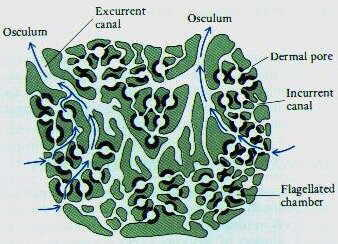
leuconoid