pH and Indicators (chpt 18)
 Call Kai
 Learn
 Practice Test
 Spaced Repetition
 Match
 Flashcards
 Knowt Play
1/24

There's no tags or description
Looks like no tags are added yet.
25 Terms
Self-ionisation of water
Pure water can conduct tiny electric current, as water dissociates slightly to form ions (endothermic as it favours higher temps)
Represented as H₂O ⇌ H⁺ + OH⁻
Equilibrium constant
Kc = [H⁺][OH⁻]/[H₂O]
Ionic product of water (Kw)
Kw = Kc[H₂O] = [H⁺][OH⁻]
Is temperature dependent
Neutral solution of water
[H⁺] = 10⁻⁷ (at 25° C, where 7 = pH)
Acidic solution of water
[H⁺] > 10⁷⁻ ie. [H⁺] > [OH⁻], eg. (10⁻⁵) > (10⁻⁹)
Basic solution of water
[H⁺] < 10⁻⁷ ie [H⁺] < [OH⁻], eg. (10⁻⁸) < (10⁻⁶)
pH
= -log₁₀[H⁺], where square brackets indicate concentration in moles per litre
Negative logarithm to the base 10 of hydrogen ion concentration measured in moles per litre
Strong acid
Good proton donor
Examples of acidic substances
Stomach acid (HCl) - pH 1, grapefruit - pH 4, milk - pH 6.2
Weak acid
Poor proton donor
Acid dissociation constant Ka
Ka = [H⁺][A⁻]/[HA]
The larger the value of Ka, the higher the concentration of H₃O⁺ and the stronger the acid
Strong base
Good proton acceptor
Examples of basic substances
Toothpaste - pH 9, Soap - pH 11, Limewater - pH 12.1
Weak base
Poor proton acceptor
Conjugate bases for acids
Strong acid: weak conjugate base
Weak acid: strong conjugate base
Finding pH when given pOH and visa versa
pH + pOH = 14
pOH
pOH = -log₁₀[OH⁻]
Limitations to pH scale
pH scale is limited to 0 - 14 range, although possible to have pH values outside in theory
Does not work w very concentrated solutions, ie. concentration above 1M as complete dissociation doesn’t always occur, and can’t predict no. H⁺ or OH⁻ ions
Limited to aqueous solutions
Calculating pH of weak acids/bases
To find, must know extent which acid/base dissociates, depends on Ka/Kb (dissociation constants)
Acids: [H⁺] = -log√Ka x Ma(cid)
Bases: [OH⁻] = -log√Kb x Mb(ase)
Where Ma is concentration of acid in moles/L and Mb is concentration of base in moles/L
After finding extent of dissociation, then can find pH using its formula and H⁺/OH⁻ found
Acid-base indicator
Substance that changes colour according to pH of solution in which it is placed (most are weak acids, very little used so negligible contribution of H⁺/OH⁻ ions)
Litmus paper indicator example
HIn (red) ⇌ H⁺ + In⁻ (blue). In keeping w Le Chatilier’s
HIn is acid form of indicator and In⁻ s conjugate base
If H⁺ ions from acid added to blue litmus, litmus turns red to keep in accordance w Le Chatelier’s Principle (equ. shifts to left to absorb added H⁺ ions)
Weak base indicators
Dissociate slightly as follows: XOH ⇌ X⁺ + OH⁻
Addiction of acid removes some of OH⁻ ions from right, therefore colour of X⁺ predominates, and vie versa with OH⁻
Range of an indicator (Methyl orange, litmus, phenolphthalein)
pH interval over which there is a clear change of colour for that indicator
Methyl Orange → range: 3-5, acid colour: red, base colour: yellow (definite red pH 3 and lower, definite yellow pH 5 and higher)
Litmus → range: 5-8, acid colour: red, base colour: blue (definite red pH 5 and lower, definite blue pH 8 and higher)
Phenolphthalein → range: 8-10, acid colour: colourless, base colour: pink (definite no colour pH 8 and lower, definite pink colour pH 10 and higher)
pH titration
Base placed in burette and acid in beaker. Done to allow us to start at low pH value and work up
Acid kept stirred by placing magnetic stirring bar in beaker and stirred by magnetic stirrer
pH sensor placed in acid solution, measures pH as base added. Connected to computer and pH recorded by datalogging software
Beaker used instead of conical flask as beaker more suitable for magnetic stirring bar and pH sensor
Graph of pH vs time plotted for solution showing change of pH related to volume of base added: pH titration curve
No indicator used as not necessary with pH sensor
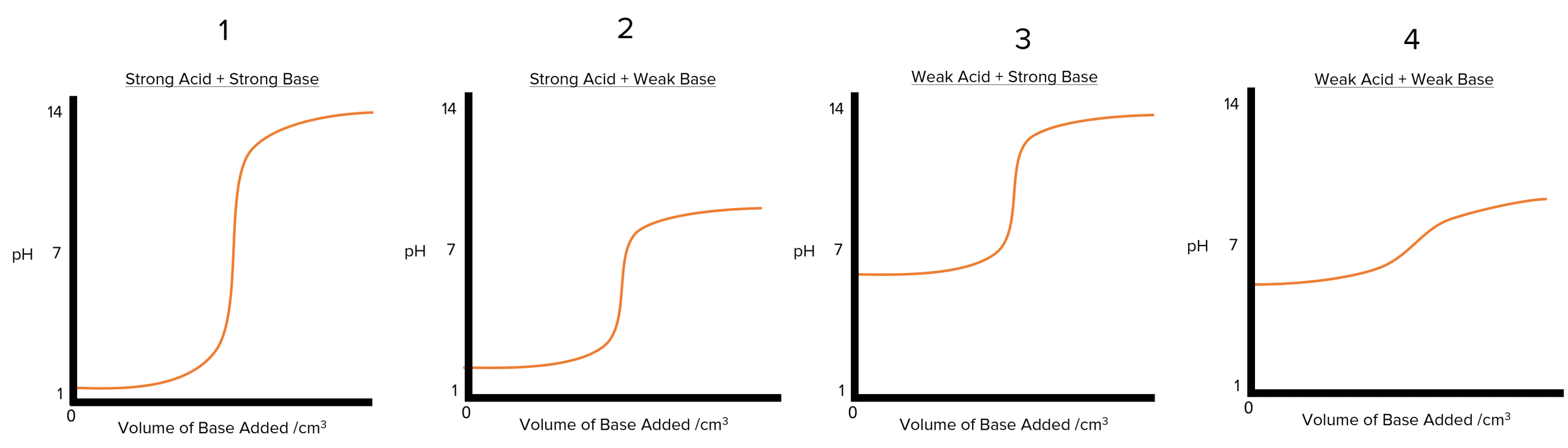
Types of acid-base titrations
Strong acid against strong base
0.1M NaOH to 0.1M HCl
Any indicator as all three fit in vertical part of curve (litmus not as reliable as other two)
Strong acid against weak base
0.1M NH₃ to 0.1M HCl
Methyl orange (vertical between 7 and 3)
Weak acid against strong base
0.1M NaOH to 0.1M CH₃COOH
Phenolphthalein (vertical between 10 and 7)
Weak acid against weak base
0.1 NH₃ to 0.1M CH₃COOH
Not possible to detect end point using indicator, so weak acid titrated against strong base and weak base against strong acid