Resonance & Source-Filter Theory
 Call Kai
 Learn
 Practice Test
 Spaced Repetition
 Match
 Flashcards
 Knowt Play
1/31

There's no tags or description
Looks like no tags are added yet.
32 Terms
Resonance
The tendency of a system to vibrate in response to frequencies near its natural frequency.
Natural Resonant Frequency
The frequency at which a system oscillates freely after an initial disturbance from equilibrium.
Physical factors determining natural frequency
Length, density, tension, mass, shape, and stiffness.
Free Oscillation
Vibration where an object oscillates at its natural frequency after an initial force is applied.
Forced Oscillation
Vibration driven by a continuous external periodic force at the driver's frequency.
Condition for maximal resonance amplitude
When the driving frequency matches the system's natural resonant frequency.
Acoustic Resonator
An air-filled container set into vibration by sound waves.
Node vs. Antinode
Nodes are points of zero wave displacement/amplitude; antinodes are points of maximum displacement/amplitude.

Pressure vs. Displacement graphs
Pressure antinodes correspond to displacement nodes, and pressure nodes correspond to displacement antinodes.

Open-Open Tube Resonant Wavelength Formula
λn = 2L / n (where L is tube length and n is any integer harmonic).
Fundamental Frequency of an Open-Open Tube
Occurs when tube length equals half the wavelength (L = λ / 2).
Quarter-Wave Resonator
A tube closed at one end; its lowest resonant wavelength is four times tube length (λ = 4L).
Harmonics in a Closed-Open Tube
Only odd-numbered multiples (1, 3, 5...) create resonance in a tube closed at one end.
Open-Closed Tube Wavelength Formula
λn = 4L / n (where n is an odd integer harmonic).
Constructive Interference in Resonance
Occurs when reflected pressure peaks meet incoming pressure peaks, amplifying the wave.

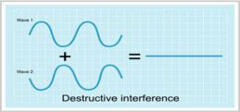
Destructive Interference in Resonance
Occurs when reflected pressure peaks meet incoming pressure troughs, cancelling sound.
Narrowly Tuned Resonator
Resonator responding to a narrow frequency range (e.g., tuning fork).
Broadly Tuned Resonator
Resonator responding to a wide frequency range (e.g., vocal tract).
Bandpass Filter
A filter allowing frequencies within a specific range to pass while blocking higher and lower frequencies.
Formants
Resonant frequencies of the vocal tract.
First Formant (F1) of 17 cm Male Vocal Tract
~500 Hz (calculated using f = c / 4L with c = 34,400 cm/s).
First 3 Formants for Neutral Vocal Tract (17 cm)
F1 = 500 Hz, F2 = 1500 Hz, F3 = 2500 Hz (odd multiples).
Effect of constriction at a pressure maximum
Raises the formant frequency (e.g., constriction in lower pharynx raises F1).
Effect of constriction at a pressure minimum (velocity maximum)
Lowers the formant frequency (e.g., lip constriction lowers F2).
Source-Filter Theory
Speech is produced by a sound source (vocal folds) filtered by the acoustic resonator (vocal tract).
Sound Source in Speech
Vocal fold vibration creating fundamental frequency and harmonic series.
Sound Filter in Speech
Vocal tract configuration shaping amplitudes of harmonics via formants.
Formant representation on a Spectrogram
Dark horizontal bands corresponding to amplified resonant frequency regions.
Independence of Source and Filter
Formants (vocal tract shape) and pitch/harmonics (vocal fold vibration rate) can change independently.
sound spectra
Frequency is the x axis;
amplitude is the y axis.
True or false: The shape of the vocal tract above the glottis acts as a filter over the sound source.
true
True or false : Harmonics that are close to a resonant frequency of the vocal tract are amplified. Other harmonics are attenuated.
true