Bioprinting: Chapter 5
 Call Kai
 Learn
Learn Practice Test
 Spaced Repetition
 Match
Match Flashcards
 Knowt Play
1/25

There's no tags or description
Looks like no tags are added yet.
Name | Mastery | Learn | Test | Matching | Spaced | Call with Kai | Chat |
|---|
No analytics yet
Send a link to your students to track their progress
26 Terms
Cells can be categorised by
source
potential for expansion and differentiation
cell format
(individual or aggregates)
Cell Sources
autologous cells
allogeneic cells
xenogeneic cells
Autologous cells
taken from the patient and then provided for the patient
blood would be taken, stored, and used after the surgery
ex: blood marrow transplantation
advantages:
no rejection, no disease transmission
disadvantages:
limitation on how much can be taken
Allogeneic cells
taken from different individuals of the same species
ex: bone marrow transplantations
advantages:
can be used from a diseased person
disadvantages:
risk of transmitting pathogens
risk of introducing diseases
weakens host’s defense mechani
Xenogeneic cells
taking cells from a different species
advantages:
can be provided from a broad range of sources
immediate availability
disadvantages:
risk of transmitting pathogens
risk of introducing diseases
commonly rejected
difficult to maintain long term
weakens host’s defense mechanisms
2 major sources of cells
specialised
stem
expansion capacity is high
availability is low
Specialised cells
terminally differentiated
potential for differentiation is low
availability is high
ex: fat cell, nerve cell, bone cell, smooth muscle cell
advantages
straight forwards process (isolate and use)
have correct characteristics and can perform natural functions
disadvantages
poor in vitro differentiation
limited expansion capacity
Stem cells
capable of
self-renewing
can differentiate (become specialized cells_
3 main types of stem cells
embryonic stem cells (hESCs)
adult stem cells (somatic)
(includes MSC, HSC, and progenitor cells)
Induced pluripotent stem cells
Embryonic stem cells hESCs
found in blastocyst
can differentiate to almost any type of cell
done in vitro (like a culture)
results in a variety of cells
(aka, results in cell pop. with heterogeneity)
Mesenchymal stem cells (MSC)
Multipotent adult stem cells that can self-renew and differentiate into multiple cell types.
Mainly found in bone marrow and adipose tissue.
Differentiate into bone, cartilage, and fat cells
Mesenchymal stem cells advantages & disadvantages
advantages:
Easily obtained from many tissue sources.
Simple isolation procedure.
Can be expanded in large numbers for therapies.
Widely used in clinical applications.
disadvantages:
Undergo replicative senescence (stop dividing over time)
Risk of malignant transformation (becoming cancer-like).
Can have chromosomal abnormalities/genetic instability.
Can differentiate into unwanted cell types.
Haematopoietic stem cells
stem cells that produce all types of blood cells.
Differentiate into:
Myeloid cells (e.g., red blood cells, platelets, some immune cells)
Lymphoid cells (e.g., B cells, T cells, NK cells)
Found in cord blood (ex: bone marrow)
induced pluripotent stem cells (iPSC)
adult somatic cells are reprogrammed to form pluripotent stem cells
can self-renew + differentiate
cell reprogramming efficiency is low
iPSC advantages & disadvantages
advantages:
no need for embryos
less ethical issues
less chances of rejection
accessible
disadvantages:
reprogramming…
can cause tumor formation
may be linked to disease
instable
Cell format for bioprinting
individual cells or cell spheroid
in solution or in hydrogel
Cell spheroid requirements
of sufficient quantity and cell density
well-compatible with the bioprinting strategies
Cell spheroids can look like…
round (exactly how you image it)
mass (connected)
stellate (like a pain splatter, messy)
grape (little grapes, tiny spheres connected)
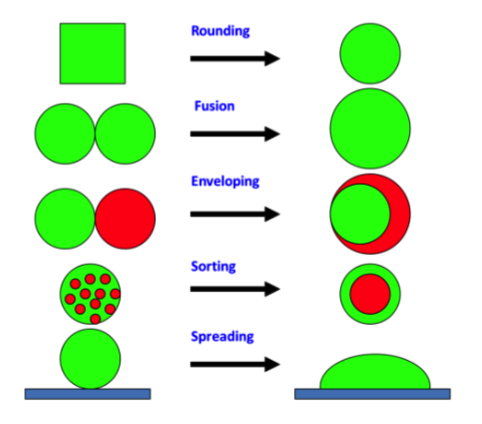
Characteristics of cell spheroids
complex fluid
rounding
fusion
enveloping
sorting
spreading
ronald fights evil sorta sneaky
Fusion
when 2 spheroids come in contact, they fuse together to create…. a larger spheroid!
Enveloping
first.. cohesion is
how strongly cells stick together
less cohesive spheroids envelop more cohesive spheroids
Sorting
when cells contain different populations, they sort out without human intervention
Spreading
spheroids spread on a wettable substrate
How many types of vascular tissue spheroids are there
3
What do we use in experiments
primary cells
cell lines
stem cells
cell lines
cultures of animal cells
can be propagated repeatedly (sometimes indefinitely)