1H NMR Theory
 Call Kai
 Learn
Learn Practice Test
 Spaced Repetition
 Match
Match Flashcards
 Knowt Play
1/9

There's no tags or description
Looks like no tags are added yet.
Name | Mastery | Learn | Test | Matching | Spaced | Call with Kai | Chat |
|---|
No analytics yet
Send a link to your students to track their progress
10 Terms
Spectroscopy
Most of the analytical techniques are a form of spectroscopy
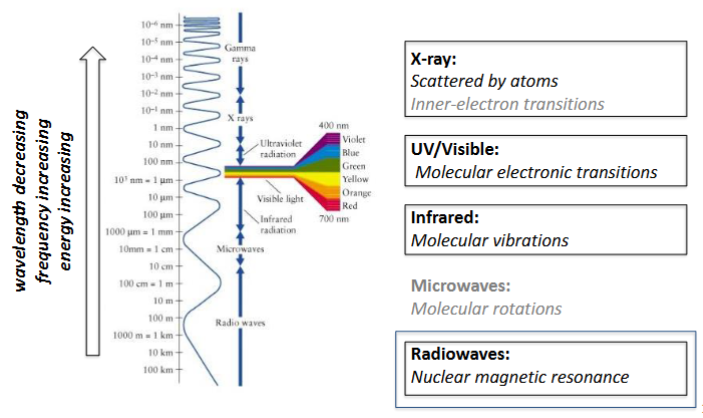
NMR
NMR utilises the fundamental property of particles known as ‘spin’
Some nuclei possess imbalanced spin states resulting in them having magnetic properties
How NMR works
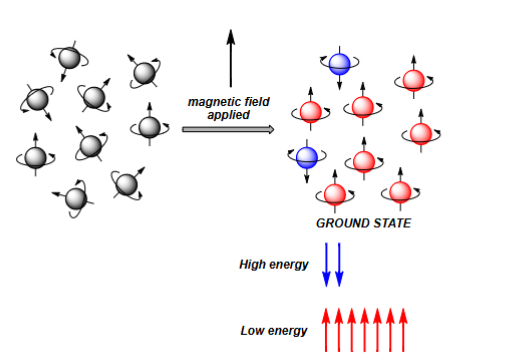
NMR relies on the relationship between spin and magnetism - usually the spin angles of nuclei in atoms are randomly orientated
Application of a magnetic field causes them to become aligned - as with other magnets the nuclei can align either with or against the magnetic field

How NMR works (diagram)

Running an NMR experiment (theory)
Start by putting a sample into the applied magnetic field
The spins of the molecules align either with or against the magnet field
Broad radiation in the radio-wave frequency region of the electromagnetic spectrum has the correct energy to flip nuclei from the low energy to the high energy state
Expose the sample to radio-wave frequency energy, some spins will flip to higher energy
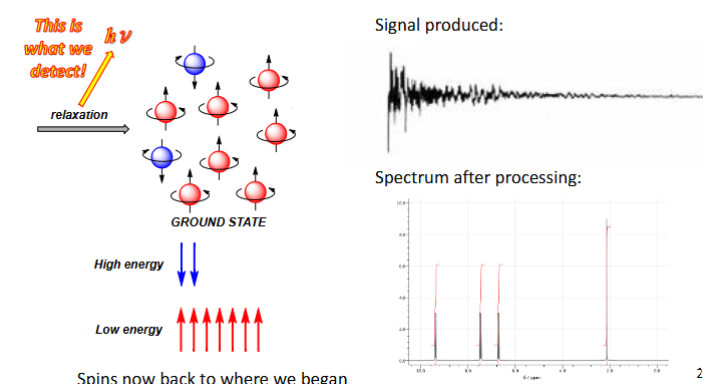
When the radio-wave pulse is stopped the nuclei return (relax) to the low energy state by emitting radio-wave electromagnetic radiation
This frequency is equal to the wavelength that was absorbed in the broad pulse as it’s proportional to the energy difference between the 2 states

Running an NMR experiment (theory) - how the signal is received
This emitted radio wave is detected using a very sophisticated radio receiver
The signal then undergoes an extensive mathematical manipulation (Fourier Transformation) to give a spectrum displayed as intensity against δ chemical shift (ppm)
Running an NMR experiment (in practice)
Sample is dissolved in a deuterated solvent and placed in an NMR tube
Placed in an NMR spectrometer which has a very strong magnet
The sample is then spun to even out imperfections in the sample
Sample is then irradiated with a pule of radio-wave frequency radiation
When the pulse is finished the nuclei drop back to the low energy state by emitting radio-wave radiation, which is detected
Following extensive mathematical manipulation (Fourier Transformation) the results are displayed as intensity against δ chemical shift (ppm)
What is the frequency of radio waves absorbed dependent on?
The size of the magnetic field experienced by the nucleus
Different NMR machines have different magnetic fields (field strength) and give slightly different spectra – higher field strength increases energy difference (Hz) between the states (bigger MHz, better the signals)
To try to standardise spectra, they are NOT displayed as frequency on the x-axis – displayed as a ppm shift (parts per million, written as δ) relative to a reference compound, TetraMethyl Silane (TMS, SiMe4), which is given δ = 0 ppm
The nucleus (1H, 13C, etc)
Due to differences in energy we can only look at 1 type of nucleus at a time, the most common is 1H
NMR solvents
Due to complexities in the relaxation process in the solid state we can not measure this kind of data unless the sample is in solution - therefore the sample needs to be dissolved in solvent
If this also contains hydrogen atoms then this causes a problem as the solvent would be in massive excess so we’d only really see a spectrum of the solvent
Deuterated solvents (2H) are used where all hydrogen atoms have been replaced by deuterium as most solvent contain 1H
The deuterium nucleus itself is spin active and so the magnetic but absorbs in a very different frequency to 1H so the solvent is no longer seen in the spectrum
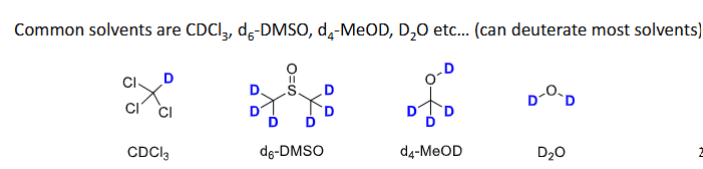
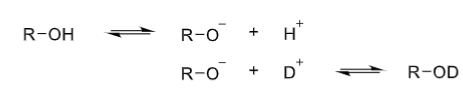
Problems with deuterated solvents - exchangeable protons
Acid-base equilibria can occur in the NMR tube between certain protons and the deuterated solvent
This means that certain 1H are often swapped for 2H and so either disappear from the 1H NMR spectrum, or do not integrate properly
In the compounds we are NMR-ing, any protons attached to a heteroatom (especially acidic/basic sites aka those the most likely to dissociate) are the ones most likely to exchange