PSY 330 Exam 1
 Call Kai
 Learn
Learn Practice Test
 Spaced Repetition
 Match
Match Flashcards
 Knowt Play
1/123

There's no tags or description
Looks like no tags are added yet.
Name | Mastery | Learn | Test | Matching | Spaced | Call with Kai | Chat |
|---|
No analytics yet
Send a link to your students to track their progress
124 Terms
Intellectual Disability (ID)
Significant limitations in intellectual functioning AND adaptive behavior, originating before age 22.
Two main areas required for an ID diagnosis
Impact on intellectual functioning and adaptive behavior.
Adaptive behavior
The everyday social and practical skills needed to function independently.
What does AAIDD say about people with ID/DD?
They have both strengths and limitations, and appropriate personalized supports can improve functioning.
3 major areas of adaptive functioning
Conceptual, social, and practical skills.
Developmental disability (DD)
A severe, chronic disability caused by a mental and/or physical impairment that begins before age 22 and is expected to continue indefinitely.
Examples of major life areas that DD can substantially limit
Self-care, language, learning, mobility, self-direction, independent living, and economic self-sufficiency.
Important assumption when evaluating limitations
Limitations should be considered in the context of the person's age, culture, and typical community environment.
What happens when appropriate supports are provided over time?
Functioning and quality of life can generally improve.
DNA
Deoxyribonucleic acid; the molecule containing genetic instructions.
Four DNA bases
Adenine (A), thymine (T), cytosine (C), and guanine (G).
DNA bases pair that together
A pairs with T; C pairs with G.

How many chromosomes does a typical human have?
46 chromosomes arranged in 23 pairs.
How many autosomes does a typical human have?
44 autosomes.
Sex chromosomes
The 23rd chromosome pair; typically XX or XY.
Chromosome
A structure made of DNA that contains many genes.
Gene
A section of DNA that provides instructions for producing a particular protein
Allele
An alternative form of a gene.
Genotype
A person's genetic makeup.
Phenotype
The observable characteristics or traits produced by genes and environment
Homozygous
Having two identical alleles for a gene.
Heterozygous
Having two different alleles for a gene.
Dominant
An allele expressed when at least one copy is present.
Recessive
A trait generally expressed when two recessive copies are present.
Karyotype
An organized picture/display of a person's chromosomes.
What can a karyotype show?
Chromosome number, sex chromosome pattern, and large chromosomal abnormalities.
Trisomy
Having three copies of a chromosome instead of two.

Monosomy
Having only one copy of a chromosome instead of two.

Nondisjunction
Failure of chromosomes to separate properly during cell division.
What can meiotic nondisjunction cause?
Trisomy or monosomy.
Mosaicism
Having two or more genetically different cell lines within the same person.
What causes mosaicism?
A genetic error occurring after fertilization during mitotic cell division.
Translocation
A chromosome segment becomes attached to another chromosome.
Mutation
A change in DNA.
Point mutation
A change in a single DNA base.
Deletion mutation
Loss of a section of DNA.
Repeat expansion
When a DNA sequence is repeated more times than normal.
What can a mutation do to a protein?
It can produce a poorly functioning protein, reduce the amount of protein, or prevent the protein from being produced.

Mitosis
Cell division used primarily for growth, development, and maintenance.

Meiosis
Cell division that produces reproductive cells/gametes.

Recombination
The exchange of genetic material during meiosis.
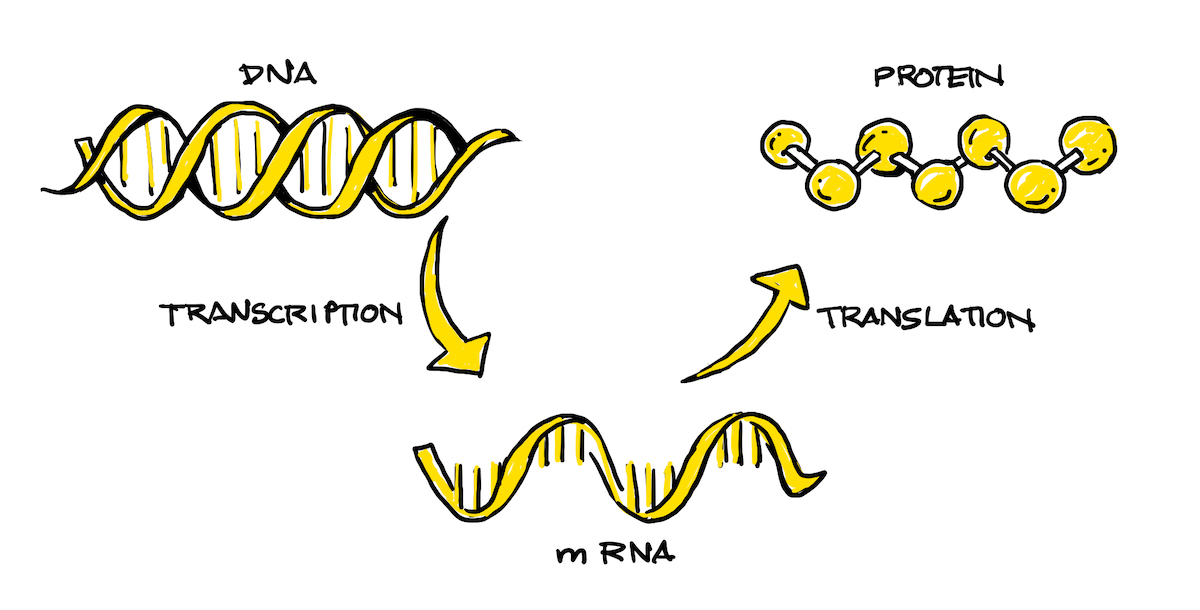
Transcription
DNA is copied into messenger RNA (mRNA).
Transcription occurs
In the nucleus.
What happens to mRNA after transcription?
It leaves the nucleus and travels to the cytoplasm.
Translation
The ribosome reads mRNA and builds a chain of amino acids to make a protein.
Translation occurs
At the ribosome in the cytoplasm.
Basic sequence of gene expression
DNA → transcription → mRNA → translation → protein.
If one DNA strand is A-G-T-C-G, what is the complementary strand?
T-C-A-G-C.

A gene ultimately provide instructions for
Producing a particular protein.
What does the "C" in a gene location code such as C4q36 mean?
Chromosome 4.
The "p" in a chromosome location
The short arm of the chromosome.

The "q" in a chromosome location
The long arm of the chromosome.

p or q represent
The approximate location/band on the chromosome.

C4q36 means
Chromosome 4, long arm (q), at approximately band/location 36.

Centromere
Between the p and q arms of a chromosome.

Two major prenatal developmental stages
Embryonic stage and fetal stage.
When is the embryonic stage?
Approximately weeks 0–8.
When is the fetal stage?
Approximately week 9 through birth.

Proliferation
Cells rapidly increase in number through mitosis.
Differentiation
Cells become specialized for specific functions.
Migration
Cells move to their proper locations in the developing body/brain
Apoptosis
Programmed cell death that removes unnecessary cells.

Synaptogenesis
The formation of connections between neurons.
Myelination
The development of myelin around nerve fibers, which helps speed neural signaling.

Fertilization
Sperm and egg combine to form a zygote.

Morula
An early ball of dividing cells after fertilization.
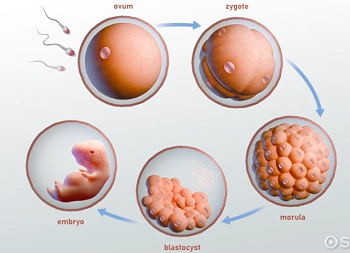
Blastocyst
A developing structure containing an inner cell mass/embryoblast and trophoblast that will contribute to the placenta.

Implantation
The blastocyst attaches to the uterine wall.

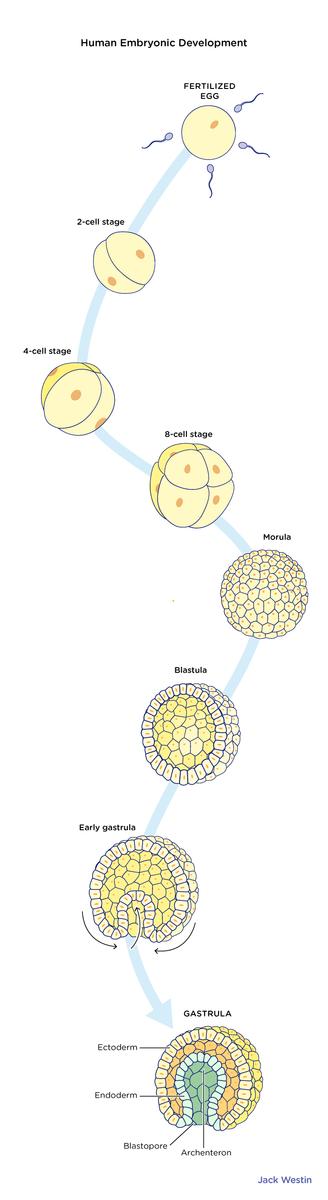
Gastrulation
The process that forms the three germ layers.

Three germ layers
Ectoderm, mesoderm, and endoderm.

Ectoderm develops into
Skin and nervous system.
Mesoderm develops into
Muscles, bones, and blood vessels.
Endoderm develops into
Many internal organ systems.
Neural fold fusion
The neural folds come together to form the neural tube.

The neural tube develops into
The brain and spinal cord.
Correct basic order of early development
Fertilization → morula → blastocyst → implantation → gastrulation → neural development → fetal development → birth.
If a major developmental problem occurs before or very early in pregnancy
It is more likely to result in miscarriage
"all-or-none" idea in very early development
A very early severe insult may cause pregnancy loss; if the embryo survives, development may continue but potentially with major differences.
If a developmental disruption occurs during the embryonic stage
It is more likely to cause structural abnormalities/malformations
If a developmental disruption occurs later during the fetal stage
The person may appear physically typical but develop functional problems such as epilepsy or cerebral palsy.
General pattern of timing of prenatal insults
Early = miscarriage; embryonic = structural abnormalities; later fetal = functional problems
Brain cell proliferation occurs
Primarily during the early-to-middle prenatal period.
Disruption of proliferation causes
Microcephaly due to reduced brain growth.
Microcephaly
A condition in which the head/brain is significantly smaller than expected.
Neuronal migration
The movement of developing brain cells to their appropriate locations.
Abnormal neuronal migration may cause
Abnormal brain development and conditions such as epilepsy.
Synaptogenesis
Formation of connections between neurons.
Pruning
Removal of unnecessary neural connections to make brain networks more efficient.
X inactivation
The process in which one X chromosome in female cells becomes largely inactive.
X inactivation occurs
To balance gene expression between individuals with different numbers of X chromosomes
Mosaicism related to X inactivation
Different cells may have different X chromosomes active, creating genetically different cell populations.
Common example of X-inactivation mosaicism
Calico/tortoiseshell cats.
Difference between screening and diagnostic testing
Screening estimates risk; diagnostic testing is used to determine whether a condition is actually present.
What are screening tests generally like?
Less invasive, less expensive, earlier, and probabilistic.
What are diagnostic tests generally like?
More invasive, more expensive, usually later, and much more definitive.
What does sensitivity measure?
How well a test correctly identifies people who have the condition.
What does specificity measure?
How well a test correctly identifies people who do not have the condition.
What is a false positive?
A test says a person has a condition when they do not.