Aminotransferases
 Call Kai
 Learn
 Practice Test
 Spaced Repetition
 Match
 Flashcards
 Knowt Play
1/34

There's no tags or description
Looks like no tags are added yet.
35 Terms
The aminotransferases constitute a group of enzymes that catalyze the interconversion of _________ to _________ by transfer of amino groups.
amino acids to 2-oxo-acids
Two diagnostically very useful enzymes in this category are:
aspartate aminotransferase, also known as serum glutamate oxaloacetate transaminase, and alanine aminotransferase, formerly called serum glutamate pyruvate transaminase
_________ and its amino analogue, ___________, function as coenzymes in the amino- transfer reactions.
Pyridoxal-5'-phosphate (P-5'-P)
pyridoxamine-5'-phosphate
The P-5'-P bound to the apoenzyme accepts the amino group from the first substrate, _________, to form enzyme-bound ________ and the first reaction product, ___________, respectively. The coenzyme in amino form then transfers its amino group to the second substrate, ________, to form the second product, ________. P-5'-P is thus regenerated.
aspartate or alanine
pyridoxamine-5'-phosphate
oxaloacetate or pyruvate
α-keto-glutarate
glutamate
Aspartate Aminotransferase
EC 2.6.1.1; L-aspartate: 2-oxoglutarate aminotransferase; AST
It is involved in the reversible transfer of an amino group between aspartate and α-keto acids.
Aspartate Aminotransferase
AST exists as two isoenzyme fractions located in the _______ and _________.
cell cytoplasm and mitochondria
The intracellular concentration of AST is __________ higher than the plasma concentration.
7,000 times
The ________ is the predominant form occurring in AST serum.
cytoplasmic isoenzyme
Alanine Aminotransferase
EC 2.6.1.2; L-alanine: 2-oxoglutarate aminotransferase; ALT
It catalyzes the reversible transfer of an amino group from alanine to α-ketoglutarate with the formation of glutamate and pyruvate
Alanine Aminotransferase
Cell ALT activity is approximately _______ that in plasma
3000 times
AST is _________ while ALT is completely ___________.
intramitochondrial and extramitochondrial
extramitochondrial
AST is commonly distributed in the body tissues, including the ________, ________, ________, with smaller amounts found in the ________, ________, ________.
heart, liver, skeletal muscle
kidneys, pancreas and red blood cells
ALT is found primarily in the _________, although significant amounts are also present in the ________ and lesser amounts in _________ and ________.
liver (making it more liver specific)
kidney
heart and skeletal muscle
In most type of liver diseases, _______ is higher than that of _______ except in _________ and __________ a where fibrosis occurred already.
ALT activity
AST
hepatic cirrhosis and liver neoplasia
With most forms of acute hepatocellular injury, _______ will be initially higher than ________ because of the ___________ in hepatocytes.
AST
ALT
higher activity of AST
Within 24–48 hours, particularly if ongoing damage occurs, _______ will become higher than _______, based on its ________.
ALT
AST
longer half-life
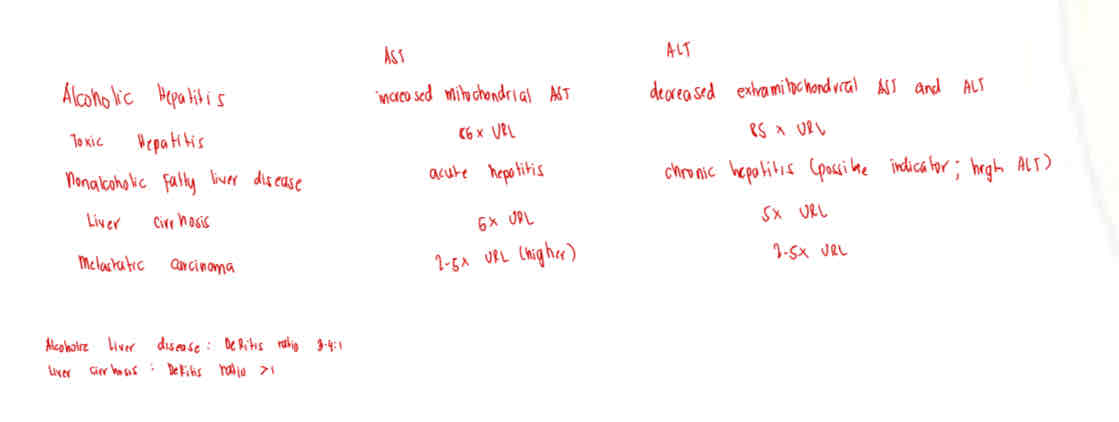
In acute alcohol-induced hepatocyte injury (e.g., alcoholic hepatitis), there is increased activity of ________ as alcohol induces mitochondrial damage. Besides being the predominant form of AST in hepatocytes, mitochondrial AST has a significantly ________ than _____________. This frequently results in the disproportionate elevation of AST over ALT, yielding an AST/ALT quotient, also called the _________, of ________ in alcohol-induced liver disease.
mitochondrial AST
longer half-life
extramitochondrial AST and ALT
DeRitis ratio
3–4:1
In toxic hepatitis (e.g., acetaminophen induced), _________ higher than the upper reference limit. Though their activities peak early, they usually fall rapidly after a _________.
AST and ALT levels are 85 times
short time
________ is also a common cause of aminotransferase increase.
Nonalcoholic fatty liver disease
__________ may serve as an indicator of possible chronic hepatitis.
Persistently increased ALT (usually for 6 months after an episode of acute hepatitis)
In liver cirrhosis, the _________ than the upper reference limit, with a de Ritis ratio of _________.
ALT and AST activities are five times higher
greater than 1
________ are also observed in patients with metastatic carcinoma, with ___________.
Twofold to fivefold elevations
AST usually higher than ALT
___________ have been observed after administration of medications such as nonsteroidal anti-inflammatory drugs, antibiotics and opiates.
Slight to moderate elevations of AST and ALT
AST levels begin to rise within ________, peak at __________, and generally return to ________ in acute myocardial infarction (AMI).
6 to 8 hours
24 hours
normal within 5 days
Because of the wide tissue distribution, ________ are not useful in the diagnosis of AMI. Similarly, following congestive heart failure, __________, probably reflecting ________ as a result of inadequate blood supply to that organ.
AST levels
AST levels may be increased
liver involvement
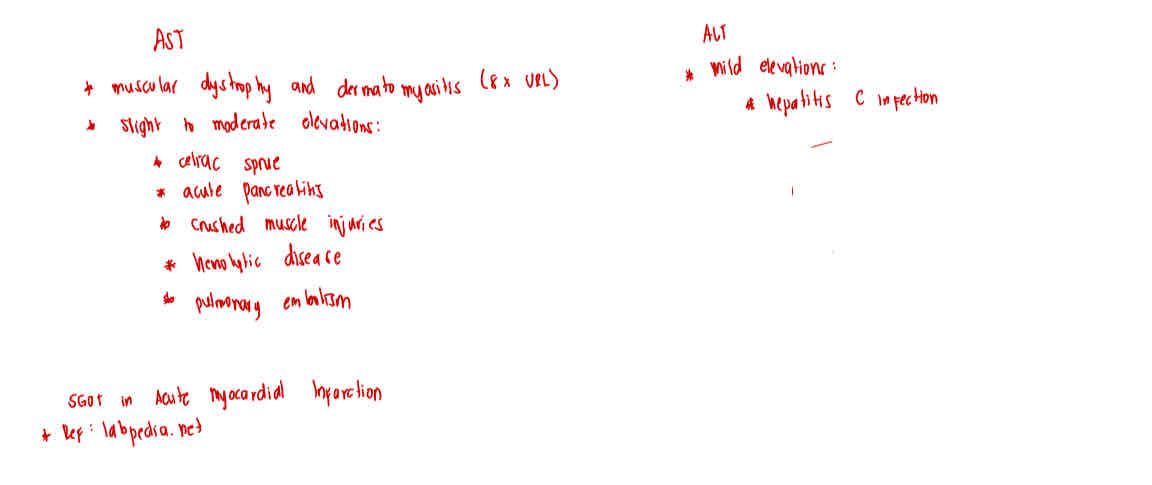
AST activity is increased in progressive __________ and ___________, reaching concentrations up to ________ higher than normal. They are usually normal in other types of muscle diseases, especially in those of neurogenic origin.
muscular dystrophy and dermatomyositis
eight times
If striated muscle is the source of increased AST activity, ____________ will be most likely elevated also.
serum CK
Slight to moderate elevations is noted in:
celiac sprue, acute pancreatitis, crushed muscle injuries, hemolytic disease and in pulmonary embolism
________ is more specific for detecting liver disease in nonalcoholic, asymptomatic patients.
ALT activity
_________ are often seen in hepatitis C infection.
Mild elevations of ALT
_________ is used for monitoring therapy with potentially hepatotoxic drugs, with a result more than three times the upper border of normal should signal stopping of therapy.
AST
COMPARISON OF AST AND ALT (1)
COMPARISON OF AST AND ALT (2)