Week 10: High Risk Pregnancy Part 1
 Call Kai
 Learn
 Practice Test
 Spaced Repetition
 Match
 Flashcards
 Knowt Play
1/34

There's no tags or description
Looks like no tags are added yet.
35 Terms
Hgb for anemia in prenancy
Risks of anemia pregnancy
Tire easily
Incr risk of preeclampsia & postpartum hemorrhage
Healing delayed
Poor toleration of minimal blood loss
Low birth weight, prematurity, stillbirth/death
Iron should be taken with
Vitamin C
Fetal kick counts
Fetus should kick at least 10x in 2 hrs during the final months of pregnancy
Fetal growth assessments
U/S
Leopold's
Amniotic Fluid Measurements
Fetal growth restricion
Umbilical artery dopplers
Ordered for high risk patients -- esp concern abt fetal growth
Non-Stress Test (NST)
Highly predictive of fetal well-being
Increased risk factors, post-dates, or any concerns about fetal well-being
Decreased fetal movement

Reactive non-stress test
2+ fetal accelerations in a 20 min periods -- want >15 beats above baseline, lasting at least 15 secs (or >10 beats for 10 secs before 32 weeks)
Fetal well-being

Non-reactive stress test
Lacks sufficient FHR accelerations over a 40 min period
Not reassuring of fetal well-being

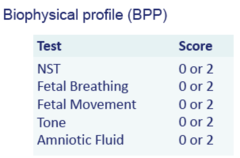
Biophysical Profile (BPP)
Non-invasive assessment of fetus based on acute and chronic markers of disease
U/S and NST
- Amniotic fluid volume
- Fetal breathing movements
- Fetal tone
- FHR reactivity
10/10 is ideal
8/10 is okay
Amniotic Fluid Index
Determined by:
- Fetal swallowing
- Fetal urine output
Oligohydramnios
AFI < 5cm
too little amniotic fluid
Polyhydramnios
AFI >25cm
too much amniotic fluid
Increases risk for: PPROM, cord prolapse
Contraction Stress Test
Must have 3 contractions of at least 40 seconds duration in 10 mins
FHR assessed in comparison to contractions
Contractions may spontoons or induced -- through oxytocin or nipple stimulation
Negative contraction stress test
normal result!
no late or significant variable decels
Positive contraction stress test
abnormal result!
late decels following 50%+ contractions
Chronic HTN
Defined as HTN present prior to start of pregnancy or develops during first 20 weeks of pregnancy
Dx: 2 readings of 140/90 or greater, at least 4 hrs apart
13-40% go on to develop gestational HTN
Gestational HTN
Onset at or after 20 weeks of pregnancy WITHOUT proteinuria
Dx: 2 readings of 140/90 or greater, at least 4 hrs apart, who were previously normotensive
Preecampsia
Onset at or after 20 weeks of pregnancy WITH proteinuria (or another severe feature)
Dx: 2 readings of 140/90 or greater, at least 4 hrs apart, who were previously normotensive
Can also develop during postpartum period
Risks of chronic HTN
Death, stroke, stillbirth, fetal growth restriction, preterm, etc
Treatment of chronic HTN
Counseling
Initiate low-dose aspirin after 12 wks
Frequent prenatal visits
BP log
Treat if >140/90 w/ Labetalol of nifedipine
Risk factors of preeclampsia
Previous preeclampsia
Multifetal gestation
Renal disease
Autommune dx
DM
First pregnancy
35 y/o+
BMI>30
Family hx, race, low socioeconomci status
What does USPSTF recommend for pt's who are high risk for preeclampsia starting at 12 wks
Low dose (81mg) aspirin
Preeclampsia physiology
Progressive - likely caused by disruption in placental perfusion and endothelial cell dysfunction
Lack of vascular remodeling --> decr placental perfusion
Generalized vasospasm --> system poor organ tissue perfusion (why proteinuria is common)
Preeclampsia s/s
HA
RUQ pain
Visual disturbances ("it looks like a prism")
Edema (hands/face)
Hyperreflexia
HA med of choice in pregnancy
Acetaminophen
Preeclampsia diagnosis
BP 140/90 at least 4 hrs apart
Proteinuria or protein/creatinine ratio
OR
Thrombocytopenia
Renal insufficiency
Incr liver enzymrs
Pulmonary edema
Cerebral Visual Changes
When an NST is non-reactive...
Move onto Biophysical Profile
Treatment of preeclampsia
Delivery of baby
Magnesium Sulfate
Magnesium Sulfate
Given in preeclampsia to prevent seizures
Will IV bolus then go to a maintenance dose until 24 hrs postpartum
Assess: RR, HR, LOC, fetal HR, DTRs, Clonus, hourly urine output (use foley with urometer)
Antidote for Magnesium Sulfate
Calcium Gluconate
1g IV push over 3-5 minutes (SLOW TO PREVENT CARDIAC ARREST)
Magnesium Sulfate Toxicity
Decreased LOC
RR
Eclampsia
Convulsive manifestation of the HTN disorders of pregnancy
Can lead to maternal deathh
HELLP Syndrome
Hemolysis, Elevated Liver Enzymes, Low Platelets
Can occur in absence of HTN or proteinuria
S/s: Nausea, extreme fatigue, chest pain, RUQ pain, difficulty breathing, shoulder pain, malaise
Life-threatening for patient & fetus
2 severe syndromes that preeclampsia can progress into
HELLP syndrome & Eclampsia