Module 5 - Magnetism and Electromagnetism
 Call Kai
 Learn
 Practice Test
 Spaced Repetition
 Match
 Flashcards
 Knowt Play
1/93

There's no tags or description
Looks like no tags are added yet.
94 Terms
Magnetism Definition
The polarization of a material
Magnets Definition
Matter that has the ability to attract
Magnetic Field Definition
A vector field that describes the magnetic influence on an electric current
Caused by a moving charged particle
Magnetic Domain Definition
When groups of magnetic fields are spinning in the same direction
Natural Magnets Definition
Magnets that occur naturally
Permanent Artificial Magnets Definition
Magnets that are man-made
Electromagnet Definition
Made by wrapping a coil of wire carrying a current (solenoid) around an iron core
Solenoid Definition
Coil of wire carrying a current
Dipole Definition
Something that has 2 poles, a North and a South
Nonmagnetic Definition
These materials are NOT affected by a magnetic field (have NO attraction to magnets)
Diamagnetic Definition
These materials are weakly repelled from both poles of a magnetic field (repelled by magnets)
Paramagnetic Definition
Materials that are weakly attracted to both poles of a magnetic field (slight attraction to magnets)
Ferromagnetic Definition
Can be strongly magnetized, has a very strong attraction to magnets (strongly attracted to magnets)
Permeability Definition
The ease with which a material can become magnetized
Retentivity Definition
The ability of an object to retain its magnetism
Magnetic Flux Definition
The amount of magnetic field in a certain area
Electromagnetism Definition
The interactions of Electric Currents with Magnetic Fields
Self-Induction Definition
What occurs when there is a single wire/conductor that will be able to induce voltage on itself when the current changes direction
Mutual Induction Definition
What occurs when there are 2 wires/conductors where the primary wire supplied with AC current will induce a current to flow on the secondary wire
Found in transformers
Transformer Defintion
A device that will change Voltage and Current into increasing and decreasing values
Autotransformer Definition
A transformer that has one winding and varies the voltage and current
This type of transformer works off the principle of self-induction
This is found in our operating control console
It is supplied with AC
Closed-Core Transformer
A square core of ferromagnetic material
This type of transformer works off the principle of mutual induction
The primary side is supplied with AC
Shell-Type Transformer
Essentially 2 Closed-Core Transformers with a center post that contains both the primary and secondary windings
This type of transformer works off the principle of mutual induction
The primary side is supplied with AC
This is the most efficient type of a transformer there is
It is also the most common type of transformer used in radiology imaging systems
Stators Definition
Stationary Electromagnets that have AC current supplied to them
Rotor Definition
Center rod that turns, NOT supplied with current, a current is induced in the rotor
Electromechanical Devices Definition
Devices with Electrical and Mechanical processes that came about as a result of Oersted’s and Faraday’s Experiments
What is the SI unit for Magnetic Flux
Weber
What is the traditional unit of measure for Magnetic Flux
Maxwell
1 Maxwell =
1 × 10 ^-8 Webers
What is the SI unit of measure for Magnetic Strength
Tesla
What is the traditional unit of measure for magnetic strength
Gauss
10,000 Gauss =
1 Tesla
What is an example of a natural magnet
Magnetite AKA Lodestone, Leading Stone
Natural Ore
Earth
What is an example of a Permanent Artificial Magnet
Made of: Iron, Cobalt, Nickel
Examples: Refrigerator magnets
Horseshoe shaped magnets
What 2 places in Radiology use Electromagnets
Our detent locks on our tubes are electromagnets
MRI uses a GIANT electromagnet
Examples of nonmagnetic material
Wood
Glass
Examples of Diamagnetic Material
Water
Plastic
Bismuth
Beryllium
Examples of Paramagnetic Material
Gadolinium
Platinum
Examples of Ferromagnetic Material
Iron
Nickel
Cobalt
What is considered to be the best artificial magnet
Alnico
What 3 materials is Alnico made from
Aluminum (Al)
Nickel (Ni)
Cobalt (Co)
What are 2 advantages of an electromagnet
We can control the strength of an electromagnet
We can turn an electromagnet on and off
What are the two types of induced currents
Self-Induction
Mutual Induction
What are the three classifications of magnets
Natural
Permanent Artificial Magnets
Electromagnets
What are the 4 laws of magnets
Magnets are dipolar
Like charges repel and opposite charges attract
The Law of Magnetic Induction- the stronger the magnet is, the stronger the attraction will be
The Law of Magnetic Force- The more distance there is between the magnet and an object, the less force there will be
What are the 5 natures of magnets
Breaking a magnet in half produces 2 smaller magnets
Hammering or heating a piece of steel while it is close to a magnetic field will cause the piece of steel to become a magnet
Heating or hammering a magnet close to a magnetic field will cause the magnet being heated or hammered to become unmagnetized
Stroking a metal bar repeatedly with a magnet will cause the metal bar to become magnetized
Any charged particle in motion will create a magnetic field perpendicular to the motion
What are the four factors that affect the induced current
Strength of the magnetic field
Speed of the magnetic field
The angle of the conductor to the magnetic field
The number of turns on the conductor
The stronger the magnetic field is the — the induced current will be
Stronger
The faster the magnetic field moves past the conductor the — the induced current will be
Stronger
The induced current is stronger when the magnetic field lines and the conductor are at or closer to a — degree angle
90 degree angle
The more turns there are on a conductor the — the induced current will be
Stronger
What are the 4 magnetic states of matter
Nonmagnetic
Diamagnetic
Paramagnetic
Ferromagnetic
In a step-up transformer: There are — turns on the primary side
Fewer
In a step-up transformer: There are — turns on the secondary side
More
In a step-up transformer: Voltage — on the secondary side
increases
In a step-up transformer: Amperage — on the secondary side
decreases

What transformer is this?
Step-Up Transformer
What are the AKAs for a Step-Up transformer
High-Tension Transformer
High-Voltage Transformer
In a step-down transformer: there are — turns on the primary side
More
In a step-down transformer: there are — turns on the secondary side
Fewer
In a step-down transformer: Voltage — on the secondary side
Decreases
In a step-down transformer: Amperage — on the secondary side
Increases

What transformer is this?
Step-Down Transformer
What are the AKA’s for a Step Down Transformer
The Filament Transformer
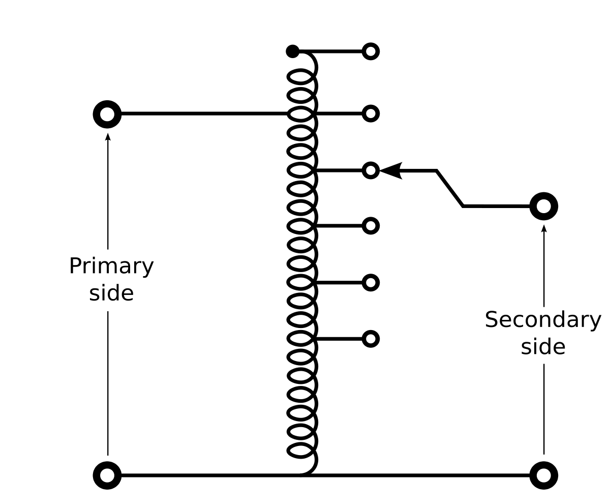
What transformer is this
Autotransformer

What transformer is this?
Closed-Core Transformer

What type of transformer is this
Shell-Type Transformer
Which type of transformer works on the principle of self-induction
Autotransformer
Which types of transformers work on the principle of mutual induction
Closed-Core Transformers
Shell-Type Transformer
Which type of transformer is the most efficient
Shell-type transformer
Which type of transformer is used in the operating control console
Autotransformer
Which type of transformer is the most commonly used in radiology imaging systems
Shell-Type Transformer
What is the turns ratio equation?
Ns/Np
In a turns ratio equation, how would you know if a transformer is a step-up transformer or a step down transformer
If the turns ratio is greater than 1, it is a step-up transformer
If the turns ratio is less than 1, it is a step-down transformer
For the Transformer Law: What is the equation if looking for Voltage and given the number of turns
Vs/Vp = Ns/Np
For the Transformer Law: What is the equation if looking for Amperage and given the number of turns
Is/Ip = Np/Ns
For the Transformer Law: What is the equation if looking for voltage or amperage and the number of turns is NOT given
Is/Ip = Vp/Vs
What is the purpose of a transformer
To change voltage and current into increasing and decreasing values
What is the purpose of an electric motor
Converts electrical energy into mechanical energy
What is the purpose of an electric generator
Converts mechanical energy into electrical energy
What is the purpose of an induction motor
To use electric current to make a rotor turn/rotate
Where is the induction motor used
In the X-ray tube
Which part of the induction motor is fixed/stationary
Stators
Which part of the induction motor turns
Rotor
Which part of the induction motor is supplied with AC
Stators
What type of relationship exists between permeability and retentivity
Inverse Relationship
Magnetite AKA
Lodestone
Leading Stone
Faradays Law AKA
Law of Electromagnetic Induction
Step-Up Transformer AKA
High-Tension Transformer
High-Voltage Transformer
Step-Down Transformer AKA
Filament Transformer
Turns AKA
Windings
Taps
Coils
Electric Generator AKA
Dynamo
A Danish physicist was the first scientist to link electricity and magnetism together.
He took a wire and placed a compass near the wire and ran an electric current over the wire and noticed the compass had moved
He proved that electricity could create a magnetic field
Oersteads Experiment
This experiment went off of Oersted’s Experiment to see if magnetic fields could generate an electric current
An electric current will flow in a circuit as long as some part of the circuit is in a changing magnetic field
Faradays Law