MGMT 159 Final
 Call Kai
 Learn
 Practice Test
 Spaced Repetition
 Match
 Flashcards
 Knowt Play
1/138

There's no tags or description
Looks like no tags are added yet.
139 Terms
What is entreprenurship?
it is novelty, creating value, risk, and addressing an problem to then create an solution
What are the three definitions of entreprenurship?
Peter Drucker: entrepreneurship is a purposeful practice where an individual or organization always searches for change, responds to it, and exploits it as an opportunity.
Howard Stevenson: the pursuit of opportunity without regard to resources currently controlled
Saras Sarasvathy: entrepreneurs practice effectuation - understanding themselves and their current resources, making changes, “creating the future”, building a path as they go
What do these definitions emphasize?
Peter Drucker: Change creates openings for innovations (What has changed in the enviornment)
Howard Stevenson: Opportunities can exceed resources already controlled (What should we make?)
Saras Sarasvathy: Available means and commitments shape possible ventures, which evolve (Who are we? What do we know right now?
In Peter Drucker’s definition, define pursuit, opportunity, and resoures?
Pursuit: somebody takes action
Opportunity: there is an reason to believe value can result (value creation, value capture)
Resources: the founder can seek access, partners, and commitments
What is the difference between liquidity assets and non liquidity assets?
Liquidity assets are ones that could be traded (such as selling an company for cash and IPO) versus non-liquid assets demonstrate the spread or margin of how much wealth or profit someone has like an house or an private compant
What is the difference between opportunities and ideas?
Opportunities are validated ideas that we can act on-they are ideas that we can monetize (or capture value from). While an idea is a possible product, service, or way of doing something
What is value creation and value capture?
Value creation is what becomes better for someone. Value capture is who receives a share of the benefit and how?
When creating an business or product, it is important to note that
other companies can capture that value too
What is the customer surplus?
The customer’s maximum willingness to pay minus the price paid
What is the provider contribution?
The price paid minus the variable fulfillment costs
COME BACK FOR USER AND PAYER
What is hypothesis testing?
managing your relationship between customers, product, and operations
What are feedback loops when hypothesis testing?
reacting to previously produced products
Why is it important to collect qualitative evidence when determining an customer’s interest in your products?
Test subjects purchasing your product multiple times overides people’s response, sample, and authority bias. As well, it overcomes people’s false assumptions as they often overestimate willingness to buy
To identify an customer you can actualy find?
Must be specific
Investigate when the problem occurs, what they already spend or give up, and where to find people with that experience
How did Spanx begin and what did Blakely test it on?
In 1998, Spanx began after the owner wanted a smoother look under white pants, so she cut the feet off a pair of pantyhose. She tested it on herself, testers, and friends, and worked to improve them
If an product works well for its investor, what else should you investigate next?
Dos it work for others
Will someone choose it
Can we supply it consistently
Can the venture retain value
What is an consumer packaged goods?
everyday products that people use
How do we define revenue?
price x quantity
When an business cannibalizes an product?
A company’s new product takes revenue away from existing offerings
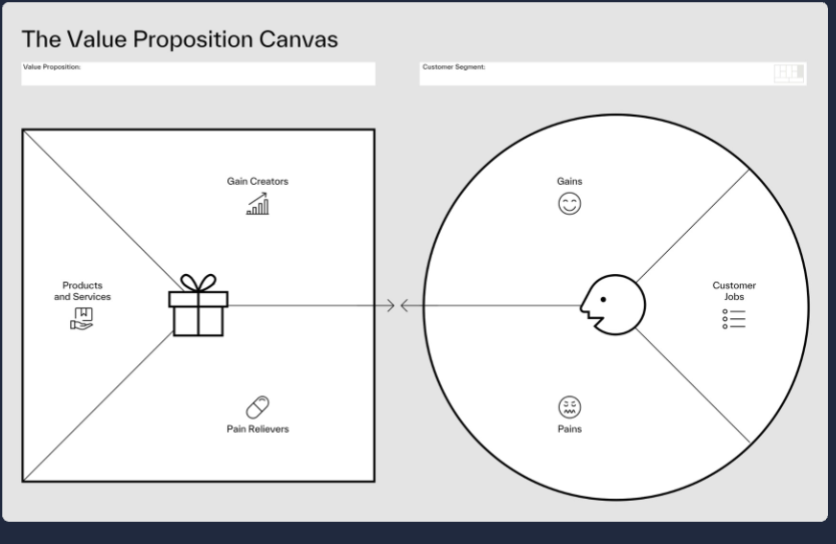
The Value Proposition Canvas
matches an offer to an customer’s needs and explores product-market fit
What are the aspects of an Value Proposition Canvas?
Customer Profile: Jobs (What they need to do), Pains (What makes it difficult), Gains (What they want)
Value map: Products and Services (What we offer), Pain Relievers (How we help), Gain Creators (What we make better)
What is an Business Model Canvas?
Describes how an business works
What are the aspects of an Business Model Canvas?
Customer Segments: Whom we serve
Value Propositions: Why they choose us
Channels: How we reach and serve them
Customer Relationships: How we attract and retain them
Revenue Streams: How money comes in
Key Resources: What we need
Key Activities: What we do
Key Partnerships: Who helps us deliver

What are the Five Forces + Complementors?
Addresses the pressures, industry competition, and profit potentional in an industry
What are the aspects of the Five Forces + Complementors?
Rivalry: Competition among existing businesses
New Entrants: New businesses entering the market
Substitutes: Other ways to meet the same need
Buyer Power: Customers’ ability to demand better terms
Supplier Power: Suppliers’ ability to demand better terms
Complementors: Offerings that become more useful together
What are McKinsey 7s?
Examines the internal effectiveness of an organization
What are the aspects of an McKinsey 7s?
Strategy: The plan for competing
Structure: Responsibilities and authority
Systems: Everyday processes
Shard values: Beliefs guiding decisions
Skills: Capabilities
Style: How leaders manage
Staff: People and staffing needs
What is PESTLE?
The conditions outside the business
What are the aspects of PESTLE?
Political
Economic
Social
Technological
Legal
Environmental
What is SWOT?
An quick summary of the situation
What are the aspects of SWOT?
Strengths
Weaknesses
Opportunities
Threats
What is an BCG Growth Share Matrix?
it compares products or business units for resource allocation
What are the aspects of an BCG Growth Share Matrix?

Which frameworks work for which Jobs?
The Value Proposition Canvas helps us to understand the customer + offer
The Busniess Model Canvas helps us to understand how the business creates, delivers, and captures value
Five Forces + Complementors demonstrate industry competition and relationships
McKingsey 7s helps us to understand internal alignment
PESTLE helps us to understand the wider enviornment
SWOT helps to understand the overlal situation
BCG Growth-Share Matrix helps us to understand the investment across a portfolio
What is an product-market fit?
A product that meets an important need for an particular market
How do you know whether an product is an product-market fit?
Customers choose it over their alternatives
Customers return when the need arises
Customers are willing to pay for the value it provides
Customers recommend it to others
What is the “Mom Test”?
an approach to more useful customer conversations where we explore the person’s experience before introducing your idea
EX of the “Mom Test”?
Don’t ask would you use an parking app, ask “tell me about the last time you drove to campus and tried to park
What is an testable hypothesis?
an assumption you can test with evidence based off:
hypothesis to testing to measure to decision
What is concept validation?
concept validation tests the assumptions behind an idea
To test ideas, what method is used?
Build: Create an small version that tests an important assumption
Measure: Observe what customers do and what results they get
Learn: Use the evidence to decide what to change or test next
Repeat the cycle as your understanding improves
What is an Minimum Viable Product
An MVP lets an team learn from real customers with an limited initial version. This can then be useful before automating the product.
What is the definition of _______ development?
iterative development: improving an product through repeated cycles of use, feedback, and revision
What is the difference between lean startup and agile development
Lean startup focuses on reducing uncertainty about the product and business by testing assumptions before making larger investments vs. Agile development delivers useful increments and adapts to feedback by releasing usable pieces and revises priorities as it learns
What is waterfall development?
A predictive approach that organizes development into planned, sequential phases
What are the phases of waterfall development?
Requirements
Design
Implementation
Verification
Release
When is waterfall development ideal and what is an example of it?
When the requirements are stable
Work has strict dependencies
Late changes are costly or difficult to reverse
Building an concert venue is an example of waterfall development
What is the caveat around waterfall development?
The amount of capital and risk involved affect whether we can do waterfall or not
You can’t do iterative development on
waterfall development
When is an measure an useful metric?
When it connects to the value the product is meant to provide
Within this bubble of useful metrics, what are other metrics that are needed but are not often considered?
Business measures like acquisition cost, repeat use, and contribution after variable costs
Why are vanity metrics impressive, but useless?
They may show reach but provide little guidance about whether the business is improving
What is an local maximums?
A measuring metric where the best result (local maximum) produced is among nearby options but an better option may exist elsewhere
What is one example of local maximums?
The local maximum, improving the swipe screen on an dating app, is slightly helpful but gains eventually flatten. The better option, is small in-person events, that existed elsewhere where customers can meet people more effectively
Why is it important on what you measure?
What you measure shapes behavior. For example, if you measure the amount of calls an team receives, the metric can improve to have an shorter amount of calls but the customer experience gets worse. So an better approach is to measure whether the problem was resolved + how long it took
What are the possible decisions after an test has been conducted and evidence has been collected?
Based on the evidence, business should:
Continue: The assumption has support. Test what remains uncertain
Revise: Change part of the offer and test again
Pivot: Test a substantial change in the customer, offer, or business model
Stop: The evidence no longer supports further investment
What is an syndicate?
A big group that pools large checks to fund a large loan. However, the checks aren't guaranteed because they raise money deal by deal from individual investors (called Limited Partners or LPs).
What is Sydneys Singh’s busniess, A26?
a student-backed early-stage angel fund connected to UCLA
What’s the difference between A26 and syndicate?
it is easier for A26 to have an relationship with the founder and in exchange founder with the fund
gaurentees checks through their current management fees
What is an pledge fund?
an ongoing syndicate that promises to write checks sourced by a general partner over time
What is the four aspects of marketing?
Understanding customers and their alternatives
Designing an offer that meets their needs
Setting an price and making the offer accessible
Communicating value and supporting ongoing relationship
What is the definition of Marketing
Marketing is finding the right customers, understanding their needs, creating an valuable offer, and building connections that lead to lasting relationships. It also includes sales, customer research, offer, and the experience that brings people back
What is the aim of the STP model?
The STP model guides whom the company serves and how it competes
What are the two formal strategy that STP guides?
The STP guides the marketing mix (the 4 P’s of Marketing) and the acquisition strategy, or the plan for attracting new customers
What does the STP stand for?
Segmentation: Divide an market into groups with shared needs, characteristics, or behaviors
Targeting: Select the segment or segments the company will pursue
Positioning: Defines the reason a target customer should choose an offering over alternatives
What are the four ways an market can be segmented by?
Geography: location or service area
Demographics: Age, income, occupation, or life stage
Psychographics: Values, interests, or lifestyle
Behavior and Benefits: Usage, buying occasions
What does an promising target have?
A meaningful need
Can be reached
Offers sufficient economic potential
Fits capabilities the company has to serve it well
How should we write an positioning statement?
Include:
The Target customer
The need or benefit that matters
The relevant alternatives
The distinctive value and reason to believe it
What is the format of an positioning statment:
For [target customer'], [offering] provides [benefit] compared with [alternative], supported by [evidence or capability].
What are the marketing mix (the Four P’s of marketing)?
The marketing mix consists of choices a company makes to serve its target customers
What are the Four P’s of marketing?
Product: Features, quality, design, benefits, and service
Price: What customers pay, including pricing structure and payment terms
Place: Distribution channels, availability, and delivery
Promotion: Advertising, sales, public relations, and other communications
What should the four P’s of marketing reinforce
the value the company promises
What are the Four C’s of Marketing?
The four C’s examine the same marketing decisions from the customer’s perspective
Compare the Four C’s to the company’s perspective and state what does it ask?
Product = Customer Needs, The problem solved or benefit received
Price = Cost, The money, time, effort, and risk involved
Place: Convenience: How easily customers can buy and receive the offering
Promotion = Communication: How customers learn, ask questions, and asses credibility
Even though you may be lowering the price of an product, why can it still be considered an affordable inconveneience?
There may be an low monetary price, but the customer experience looks differently. Here, customers can face additional costs in time, effort, or connivence (These are based off the Four C’s) which turns it into an inconvenience
What is the AIDA Model?
AIDA describes four responses marketing communication seeks to encourage
What are the four AIDA responses?
Attention: Get noticed by the intended audience
Interest: Show why the offering is relevant
Desire: Make the benefits compelling and credible
Action (Purchase, trial, booking, request for more info): Make the next step clear and easy
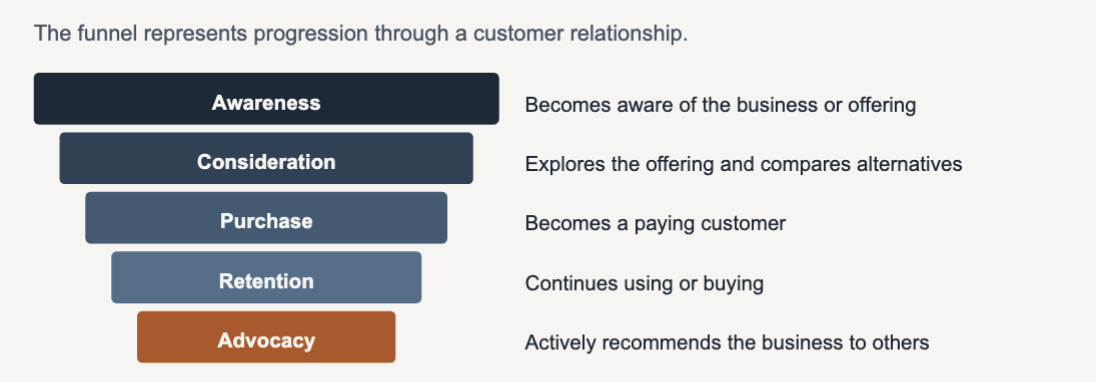
What is the customer funnel?
An funnel that represents progression through a customer relationshop
Describe the tiers of the customer funnel?
What is the caveat with the customer funnel?
The advocacy stage (last stage) brings in new customers into the funnel. So, at that point, the retained customer will work to bring in other customers. Additionally, customers can leave, return, or skip stages too in the marketing funnel
How does the AIDA and the funnel correlate to one another?
Awareness = Gain Attention
Consideration = Build Interest and Desire
Purchase = Encourage action and reduce buying friction
Retention = Deliver ongoing value and support repeat purchases
Advocacy = Make recommendations easy and worthwhile
What is the caveat with AIDA and the funnel’s correlation to each other?
AIDA’s action may occur before an purchase and retention depends on the experience after the sale
Although AIDA helps structure communication,
the funnel helps track the broader relationship
What is the Customer Acquisition Cost and what is it’s fomula?
The average cost of acquiring an new paying customer + CAC = Total acquisition costs/ New Customers acquired
For CAC, we have to make sure we match costs and customers (the numerator and denominator) to the same
campaign or time window, allowing for sales-cycle delays
What are some types of acquisition costs?
Advertising and campaign production
Sales and marketing labor
Acquisition tools and agency fees
Acquisition incentives and referral rewards
What is the customer lifetime value?
The present value of an customer relationship, before acquisition cost
For Customer Lifetime Value, you need to calculate two other equations. So, how do you calculate lifetime revenue and expected lifetime purchases? Then, what is the equation for LTV
Lifetime Revenue: Average revenue per purchase x Expected lifetime purchases
Expected Lifetime Purchases: Purchases per year x Expected years as a customer
LTV: Average contribution per purchase x Expected lifetime purchases
Contribution margin per purchase = Revenue - costs of delivering and serving the purchase
What is the caveat with contribution margin?
Include delivery, service, and retention costs
Remember that the contribution margin is not an net profit because
it doesn’t consider fixed costs and acquisition costs remaining
Churn
the share of customers who leave during an period
What are the formulas for monthly churn, expected lifetime, and subscription LTV?
Monthly Churn = Customers lost during the month + Customers at the start of the month
Expected lifetime = 1 divided by Monthly churn rate (with stable churn)
Subscription LTV = Monthly contribution per customer divided by Monthly churn rate
An dollar received later is worth less today because
money has an opportunity cost
What is the equation for present value?
Present Value = Future Cash flow/(1 + discount rate) ^ periods
How do you find the present value fo an LTV?

What is the difference between CAC vs LTV?
CAC is the costs to acquire the customer, often incurred before or around the first purchase, based on acquisition spending and new customer counts. While the LTV is the present value of expected contribution over the relationship, often realized across multiple purchases, and based on margins, retention, cash-flow timing, and discount rate
Timing and Uncertainty One?
Why do we aim for an 4-5x LTC/CAC
Businesses invest at the top of the funnel to earn attention and trust, but the payoff
comes through later retention and repeat purchase