GRE Math Formulas
 Call Kai
 Learn
 Practice Test
 Spaced Repetition
 Match
 Flashcards
 Knowt Play
1/137

There's no tags or description
Looks like no tags are added yet.
138 Terms
Distributive property
a+c/b = a/b + c/b
Multiplying fractions
a/b x c/d = ad/bc
Dividing fractions
a/b / c/d = a/b x d/c
LCF
Squares of fractions
(a/b)2 = a2/b2
Square roots of fractions
√x/y = √x / √y
If 0 < x < 1, it must be true that…
x2 < x < √x
General form of a quadratic equation
ax2 + bx + c = 0
Factoring a quadratic
x2 + bx + c = 0 factors to (x+p)(x+q)
p & q must MULTIPLY to c
p & q must ADD to b
Quadratic identity: (x+y)2
(x+y)(x+y) = x2 + 2xy + y2
Quadratic identity: (x-y)2
(x-y)(x-y) = x2- 2xy + y2
Quadratic identity: (x+y)(x-y)
x2 - y2
Difference of squares
a2 - b2 = (a+b)(a-b)
Ex: 9x2-16 = (3x+4)(3x-4)
Even/odd rules for addition/subtraction
odd + odd = even
even + even = even
even + odd = odd
odd - odd = even
even - even = even
Even/odd rules for multiplication
even x even = even
even x odd = even
odd x even = even
odd x odd = odd
Even/odd rules for division
even/odd = even
odd/odd = odd
even/even = even or odd
Prime numbers up to 100
2, 3, 5, 7, 11, 13, 17, 19, 23, 29, 31, 37, 41, 43, 47, 53, 59, 61, 67, 71, 73, 79, 83, 89, 97
Factors
If y divides evenly into x, we say y is a factor of x
Multiple
The product of that number an any integer
A number is divisible by 2 if…
the ONES digit is 0, 2, 4, 6, or 8
A number is divisible by 3 if…
the sum of all digits is divisible by 3
A number is divisible by 4 if…
the last TWO digits of a number are a number divisible by 4
A number is divisible by 5 if…
the last digit is a 0 or a 5
A number is divisible by 6 if…
the number is divisible by both 2 and 3
A number is divisible by 8 if…
the last THREE digits are a number divisible by 8
A number is divisible by 9 if…
the sum of all digits is divisible by 9
A number is divisible by 11 if…
the sum of the odd-numbered digits MINUS the sum of the even-numbered digits is divisible by 11
Prime factorization
Finding which prime numbers multiply together to make the original number
One method:
Divide # by smallest prime possible; note this
Divide result by smallest prime possible (or, factor the result)
Keep going until all factors are prime numbers
Ex: 147 → 147/3 = 49; 49/7 = 7
Prime factorization: 3 × 72
Finding the total number of factors in a particular number
Find the prime factorization of the number
Add ONE to the value of each exponent
Multiply the results and the product will be the total number of factors
Ex: Number of positive factors of 240
240 = 24 × 31 × 51
(4+1)(1+1)(1+1) = 20
240 has 20 positive factors
Finding the LCM
Find the prime factorization of each integer
Of any repeated prime factors, take the one with the LARGEST exponent
Multiply together what results from Step 2
Ex: LCM of 24 & 60
24 = 23 × 31
60 = 22 × 31 × 51
4 × 3 = 12
Finding the GCF
Find the prime factorization of each number
Of any repeated prime factors, take the one with the SMALLEST exponent
Of what’s left, take all non-repeated prime factors of the integers
Multiply together what results from Steps 2 & 3
Ex: GCF of 24 & 60
24 = 23 × 31
60 = 22 × 31 × 51
LCM x GCF
If the LCM of x and y is p, and the GCF of x and y is q, then xy = pq
Any factorial greater than or equal to 5!…
will always have 0 as its unit digit
Trailing zeroes
The number of (5×2) pairs in the prime factorization of that number
Ex 1: 520 → 52 × 10 = 52(5×2), so one trailing zero
Ex 2: 5,200 → 52 × 100 = 52(5 × 2)(5 × 2), so two trailing zeroes
Patterns in unit digits: power of 0
All powers of 0 end in 0
Patterns in unit digits: power of 2
The unit digits will follow the pattern 2-4-6-8
Patterns in unit digits: power of 3
The unit digits will follow the pattern 3-9-7-1
Patterns in unit digits: power of 4
The unit digits will follow the pattern 4-6-4-6
Patterns in unit digits: power of 5
All numbers end in 5
Patterns in unit digits: power of 6
All numbers end in 6
Patterns in unit digits: power of 7
The unit digits will follow the pattern 7-9-3-1
Patterns in unit digits: power of 8
The unit digits will follow the pattern 8-4-2-6
Patterns in unit digits: power of 9
The unit digits will follow the pattern 9-1-9-1
Perfect square
A number such that all of its prime factors have EVEN exponents
Perfect cube
A number such that all of its prime factors have exponents that are divisible by 3
Two consecutive integers will never…
share any prime factors; the GCF is 1
Multiplying radicals
m√a x m√b = m√ab
AND
m√ab = m√a x m√b
Dividing radicals
m√a / m√b = m√a/b
AND
m√a/b = m√a / m√b
Adding and subtraction radicals
√a+b DOES NOT = √a + √b
Solve inside first, then square root
Taking the square root of a number and/or binomial
√x2 = |x|
√(x+y)2 = |x+y|
Multiplication of like bases
(x2)(xb) = xa+b
Division of like bases
(xa) / (xb) = xa-b
Power to a power rule
(xa)b = xab
Multiplication of different bases and like exponents
(xa)(ya) = xya
Division of different bases and like exponents
xa / ya = (x/y)a
Radicals as exponents
√x = x1/2
Multiple square roots
m√n√x = (x1/n)1/m = x1/n x 1/m = x1/nm
Raising a base to a negative exponent & vice versa
x-y = 1/xy
Addition and subtraction of like radicals
Add outside #s together
Convert radical to exponent and sum to a base with exponent
Multiply
Equations with one absolute value
Solve equation twice: (1) for the case in which the expression inside the bars is positive, and (2) for the case in which the expression inside the bars is negative
Adding absolute values
ALWAYS TRUE: |a+b| is less than or equal to |a|+|b|
When |a+b| = |a|+|b|…
One or both quantities are 0
OR
Both quantities have the same sign
Subtracting absolute values
ALWAYS TRUE: |a-b| is greater than or equal to |a|-|b|
When |a-b| = |a|-|b|…
The second quantity is 0
OR
Both quantities have the same sign and the absolute value of |a-b| is greater than or equal to the absolute value of |a|-|b|
Profit
Profit = total revenue - total cost
OR
Profit = total revenue - (total fixed costs + total variable costs)
Simple interest
Principal x Rate x Time
Compound interest
A = P(1+r/n)nt
A = future value
P = principal
r = rate of interest
n = number of times per year interest is compounded
t = time in years
Distance
Rate x Time
Work
Rate x Time
“Percent less than”
Final = (1 - % less than/100) x (Initial)
“Percent greater than”
Final = (1 + % greater than/100) x (Initial)
“Percent change”
((Final Value - Initial Value)/Initial Value) x 100
Counting the number of integers in a set of consecutive integers (inclusive)
(Highest number - lowest number) + 1
Counting the number of multiples in a set of consecutive integers (inclusive)
((Highest multiple - lowest multiple)/Given number) + 1
Weighted average/mean
Where dp = data point
(dp 1) x (frequency of dp 1) +…+ (dp n) x (frequency of dp n) / total frequency of dp’s
When adding/subtracting a constant to each tern in a set of numbers, the standard deviation…
does not change
When multiplying/dividing a constant to each tern in a set of numbers, the standard deviation…
will also be multiplied/divided by that amount
Acute angle
Less than 90°
Right angle
90°
Obtuse angle
Greater than 90° but less than 180°
Straight angle (forms a line)
180°
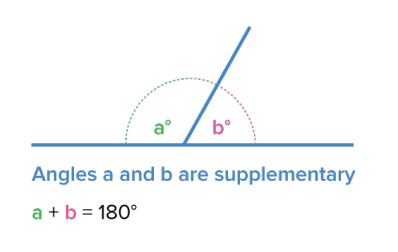
Supplementary angles
Both angle measures add up to 180

An exterior angle of a triangle is equal to…
the sum of its two remote interior angles

Parallel lines intersected by another line (transversal)
Vertical angles are equal (angles diagonal from e/o)
Corresponding angles are equal (angles in the same “spot” above and below)
Area of a triangle
A = (base x height)/2
OR
A = ½(bh)
Triangle inequality theorem
In any triangle, the sum of the lengths of any two sides is GREATER THAN the length of the third side

Pythagorean theorem
a2+b2=c2
Pythagorean triples/triplets
3-4-5
5-12-13

Isosceles right triangle
Two equal angles, two equal sides, and third angle is 90°

45-45-90 triangle
Ratios:
X for each leg
X√2 for hypotenuse

30-60-90 triangle
Ratios:
X for vertical side (opposite of 30)
X√3 for horizontal side (opposite of 60)
2x for hypotenuse
Area of an equilateral traingle
½ of side x ½ of side x √3
When are triangles congruent?
SSS
SAS
ASA
AAS
When are triangles NOT congruent?
AAA
ASS
Similar triangles
Two triangles that share the same three angles; the proportions of the sides are the same
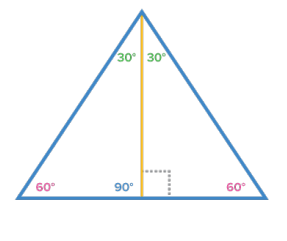
Cutting an equilateral triangle in half produces…
two identical 30-60-90 triangles
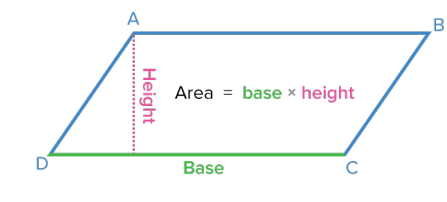
Parallelogram
Opposite sides are equal
Opposite angles are equal
A = bh
Height must be found by creating a triangle if not already provided
A rhombus is a regular version of this shape
Longest line segment of a rectangle
The diagonal
Diagonal = √L2+W2

The diagonals in a square are…
perpendicular
How to find the maximum area of a given shape
Make it regular (all sides equal)
A rectangle with the maximum area is a square
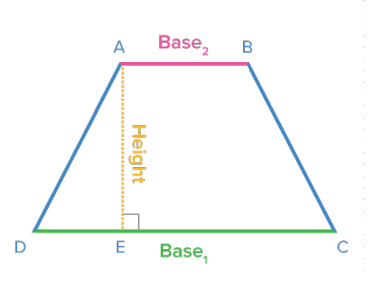
Trapezoid
Top and bottom are parallel
A = (base1+base2) x height / 2