5.4 Gravitational Fields
 Call Kai
 Learn
 Practice Test
 Spaced Repetition
 Match
 Flashcards
 Knowt Play
1/51

Earn XP
52 Terms
Using Newton's Law of Gravitation, derive another equation for gravitational field strength
g = F/m
g = -GMm/r² × 1/m
g = (-) GM/r²
Define gravitational potential energy
the work done to move an object with mass m from infinity to a point in that field.
Find an equation for gravitational potential difference by using its definition
∆V = mg∆h / m
∴ ∆V = g∆h
What is the equation for work done in a radial gravitational field
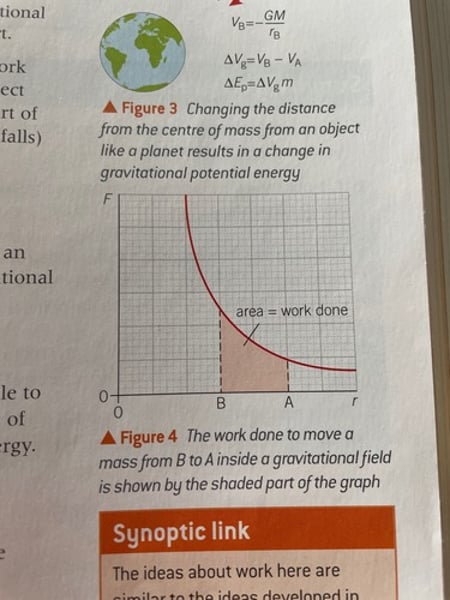
W = F∆r (integrate/area under graph)
Draw a graph for force against distance away from object the gravitational field emanates from; describe why the shape of the graph is as it is
as distance from object increases and the field weakens, less work will need to be done on an object within the field to move it as less force is exerted on the object by the field per unit mass.
moved towards object with a gravitational field...
... work done by field; loss of GPE and gain in KE
Derive the equation for change in gravitational potential
W = F∆r
W = -GMm/r² ∆r
W/m = ∆V = -GM/r₂ ∆r
INTEGRATE (moving a mass from r₁ to r₂)
∆V =∫-GMr⁻² dr (lower limit is r₁, upper limit is r₂)
∆V = -GM[1/r₂ - 1/r₁]
Use your derived equation for change in gravitational potential to derive the equation for gravitational potential
V = work done to move a mass from infinity to a point in the field
∴ r₁ = ∞, r₂ = r
V = -GM[1/r - 1-∞]
V = -GM/r
define escape velocity
the minimum speed it would require at the planet's surface to escape the gravitational field of a planet
Bearing in mind conservation of energy, derive an equation for escape velocity
To escape a planet's gravitational field, the object must be infinitely distant from the planet: final r = ∞ ∴ final PE = 0
Since escape velocity is the minimum speed needed to escape a planet's gravitational field, all initial KE must be used to move the object i.e. transferred into GPE: final KE = 0
Setting up an energy equation, assuming the only energies in the system are KE and GPE:
KE₁ + GPE₁ = KE₂ + GPE₂
½mv² + -GMm/R = 0 + 0
½v² = GM/R (KE transfers to GPE)
escape velocity = √2GM/R
where G = universal gravitational constant
M = mass of planet
R = radius of plant at surface
Using an equation for gravitational field strength, find another equation for escape velocity
g = GM/R² ∴ gR = GM/R
so escape velocity = √2gR
What happens to KE as an object moves away from a planet?
It transfers to GPE
Find an equation for orbital speed
Gravitational force = Centripetal force
-GMm/r² = mv²/r
v = √GM/r
Find the time period of a circular orbit
speed = distance / time
orbital speed = 2πr/T
√GM/r = 2πr/T
GM/r = 4π²r²/T²
T² = 4π²r³/GM
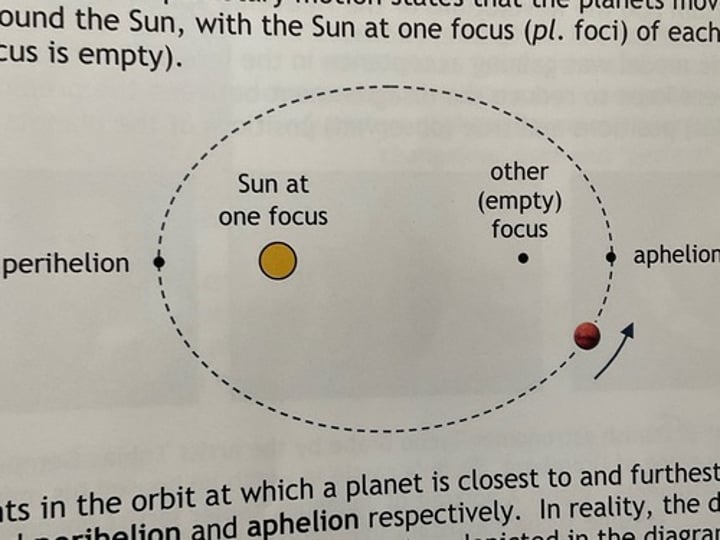
What is Kepler's First Law of Planetary Motion?
Planets orbit the Sun in elliptical orbits withe the Sun at one of the two foci
How are gravitational and electric forces different?
electric forces can be attractive or repulsive however gravitational forces are only attractive
What is a gravitational field?
region of space around a massive body in which an object with mass will experience an attractive force.
How is an attractive force indicated?
with a minus sign (-)
What type of field is gravity? Where and in what direction does it act from?
radial; it acts from the centre of mass of the object in the direction towards the object with a greater mass
what can a gravitational field be approximated at when regarding small scales relative to the size of the object?
a 'uniform' field with field lines acting towards the 'horizontal' surface of the object
what is a similarity between gravitational and electric forces?
they both follow inverse square laws
What does NIII tell us about the forces between object with mass M and object with mass m?
Force on M by m = force on m by M
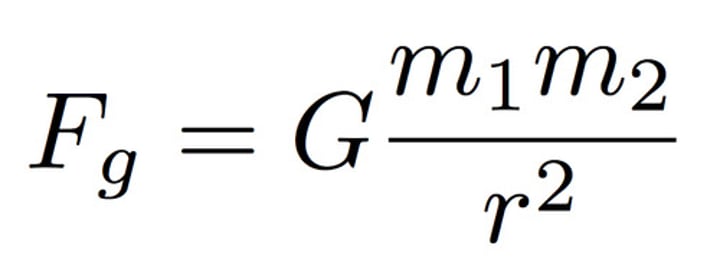
What is Newton's Law of Gravitation?
The force between two masses is proportional to the product of the masses involved and inversely proportional to the square of the separation of the masses.
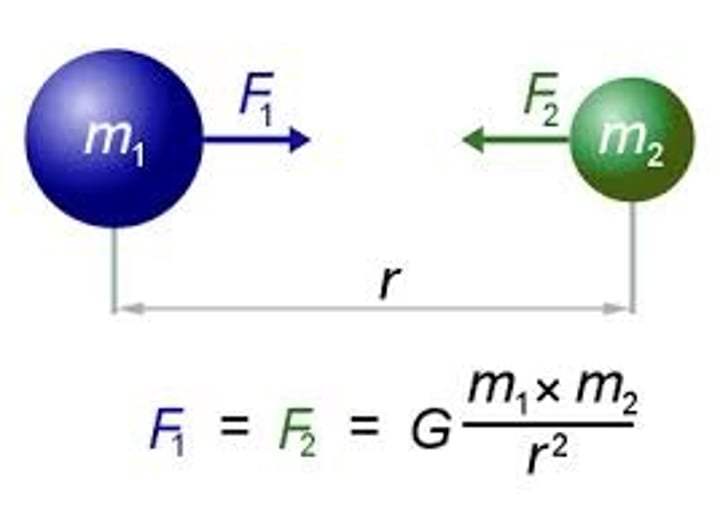
for the equation of gravitational force, what is r?
the distance between the centres of mass of object A and object B
what is gravitational field strength (g)? What is it measured in?
Force per unit mass; Nkg⁻¹ or ms⁻²
Equation for change in GPE in a uniform field
∆GPE = mg∆h
Define gravitational potential; what is its units?
Work done per unit mass in moving a mass from infinity to a point in the field; Jkg⁻¹
Where is does PE = 0?
When a mass is infinitely distant from a gravitational field ∴ the force exerted on this mass by that field is negligible. As r increases towards infinity, V becomes less negative → max value is 0
Define equipotential
A line perpendicular to the gravitational field lines along which no work is done in moving an object, nor does the object gain or lose GPE (as it's not changing height)
What is the relationship between gravitational potential and height in a uniform field; draw the graph
V is directly proportional to h, their constant of proportionality being the GFS (g); straight line graph, V on y axis, h on x axis, gradient = g
What is the relationship between gravitational field strength and height in a uniform field; draw a graph
g doesn't change with height; horizontal line, g on y axis, h on x axis, area under graph = ∆V
moved away from object with a gravitational field...
...work done against field; gain in GPE and loss of KE
How many forces acts on an object in a circular orbit?
1
What force acts on an object in a circular orbit and give its equation
gravitational force exerted by the planet it is orbiting
F = -GMm/r²
Does the speed of an object in a circular orbit vary? Explain why or why not.
It doesn't. As the distance the object is from the planet it's orbiting doesn't change, the gravitational force acting on it doesn't change and therefore the centripetal force acting on it doesn't change
Define geosynchronous orbit
any orbit about Earth with a time period equal to Earth's rotational period (~23 hours, 56 mins)
Define geostationary orbit
a type of geosynchronous orbit where a satellite orbits Earth in the same plane as the Equator
How do satellites in geosynchronous orbits appear in the sky?
They appear in the same place in the sky at the same time each day
How do satellites in geostationary orbits appear in the sky?
They appear fixed in the sky
Most orbits are....
...elliptical in shape.
How does the shape of planetary orbits differ from the orbits of comets?
Planetary orbits are near-circular whereas the orbits of comets are very eccentric
define perihelion
The point on an orbit closest to the Sun
define aphelion
The point on an orbit farthest to the Sun
What shape can a planetary orbit be modelled as?
circular
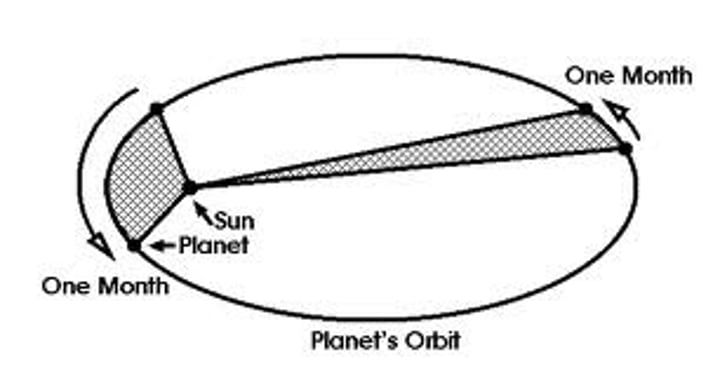
What is Kepler's Second Law of Planetary Motion?
A line segment joining the planet to the Sun sweeps out equal areas in equal time intervals
What is Kepler's Third Law of Planetary Motion?
T² is proportional to r³
Where is an orbiting mass fastest?
Near the sun → at the perihelion
Where is an orbiting mass slowest?
Far from the sun → at the aphelion
What is a satellite?
Objects that orbit other, more massive objects
What are the two types of satellites and give some examples
Natural satellites e.g. the Moon
Artificial satirists e.g. satellites used for GPS
What does GPS stand for?
Global Positioning Systems
What are geostationary satellites used for?
Communications and surveyings