ACC401 CHP 1 &2
 Call Kai
 Learn
 Practice Test
 Spaced Repetition
 Match
 Flashcards
 Knowt Play
1/79

There's no tags or description
Looks like no tags are added yet.
80 Terms
The primary purpose of taxation
To be used by governments (Federal, State, & local) to raise revenue to cover the cost of their operations:
Defense, protection(police ad fire department), education, roads, court system(s), social services, etc
Who cares about taxes?
Individuals
Why?
It affects financial decisions and is part of daily life.
Examples: Investment and/or retirement planning, job offers, education expenses, divorce
Taxation
Used as a tool to influence the behavior of individuals and businesses.
For example, an income tax credit (which reduces a taxpayer’s tax liability) may be designed to encourage people to purchase a fuel-efficient car.
A tobacco excise tax may discourage individuals from smoking by increasing the cost of tobacco products.
What are the objectives of taxation?
Raising revenue, economic, social, and political goals.
Individuals & Taxes
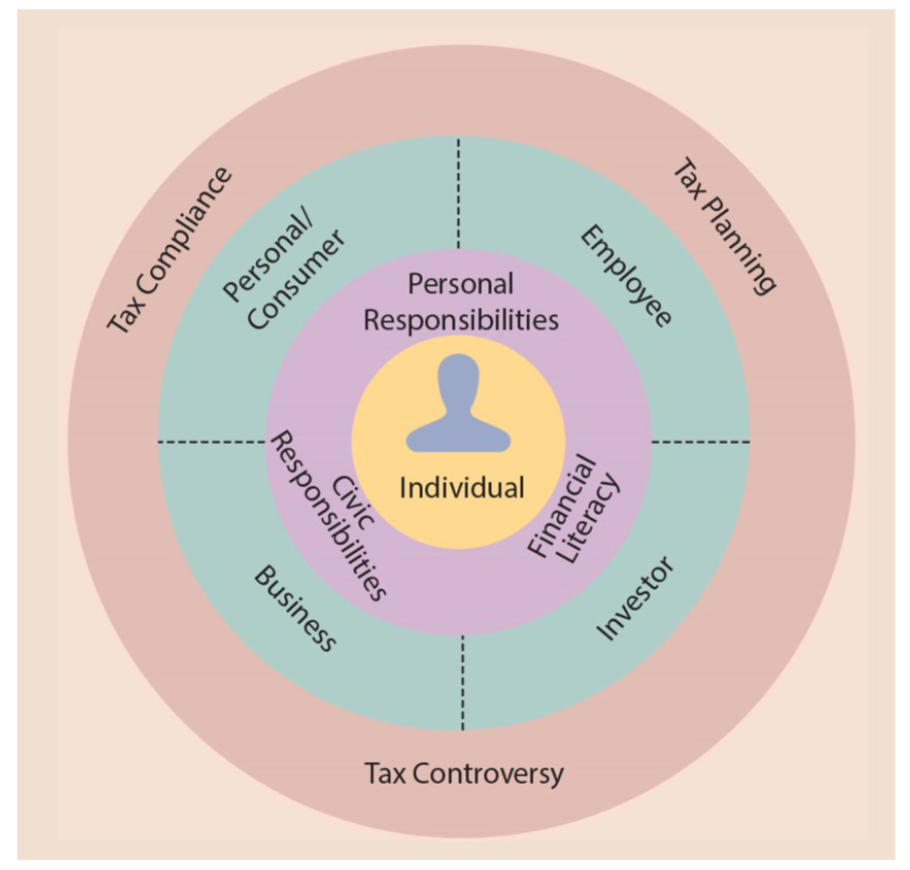
Tax Compliance
Ensures business reports & pay its taxes accurately & timely
Tax Planning
Helping a business understand how tax-law incentives may apply to it and what impact, if any, they may have on its organization and operations.
Effective tax planning can involve structuring a company and its operations to minimize the amount of taxes paid, or to defer when taxes must be paid.
Financial Reporting
Financial statements include a variety of tax information, including income tax expenses on the income statement and deferred tax assets and liabilities on the balance sheet.
Footnotes to the financial statements report various tax details, including the company’s effective tax rate and the potential impact of uncertainty in how tax laws apply to the company and its operations.
The proper reporting of this information requires knowledge of both tax and financial reporting rules [including the Financial Accounting Standards Board’s Accounting Standards Codification (ASC) 740, Income Taxes].
Environmental, Social, & Governance (ESG)
Many corporate reports address business sustainability and responsibility matters and identify environmental, social, and governance activities and their impact on the company and its investors. Standard frameworks such as those promulgated by the Global Reporting Initiative (GRI) or the World Economic Forum typically include certain tax metrics.
These metrics can include the taxes paid in each country in which the company operates (part of “country-by-country reporting”), a reconciliation between taxes paid and the statutory tax rate on financial statement profits, any financial assistance received from governments via tax deductions and credits, and an explanation of the corporation’s tax policy and strategy.
Tax professionals assist businesses in identifying relevant and possibly required ESG reporting and help verify that the information is accurate and clearly explained.
Tax Controversy
An interaction between a taxpayer and a tax agency such as the IRS.
The IRS and state and local tax agencies regularly examine (audit) tax returns that have been filed to verify that taxes were properly computed and paid.
Tax agencies also pursue individuals and businesses that fail to file returns.
Tax practitioners may represent a taxpayer before the IRS (or other tax agency) to assist with an audit or to provide answers to questions the tax agency has asked the taxpayer. This work is often referred to as tax representation services.
Cash Management
Taxes must be paid on time to avoid penalties and interest. Income and self-employment taxes must be estimated and paid quarterly and reconciled on the annual return. Other taxes may be due weekly, monthly, or semiannually. Businesses must be sure they have the funds ready when the taxes are due and have procedures to track due dates.
Data Analysis
Tax Advocay
What qualifies as a tax?
A payment required by a government agency that is unrelated to any specific benefit or service received from the government agency
3 elements of tax
Payment is required
Payment is imposed by a government agency
Payment must NOT be directly tied to the benefit of the taxpayer
Type of taxes
Income
Sales
Property
Excise
Direct taxes
Taxpayers pay directly to the government imposing it
Example: Personal income tax
Indirect taxes
Embedded in the prices charged by a seller of goods/services
For example, a renter indirectly pays property taxes assessed on the landlord who will consider that cost when determining how much rent to charge.
Corporate Income Tax
Paid directly by corporations but is really paid indirectly by individuals in their capacity as customers, owners, or employees of the business.
Economic/Social Considerations
A tax credit is allowed for amounts spent to furnish care for minor children while the parent works.
Deductions for interest on home mortgage and property taxes on a personal residence.
Equity Considerations
Net operating losses of a current year can be carried forward to profitable years.
Political Considerations
The exclusion from Federal tax of certain interest income from state and local bonds.
Wherewithal to pay concept
A taxpayer who sells property on an installment basis can recognize gain on the sale over the period the payments are received.
Prepaid income is taxed to the recipient in the year received and not in the year earned.
How to calculate a tax?
Tax base × Tax rate = Tax Liability
What is a progressive tax?
A tax where the rate increases as income increases.
What is a proportional tax?
A tax where the rate stays constant regardless of income level.
What is a marginal tax rate?
Used for planning purposes
Taxable income on the last dollar of income
The tax rate applied to the next dollar of taxable income.
What is an average tax rate?
Total tax ÷ Taxable income
What percentage of our earned taxable income is paid by taxes
What is an effective tax rate?
Total tax ÷ Total income
Takes both taxable & nontaxable income into account
In 2026, Darcy sells an asset and reports taxable income of $40,000. Darcy also receives $50,000 from a life insurance policy that is not taxable income. The only difference between Darcy’s economic income and taxable income is the life insurance policy proceeds. Calculate Darcy’s income tax as a single taxpayer. What are Darcy’s marginal, average, and effective tax rates?
Tax Liability = 1240 + 12%(40,000 - 12,400) = 4552
Marginal tax rate = 12%
Average tax rate = 4552 ÷ 40,000 = 11.38%
Effective tax rate = 4552 ÷ (40,000 + 50,000) = 5.06%
Tax Administration (1/5)
Treasury Department issues the Internal Revenue Code(IRC)
IRS enforces tax law
Selection of returns for audit: IRS reviews tax returns
Information matching
Self-employed business (groups)
Itemized deductions
Claiming large refund
Whistleblowers: Provide information for money (30%)
Tax Administration (2/5): Types of Audit
Correspondence: Once a return is selected for audit, taxpayers are notified by mail. If the issue involved is minor, it can be resolved by the IRS requesting verification, via documents, of a particular deduction or exemption
Minor issue: Didn’t report a small amount of money
Field: Usually restricted in scope, taxpayers must go to IRS office
Office: Examination of numerous items reported on the return and is conducted at the taxpayer’s location
TLDR: The IRS physically goes to you asking for documents
Tax Administration (3/5): Revenue Agent report (RAR)
Refund (The tax was overpaid)
Deficiency (The tax was underpaid)
No change (the tax was correct)
Tax Administration (4/5): Special Agent
If, during the course of an audit, a special agent accompanies (or takes over from) the regular auditor, the IRS suspects fraud. In this case, the taxpayer should retain competent legal counsel.
Tax Administration (5/5)
Settlement Procedures:
Assessment of additional tax & no settlement with the agent
IRS office appeals: Evaluate if the cost of litigation is worth the possible reward
Authority to settle dispute
No settlement on administrative appeal: Tax Court, Federal District Court, Court of Federal Claims
Statute of Limitations (SOL)
For Federal Income tax purposes
IRS Assessment of additional tax deficiencies
General Rule: 3 years from the later of the due date or the filing date of the return
Material omission of gross income (more than 25%) - 6 years
No return is filed, no time limit
Fraudulent return is filed, no time limit
Statute of Limitations (SOL): TP Refund Claims
General Rule - later of
3 years from the date the return was filed OR
2 years from the date it was paid
Income tax returns filed early
Interest
Starts to accrue on taxes due - tax return due date
IRS publishes the rate quarterly
1/1/26 to 3/1/26, interest rate = 7%
Penalties
For the taxpayer’s lack of compliance:
Failure to file a tax return by the due date: 5% per month, max 25%
A fraction of a month counts as a whole month (e.g., 35 days = 2 months)
Failure to pay the tax by the due date: 0.5% per month, max 25%
20% underpayments of tax attributable to negligence(without the intent to defraud)
Rita files her income tax return 35 days after the due date of the return without obtaining an extension from the IRS. Along with the return, she remits a check for $40,000, which is the balance of the tax she owes.
Note: Assume 30 days in a month.
Disregarding the interest element, enter Rita's failure-to-file penalty and failure-to-pay penalty
failure-to-file penalty = 0.005% × 40,000 × 2 (months) = $400
*0.5 = 0.005
failure-to-pay penalty = 0.05 × 40,000 × 2(months) = $4000
$4,000 - $400 = $3,600
Penalties for Fraud
Tax evasion
Civil: 75% of tax understatements
Clear & convincing evidence
Criminal: large fines &possible criminal sentence
beyond reasonable doubt
For tax year 2024, the IRS assesses a deficiency against David for $500,000.
Question Content Area
a. Disregarding the interest component, enter David's penalty if the deficiency is attributable to negligence.
b. Disregarding the interest component, enter David's penalty if the deficiency is attributable to civil fraud
a. 100,000(=$500,000 × 0.20)
b. 375,00(=$500,000 × 0.75)
What is the general rule for IRS assessment of additional tax deficiencies?
Three years from the later of the due date or the filing date of the return.
When does the statute of limitations extend to six years?
When there is a material omission of gross income exceeding 25%.
What happens if no return is filed or a fraudulent return is filed?
No time limit for IRS assessment.
What are the ethical guidelines under AICPA’s Statements on Standards for Tax Services (SSTS)?
Tax positions must have a realistic possibility of being sustained; use reasonable estimates; advise clients to correct prior errors; protect taxpayer information.
What are statutory penalties for tax preparers?
Understatement of tax liability, willful understatement, and failure to exercise due diligence for credits (e.g., earned income tax credit, child, American opportunity tax credit).
Rev.Rul. 2012–15, 2012–23 I.R.B. 975
Revenue Ruling Number: 15
Page: 975
Year: 2024
Ltr.Rul. 202425009
Letter Ruling: 9
Issue Week: 25
Year: 2024
Tax Law Sources
Primary Authorities: official sources of law (Internal Revenue Code, Treasury Regulations, court decisions)
Secondary Sources Authorities: unofficial tax commentaries and legal analysis.
Primary authorities include statutes, regulations, and court cases, while secondary authorities consist of commentary, articles, and interpretations of tax laws.
Statutory Authority: Organization of Internal Revenue Code

Structure of an Internal Revenue Code citation (e.g., § 2(a)(1)(A))
The format includes the section symbol (§), the title number, and the section number, which identifies specific provisions within the Internal Revenue Code.
Statutory Sources of Tax Law
§2(a)(1)(A)
§ = Abbreviation for “Section.” This structured format helps identify specific legal provisions in tax law.
2 = Section number
(a) = subsection
(1) = paragraph
(A) = subparagraph.
Judicial Sources: The Courts
Supreme Court
Court of Appeals
Trial-Level Courts
U.S. District Court
U.S. Court of Federal Claims
U.S. Tax Court (Regular & Small Cases Division)
The 3 Federal Trial Courts For Tax Disputes Are…
1. U.S. Tax Court
2. U.S. District Court
3. U.S. Court of Federal Claims
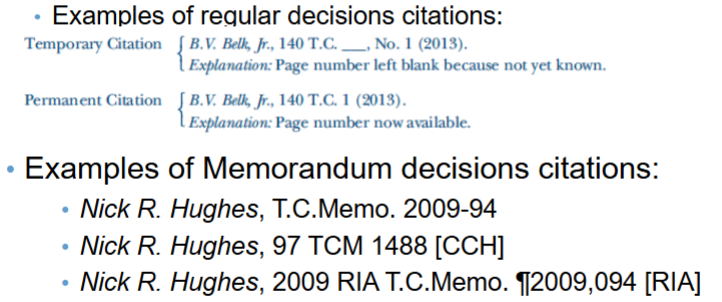
The U.S. Tax Court issues…
Two types of decisions:
Regular
Memorandum
How many judges are on the U.S. Tax Court?
19
How many judges are in in the U.S. Court of Federal Claims?
16
How many judges are in the U.S. District Court?
1 per case
The U.S. Tax Court
No prepayment to be seen in court
Offers no jury trial
Type of Disputes: Tax cases only
Looks at prior appellate cases with jurisdiction & similar facts
Jurisdiction: Nationwide
Appeal is to the U.S. Court of Appeals
The U.S. District Court requires…
Deficiency prepayment, then save for a refund
Offers jury trials
Held in D.C.
Mostly criminal and civil cases
Jurisdiction: Location of taxpayer
Appeal is to the U.S. Court of Appeals
IRS acquiescence policy
Determines whether the Service will follow a court’s holding in future cases, categorized as acquiescence, acquiescence in result only, or no acquiescence.
Who follows this policy:
U.S. Tax Court
U.S. District Court
Court of Federal Claims
The Supreme Court
Won’t hear you unless you apply for a writ of certiorari
Exceptions to its decisions
Congress or President
Other justices overturn the decision
Stare Decisis
“To stand by things decided“
Pro Se
Latin for “appear yourself“
Proceed without a lawyer/representing yourself
Administrative Sources: The U.S. Treasury Regulations
1. Final Regulations: Highest Administrative authority
2. Temporary Regulations: Pressing tax issues & issued concurrently with the proposed version
Example citation: Temp. Reg. §1.956-2T
3. Proposed Regulations: Tentative government views
Example citation: Prop. Reg. §1.2
Issued & open for public comment before final
Not binding on taxpayers or the IRS
Says “PROP”
Regulations

Temp.Reg. § 1.956–2T.
Type of regulation: 1
Related code section: 956
Regulation section number: 2
Temporary: T
Legislative process for passing federal tax legislation

Individual tax filing deadline and extension rules
Filing due date is the 15th day of the 4th month after tax year-end. Form 4868 provides a 6-month extension to file, but does not extend time to pay tax.
What is the rank of authority of a Letter Ruling in the Federal tax law System?
lowest(1) to highest(6)
1
What is the rank of authority of a Proposed Regulation in the Federal tax law System?
lowest(1) to highest(6)
2
What is the rank of authority of a Revenue Ruling in the Federal tax law System?
lowest(1) to highest(6)
3
What is the rank of authority of an Interpretive Regulation in the Federal tax law System?
lowest(1) to highest(6)
4
What is the rank of authority of a Legislative Ruling in the Federal tax law System?
lowest(1) to highest(6)
5
What is the rank of authority of the Internal Revenue Code in the Federal tax law System?
lowest(1) to highest(6)
6
New Jersey(NJ)
3rd Circuit
New York(NY)
2nd Circuit
California
9th Circuit