AP Bio Biochemistry: Lipids

0.0(0)
Studied by 0 people
call kaiCall Kai
learnLearn
examPractice Test
spaced repetitionSpaced Repetition
heart puzzleMatch
flashcardsFlashcards
GameKnowt Play
Card Sorting

1/13

encourage image

There's no tags or description

Looks like no tags are added yet.

14 Terms

1
New cards

What are the main elements in lipids?

C, H, O (carbon, hydrogen, oxygen). P (phosphorus) is ONLY in phospholipids. Lipids are mostly NONPOLAR (hydrophobic) and are not true polymers. How to recognize a lipid: it is mostly C and H, with very little O.

2
New cards
How do you form a triglyceride?
3 fatty acids + 1 glycerol ⇌ triglyceride + 3 H2O. Forward (→) = dehydration / condensation: removes 3 waters and forms 3 ester bonds. Backward (←) = hydrolysis: adding 3 waters breaks it apart.
3
New cards
Triglyceride (structure)
1 glycerol attached to 3 fatty acid tails by ester linkages. Also called a fat.
4
New cards
What is the function of triglycerides?
They are fats used for long-term ENERGY STORAGE (about 2× the energy per gram of carbohydrates). They also insulate and cushion the body.
5
New cards
Saturated fatty acids
• NO C=C (carbon–carbon) double bonds, only single bonds • "Saturated" with hydrogen: holds as many H as possible (memory trick) • Straight tails pack tightly → SOLID at room temperature • Examples: meats, butter • Increase LDL ("bad") cholesterol
6
New cards
Unsaturated CIS fatty acids
• At least 1 C=C (carbon–carbon) double bond • NOT fully saturated with hydrogen (memory trick) • H atoms on the SAME side of the double bond → kink in the tail • Can't pack tightly → LIQUID at room temperature • Examples: plant oils (olive oil) • Increase HDL ("good") cholesterol
7
New cards
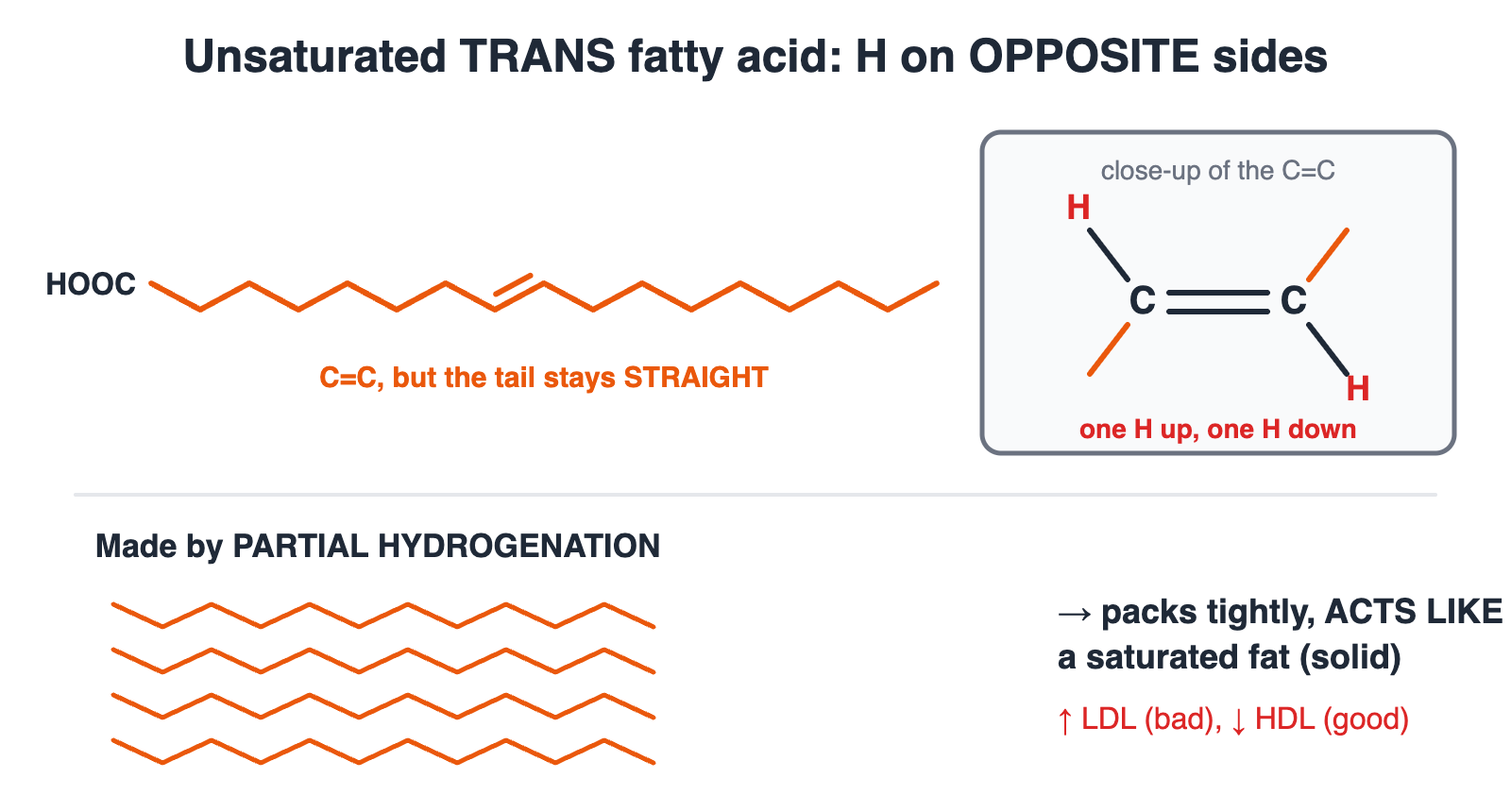
Unsaturated TRANS fatty acids
• Made by PARTIAL HYDROGENATION (adding H to plant oils) • H atoms on OPPOSITE sides of the C=C double bond → tail stays straight • Packs tightly, so it ACTS LIKE A SATURATED FAT (solid) • Raises LDL ("bad") and lowers HDL ("good"): worst for heart health
8
New cards
Phospholipids
• Hydrophilic HEAD = phosphate group + glycerol (water-loving, polar) • 2 hydrophobic TAILS = fatty acids (water-fearing, nonpolar): one saturated (straight), one unsaturated (kinked) • Amphipathic: has both parts • Make up the cell membrane = PHOSPHOLIPID BILAYER (heads face water, tails face inward)
9
New cards
Waxes, steroids, and omega fatty acids
• WAXES: long fatty acid + long alcohol; waterproof coating (leaf cuticle, beeswax, earwax) • STEROIDS: 4 fused carbon rings; e.g. cholesterol (in animal cell membranes), testosterone, estrogen • OMEGA FATTY ACIDS: unsaturated; named by where the first C=C is, counted from the omega (CH3) end (omega-3 = 3rd carbon); essential, so we get them from food like fish and flaxseed
10
New cards

What bond joins glycerol and a fatty acid?

An ESTER bond (ester linkage). It forms by dehydration (removing H2O). A triglyceride has 3 ester bonds, one for each fatty acid.

11
New cards

What is the monomer of lipids?

There is NO true monomer. Lipids are not polymers (they aren't chains of repeating units). Fats are built from glycerol + fatty acids instead.

12
New cards

What is the function of phospholipids?

STRUCTURAL: they make up the cell membrane (the phospholipid bilayer).

13
New cards

What is the function of steroids and waxes?

STEROIDS: hormones (testosterone, estrogen) and cholesterol, which keeps animal cell membranes stable. WAXES: waterproof, protective coating (leaf cuticle, beeswax, earwax).

14
New cards

What is the function of omega fatty acids?

Brain and nervous system development and function (also good for heart health). They are essential fatty acids, so we must get them from food.